Container gardening
Garden soil vs potting mix: what is the difference?
The short answer
Use a container-appropriate potting mix for most pots. Ordinary garden or topsoil used alone can compact and reduce air and drainage; specialized blends may include mineral soil, so the useful distinction is the finished medium's container performance, not a blanket ban on every soil ingredient.
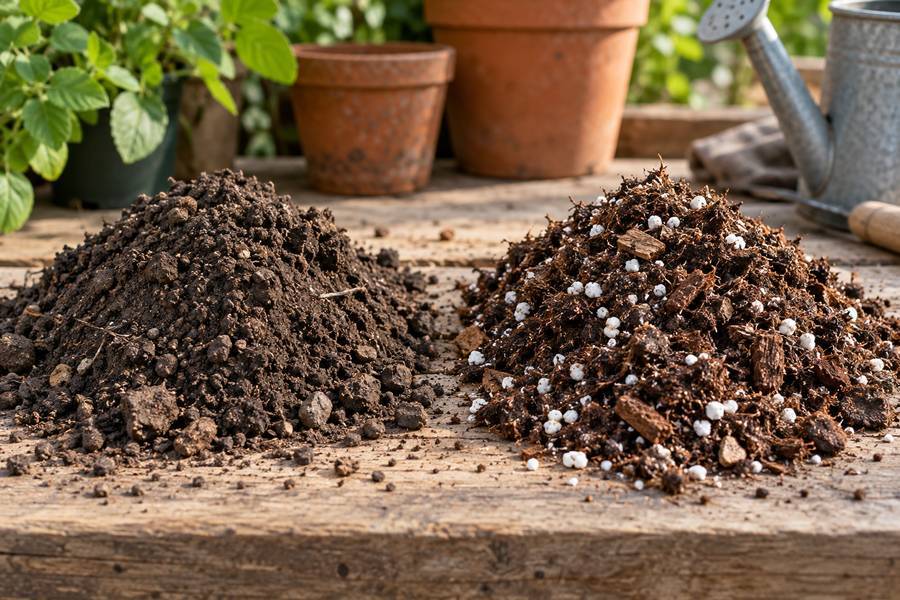
A container has a small, enclosed root zone, so the physical structure of the medium matters more than it does in open ground. Ordinary garden soil used alone is often too dense for typical pots.
Diagnostic snapshot
What to check before you act
What you are seeing
- Heavy dense material
- Slow drainage after watering
Check first
Compare whether the medium maintains visible structure and drains while staying evenly moist.
Compare first
- Ordinary garden/topsoil used alone
- Commercial potting mix
- Specialized soil-containing blend
Hold off for now
Do not fill typical containers with dense garden soil alone and assume drainage holes solve every structure problem.
Investigate further if
If a plant is already declining in dense wet media, inspect roots and drainage before simply replacing the top layer.
Photograph this before you act
- Photograph the soil surface and root-zone or container context; do not disturb roots just to take a photo.
- Take one close-up of the clearest symptom and one wider view that shows the surrounding area for comparison.
Next best check
Check two visible clues before you act.
This mini-check narrows the match using the same canonical diagnostic clues as this answer. It does not confirm a diagnosis from one or two clicks, and it does not make a photo-only diagnosis.
Two quick observations can tell you whether to keep reading this diagnosis closely or compare other possibilities first.
Match the pattern before acting
Ordinary garden/topsoil used alone
- Heavy dense texture and limited pore space
Move toward a container-appropriate medium when repotting is justified.
Commercial potting mix
- Lighter structured medium labeled for container use
Match the formulation to the plant and follow its feeding/watering guidance.
Specialized soil-containing blend
- Formulated mixture designed for a particular container crop
Judge the complete formulation and plant needs, not the presence of mineral soil alone.
How to confirm what is happening
- Compare whether the medium maintains visible structure and drains while staying evenly moist.
- Check the product label for its intended container or plant use rather than judging only by the word soil.
- If using garden soil as a component of a specialized blend, evaluate the finished mix rather than treating every mineral-soil ingredient as automatically wrong.
What to do now
- Choose a labeled mix suited to container culture and the plant.
- Keep drainage open and verify the root ball wets evenly.
- Use the existing best-soil guide for formulation selection.
GardenSolved checkpoint
Do not do this yet
- Do not fill typical containers with dense garden soil alone and assume drainage holes solve every structure problem.
- Do not state that every container blend containing mineral soil is wrong.
- Do not add fertilizer to compensate for poor physical structure.
Confirm the likely cause first, then choose the treatment.
When to investigate further
If a plant is already declining in dense wet media, inspect roots and drainage before simply replacing the top layer.
Sources
Save & recheck
Compare what changes before changing course.
Save this diagnosis only in this browser, then come back and compare the same clues. No account, reminder subscription, or server-stored diagnostic record is created.
Your baseline
- Heavy dense material
- Slow drainage after watering
Check again when you return
- Compare whether the medium maintains visible structure and drains while staying evenly moist.
- Check the product label for its intended container or plant use rather than judging only by the word soil.
Tip: photograph the same area from a similar angle so the visible pattern is easier to compare.