Container gardening
How to Protect Potted Plants From Frost and Freezing
The short answer
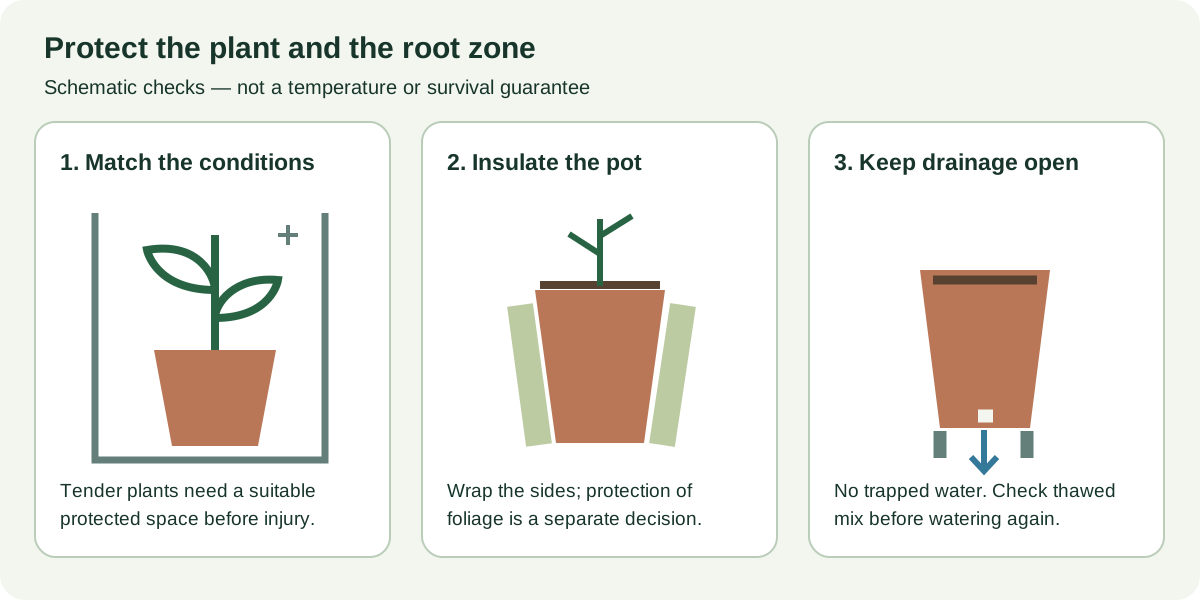
Identify the plant and compare its cold tolerance with the forecast before choosing protection. Move frost-tender plants into a suitable protected space. For plants that can remain outdoors, shelter and insulate the container, keep drainage open, and use a suitable breathable cover when needed. A cover cannot make a tender plant winter-hardy or guarantee survival during prolonged freezing.
Match the protection to plant tolerance, root exposure and the forecast before cold arrives.
Diagnostic snapshot
What to check before you act
What you are seeing
- Frost-tender plant, even with green healthy leaves
- Hardy plant in a small exposed pot
Check first
Read the botanical name and hardiness information on the label. “Outdoor plant” does not identify a minimum safe temperature. Ask the supplier if the identity is uncertain.
Hold off for now
Do not wait for black leaves before moving a frost-tender plant.
Investigate further if
If the forecast exceeds what your protected space can provide, arrange a better location before the event. For a large or valuable specimen, ask a local horticultural adviser about the identified species. If damage has already occurred, move to the recovery guide rather than adding several rescue treatments at once.
Photograph this before you act
- Photograph the soil surface and root-zone or container context; do not disturb roots just to take a photo.
- Take one close-up of the clearest symptom and one wider view that shows the surrounding area for comparison.
Next best check
Check two visible clues before you act.
This mini-check narrows the match using the same canonical diagnostic clues as this answer. It does not confirm a diagnosis from one or two clicks, and it does not make a photo-only diagnosis.
Two quick observations can tell you whether to keep reading this diagnosis closely or compare other possibilities first.
Choose the right branch
| Situation | What it changes | First action |
|---|---|---|
| Frost-tender plant, even with green healthy leaves | Injury may occur before or during frost | Find the species' minimum temperature and move it before that threshold is reached |
| Hardy plant in a small exposed pot | Roots lack the insulation of open ground | Protect the root zone and reduce exposure, not just the foliage |
| A brief cold night followed by mild weather | Temporary covering may be useful | Cover before cold arrives; check ventilation and conditions the next day |
| Repeated freezing or an exposed balcony | A thin cover may be inadequate | Arrange a more protective overwintering location suited to the plant |
| Wet mix or water trapped in an outer pot | Cold and waterlogging can coincide | Clear the outlet and remove trapped water before adding insulation |
Why these distinctions matter
RHS distinguishes shelter, pot insulation and plant wrapping; these measures solve different parts of winter exposure. Iowa State explains why roots of container-grown woody plants and perennials require particular protection.
Confirm before acting
- Read the botanical name and hardiness information on the label. “Outdoor plant” does not identify a minimum safe temperature. Ask the supplier if the identity is uncertain.
- Check the local overnight forecast, duration of cold and exposure to wind. An exposed railing and a sheltered courtyard can have different conditions.
- Inspect the base and outer pot. Drainage holes must remain open; insulation should not create a sealed water reservoir.
- If you plan to use a garage or porch, measure the temperature there. “Unheated” does not guarantee frost-free, and a dark space is not appropriate for every plant.
What to do now
- Prioritize plants whose known tolerance will be exceeded. Choose light and temperature appropriate to their species and dormancy state, rather than moving every outdoor plant into a warm living room.
- For suitable outdoor plants, move pots away from the exposed edge into a sheltered position. Group them temporarily where they can still drain and be inspected.
- Insulate the sides of the pot with suitable material. Leave outlets clear. In a garden, temporarily sinking suitable hardy plants in their pots into well-drained ground is another option; this is not available on a balcony.
- If a temporary foliage cover is appropriate, secure it before the cold arrives. Keep it stable and check plants when conditions improve. Follow the cover manufacturer's instructions; do not assume a fixed number of degrees of protection.
- Check moisture when the mix is thawed and accessible. Water a genuinely dry root zone as needed and allow drainage. Do not saturate an already wet pot “for frost protection.”
- Recheck after wind, rain and a thaw. Protection that slips, fills with water or overheats in sun needs correction.
GardenSolved checkpoint
Do not do this yet
- Do not wait for black leaves before moving a frost-tender plant.
- Do not seal foliage in an unventilated plastic bag.
- Do not block drainage while wrapping the pot.
- Do not use fertilizer to increase cold tolerance or stimulate growth before a freeze.
- Do not assume a sheltered corner is sufficient for a prolonged freeze outside the plant's tolerance.
Confirm the likely cause first, then choose the treatment.
When this plan is not enough
If the forecast exceeds what your protected space can provide, arrange a better location before the event. For a large or valuable specimen, ask a local horticultural adviser about the identified species. If damage has already occurred, move to the recovery guide rather than adding several rescue treatments at once.
Choose your next step
Sources
Save & recheck
Compare what changes before changing course.
Save this diagnosis only in this browser, then come back and compare the same clues. No account, reminder subscription, or server-stored diagnostic record is created.
Your baseline
- Frost-tender plant, even with green healthy leaves
- Hardy plant in a small exposed pot
Check again when you return
- Read the botanical name and hardiness information on the label. “Outdoor plant” does not identify a minimum safe temperature. Ask the supplier if the identity is uncertain.
- Check the local overnight forecast, duration of cold and exposure to wind. An exposed railing and a sheltered courtyard can have different conditions.
Tip: photograph the same area from a similar angle so the visible pattern is easier to compare.