Lawn & Grass
When should I aerate my lawn?
The short answer
Confirm compaction before aerating. If the soil is hard, infiltration is poor, roots are shallow, or repeated traffic has compressed the site, core-aerate during an active-growth period for the turf type with soil moist enough for tine penetration but not saturated.
Core aeration is useful when compacted soil is restricting air, water movement, and root growth. It is not automatically needed every year, and timing matters because turf needs enough active growth and moisture to recover from the holes and traffic.
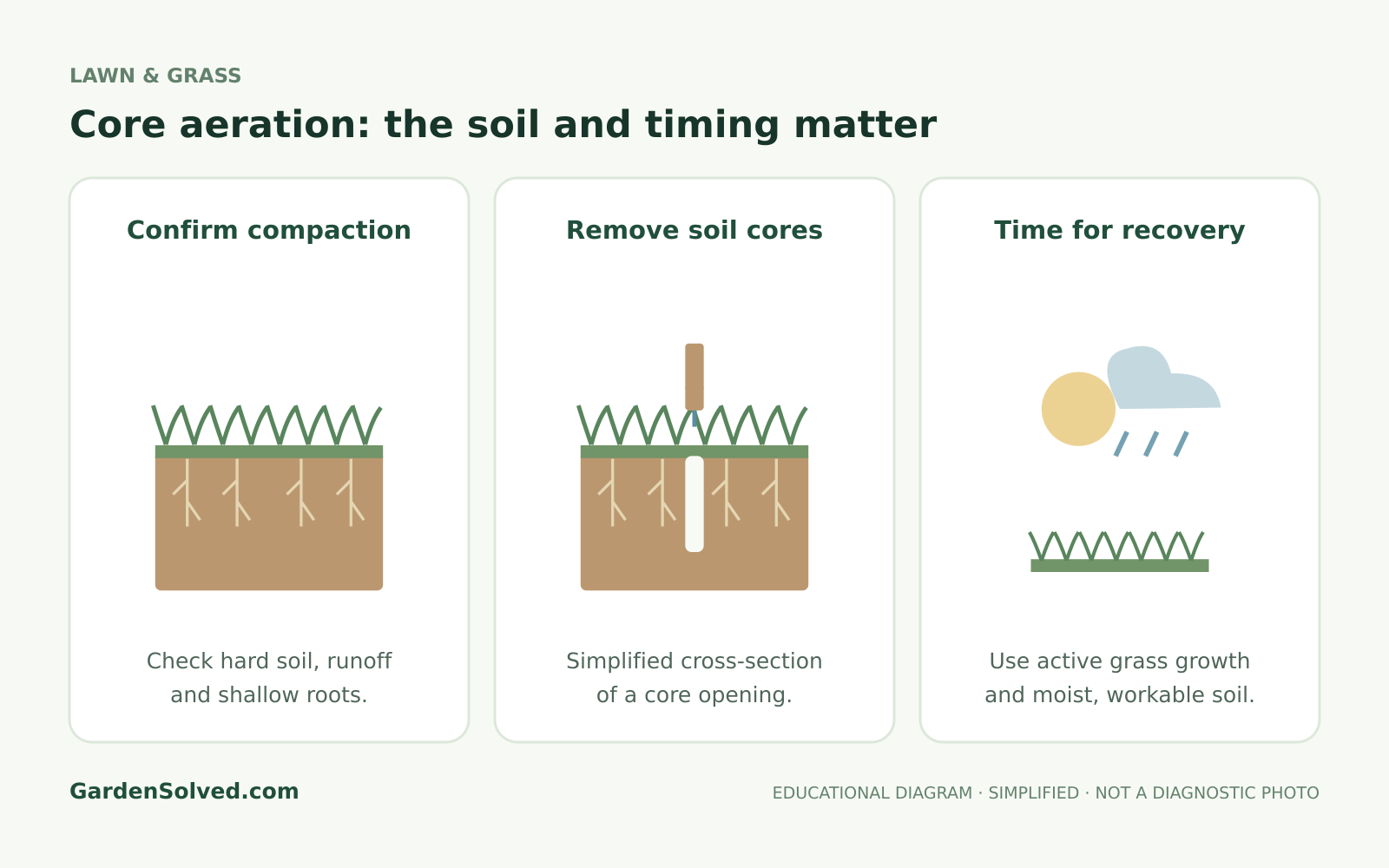
Start with the site conditions
| Observation | What it changes |
|---|---|
| Hard soil, shallow roots, repeated traffic | Compaction is a reasonable target for core aeration. |
| Water runs off but soil is dry and hard | Aeration may improve infiltration when timed for recovery. |
| Soil is wet, muddy, or flooded | Wait until it dries; aerating saturated soil can worsen structure. |
| Turf is healthy and soil is open | Routine aeration may add little benefit. |
Compare the most useful branches
Confirmed compaction
- Soil is dense, roots are shallow, and infiltration is poor.
More likely if
- The area receives repeated foot or equipment traffic.
Less likely if
- Soil is friable and roots penetrate well.
Use core aeration during active growth.
Timing is unsuitable
- The lawn is dormant, heat-stressed, drought-stressed, or waterlogged.
More likely if
- Recovery growth would be slow after aeration.
Less likely if
- Turf is actively growing and soil moisture is workable.
Delay until the grass can recover.
Another problem looks like compaction
- Thinning is driven by deep shade, disease, or irrigation rather than hard soil.
More likely if
- Soil tests and probing do not show compaction.
Less likely if
- Traffic pattern and shallow roots strongly match compaction.
Treat the actual limiting condition instead of aerating by habit.
Checks before acting
- Compare soil firmness and root depth in high-traffic and healthy areas.
- Check that the soil is workable and moist, not muddy or waterlogged.
- Identify whether the turf is actively growing and whether local timing favors rapid recovery.
What to do
- Use a hollow-tine/core aerator where compaction is confirmed.
- Choose a season of active turf growth and workable soil moisture.
- Address the source of compaction—traffic, equipment, or poor site design—after aeration.
GardenSolved checkpoint
Do not do this yet
Avoid these shortcuts
- Do not spike-aerate and assume it is equivalent to core removal.
- Do not aerate saturated soil.
- Do not aerate simply because the calendar says so when the turf is stressed or soil is not compacted.
Confirm the likely cause first, then choose the treatment.
What to expect next
- Cores can dry and break down on the surface while turf grows into the openings.
- Improved infiltration and rooting are gradual responses, not instant color changes.
- If compaction pressure continues, benefits may be temporary.
Build a more reliable routine
- Keep heavy traffic off wet soil.
- Use paths or redistribute repeated wear where possible.
- Maintain turf during active growth so roots can occupy improved soil pores.
When to investigate further
Postpone aeration if turf is severely drought-stressed, dormant, saturated, or actively diseased; investigate those problems first if compaction is not clearly present.