Lawn & Grass
When should I fertilize my lawn?
The short answer
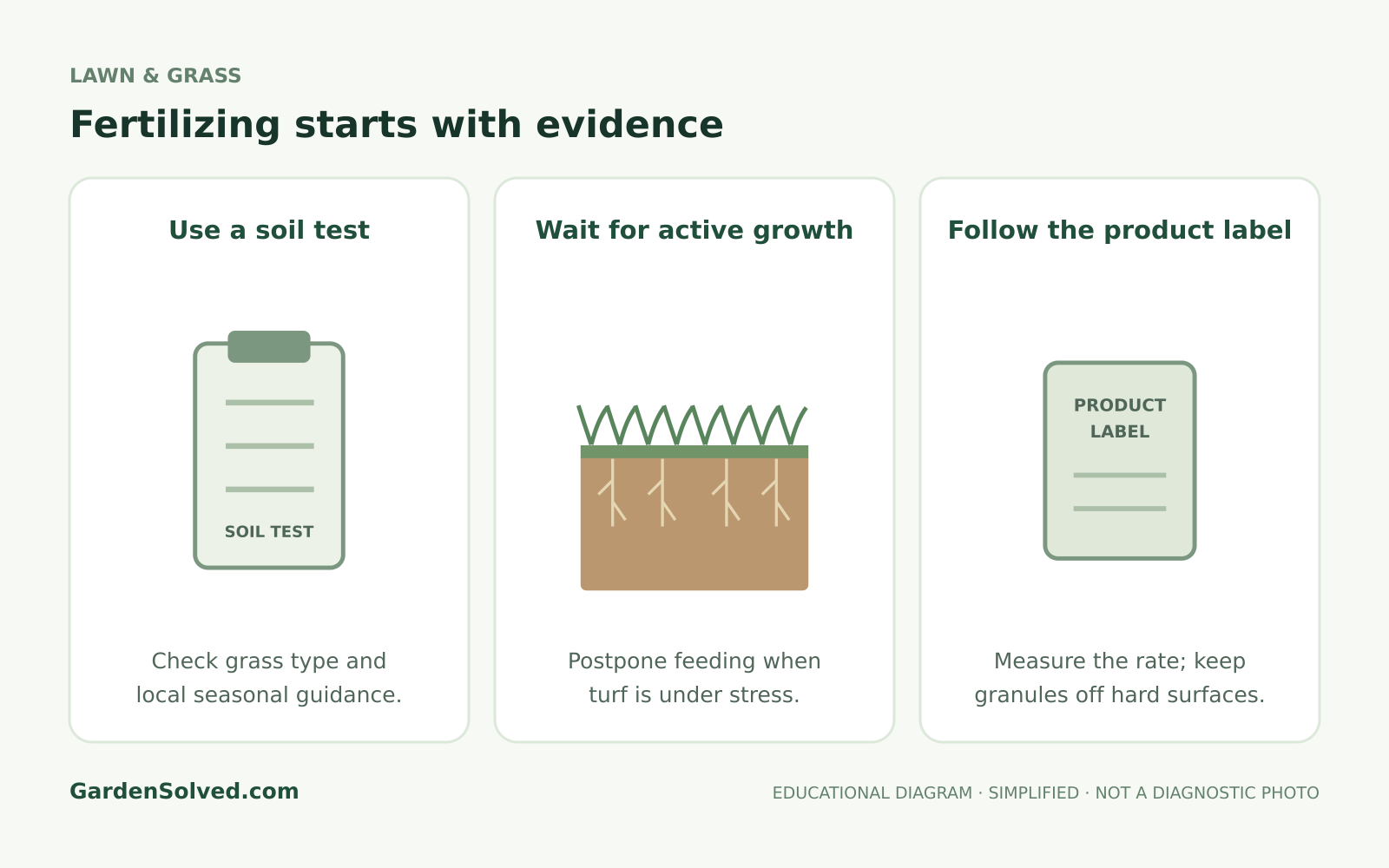
Identify the turf type, use a soil test for pH and relevant nutrients, and fertilize only during a suitable growth period at the labeled rate. Avoid feeding heat-, drought-, waterlogged-, dormant-, or disease-stressed turf as a quick color fix.
Fertilizer can support turf when nutrient supply and timing match the grass, but it cannot fix deep shade, compaction, drought, waterlogging, or disease. The useful window depends on turf type, climate, active growth, soil results, and local fertilizer rules.
Start with the site conditions
| Observation | What it changes |
|---|---|
| Actively growing turf with a documented need | A correctly timed, labeled application may be appropriate. |
| Drought-dormant or heat-stressed turf | Delay feeding until active growth and moisture return. |
| Yellowing in shade or saturated soil | Correct light or drainage limits rather than fertilizing by color. |
| Soil test shows adequate nutrients | Do not add nutrients simply because the lawn is not dark green. |
Compare the most useful branches
Fertilization is timely
- Turf is actively growing and not severely stressed.
- Soil/site evidence supports the planned nutrient.
More likely if
- Local turf guidance lists the season as a feeding window.
Less likely if
- The lawn is dormant, drought-stressed, or waterlogged.
Apply only the labeled amount and keep material off hard surfaces and waterways.
A site problem is masquerading as hunger
- Pale or thin turf is concentrated in shade, compaction, drought, or wet soil.
More likely if
- The pattern matches site conditions better than uniform nutrient shortage.
Less likely if
- Soil and site are suitable and a documented nutrient need exists.
Correct the site limitation before feeding.
Soil evidence is missing
- A specific deficiency or pH issue is being guessed from color.
More likely if
- No recent soil test or fertilizer history is available.
Less likely if
- A current test and local recommendation support the change.
Test first rather than using fertilizer as a diagnostic experiment.
Checks before acting
- Identify the grass type and local seasonal growth pattern.
- Review soil-test recommendations before phosphorus, potassium, lime, or broad nutrient changes.
- Check weather, soil moisture, recent fertilizer applications, and local product restrictions before applying.
What to do
- Use a current soil test and local turf guidance to choose the product and timing.
- Apply only when turf is actively growing and not under severe environmental stress.
- Measure and spread evenly at the product's labeled rate, following local fertilizer restrictions.
GardenSolved checkpoint
Do not do this yet
Avoid these shortcuts
- Do not diagnose a specific nutrient deficiency from lawn color alone.
- Do not fertilize drought-dormant or severely heat-stressed turf to force green-up.
- Do not apply extra product because a previous application did not change color quickly.
Confirm the likely cause first, then choose the treatment.
What to expect next
- Nutrient response should appear in new growth over time, not as an immediate overnight change.
- A lawn limited by shade, drainage, compaction, or drought may show little benefit until that limitation is corrected.
- Excess fertilizer can create injury or environmental loss, so more is not a faster fix.
Build a more reliable routine
- Test soil periodically and keep records of applications.
- Match feeding to the turf growth cycle and local climate.
- Maintain mowing, watering, light, and drainage so fertilizer supports rather than masks turf health.
When to investigate further
If turf is declining rapidly, has disease or pest symptoms, or remains pale despite soil-based fertility and suitable site care, diagnose the underlying problem before adding more fertilizer.