Lawn & Grass
Why are there circular brown patches in my lawn?
The short answer
Inspect the healthy-to-brown edge, patch size, season, soil moisture, roots, mushrooms, and pet activity. Dark-green arcs with mushrooms suggest a different branch from small repeated dog spots or expanding tan patches with damaged roots.
Circular patches and rings narrow the possibilities, but they do not identify a single cause. Turf diseases, fairy-ring fungi, dog urine, localized spills, uneven irrigation, and soil differences can all make rounded patterns.
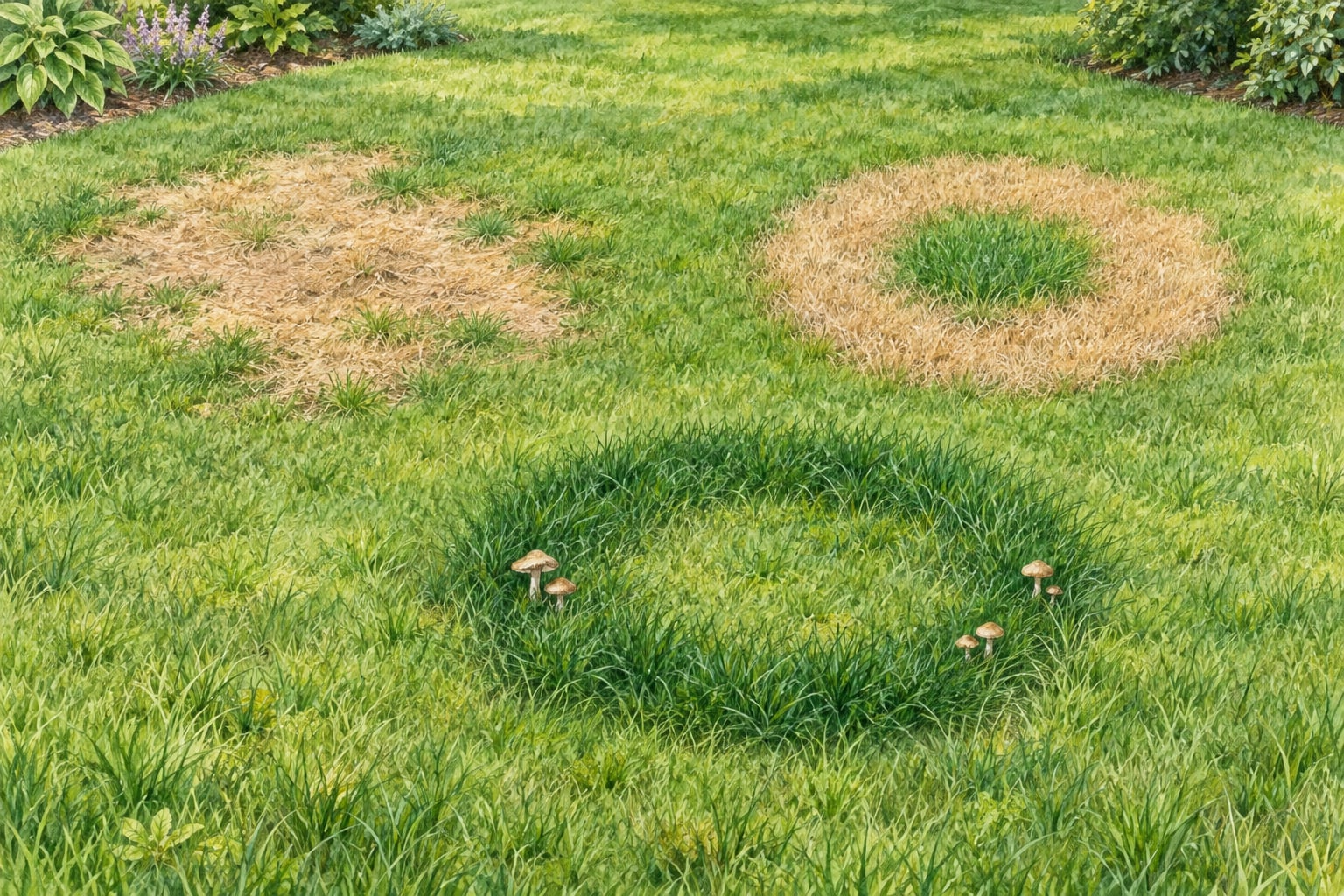
Start with the visible pattern
| What you see | What it suggests checking |
|---|---|
| Dark-green ring or arc, sometimes with mushrooms | Compare with fairy-ring characteristics. |
| Small circular dead spots in dog-use areas | Check pet pattern and greener margins. |
| Tan circular patches with root/crown damage | Use a turf disease diagnosis. |
| Rounded stress tracks irrigation or low spots | Check water distribution and drainage. |
Compare the most useful branches
Fairy ring
- Dark-green rings or arcs may occur.
- Mushrooms can appear in wet weather.
More likely if
- The ring expands over time and follows classic arc/ring geometry.
Less likely if
- Several tiny circles cluster only where a dog repeatedly urinates.
Confirm the ring pattern before attempting management.
Patch disease
- Tan upright dead turf forms circles, rings, or arcs.
- Roots/crowns may be dark or rotted depending on disease.
More likely if
- Symptoms match season and turf-disease signs.
Less likely if
- No plant damage is present beyond localized pet or water stress.
Use local turf-disease identification before fungicide.
Dog spots or localized site stress
- Small repeated spots occur along pet routes or where water/chemicals differ.
More likely if
- The pattern aligns with behavior or irrigation boundaries.
Less likely if
- Mushrooms or progressive root disease are present.
Correct the confirmed localized cause rather than treating the whole lawn.
Checks before treatment
- Photograph the entire pattern and a close view of the patch edge.
- Inspect roots, crowns, blades, mushrooms, and soil moisture at the transition zone.
- Review recent weather, irrigation coverage, pet activity, spills, and fertilizer applications.
What to do now
- Map and photograph patches before changing care.
- Correct obvious irrigation or drainage problems only where confirmed.
- Submit a sample or clear images for diagnosis when rings expand or root/crown symptoms are present.
GardenSolved checkpoint
Do not do this yet
Avoid these shortcuts
- Do not assume every circle is a fungal disease.
- Do not broadcast fungicide or fertilizer as a diagnostic test.
- Do not overwater a ring simply because it is brown.
Confirm the likely cause first, then choose the treatment.
Reduce repeat problems
- Maintain suitable mowing and irrigation without chronic excess.
- Avoid product spills and uneven applications.
- Monitor recurring rings so season and expansion rate can inform diagnosis.
When to investigate further
Get local turf diagnosis for rapidly enlarging rings, recurring patch disease, damaged roots/crowns, or patterns that do not match a clear pet or irrigation explanation.