Poinsettia
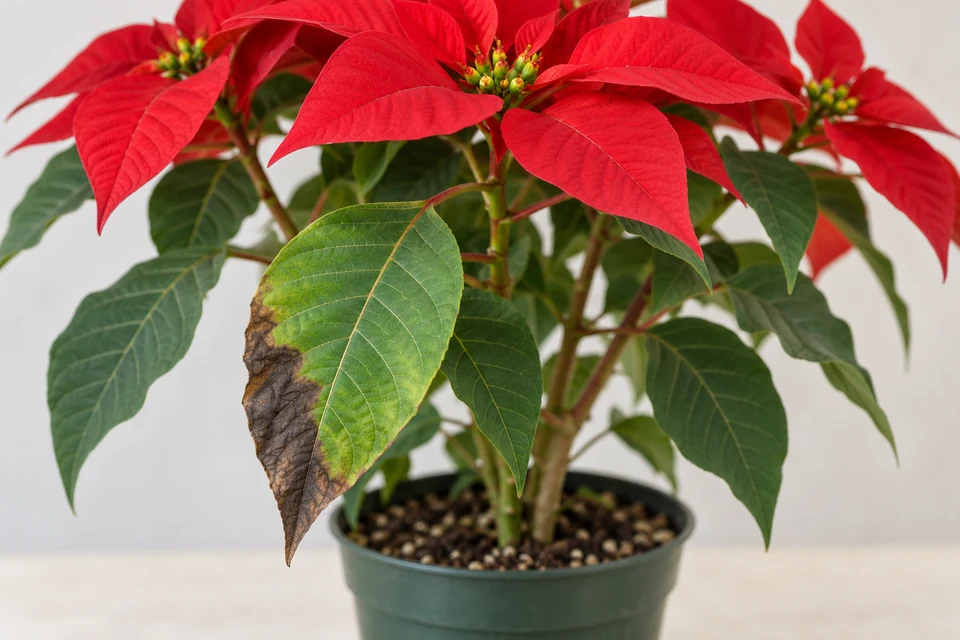
Why Are My Poinsettia Leaves Turning Black?
The short answer
Darkened poinsettia leaves or bracts after cold transport may be cold-injured, but colour alone cannot confirm that. Check whether the dark area is damaged tissue or a surface coating, whether the stem base is firm, and whether the root ball stays wet. Stabilise the conditions while you investigate. Tissue that has died will not become green again.
Black is a description of appearance, not the name of a disease. A cold-damaged leaf, a dark surface deposit and a collapsing stem base should not all receive the same treatment. Start without scraping, cutting or spraying: look at the plant in daylight and compare its history with the position of the damage.
Diagnostic snapshot
What to check before you act
What you are seeing
- Damage followed a documented cold journey or window exposure; exposed parts may be affected first.
- A soft dark base and persistent wetness occur alongside wilt.
Check first
Reconstruct transport, an unheated vehicle, open doors and contact with cold glass. Note which side of the plant faced the exposure and whether damage appeared later. Do not use a single temperature reading as proof that the whole plant must be dead or safe.
Compare first
- Cold-injured tissue is plausible
- Wet-root or basal decline
- Surface deposit
Hold off for now
Do not use fertiliser or fungicide to reverse blackened tissue before checking exposure, moisture and the stem base.
Investigate further if
Seek prompt diagnosis if the base softens, wet decay spreads, several shoots collapse or new lesions appear without a plausible exposure history. Grey fuzzy growth and live insects also need their own identification. Keep the exposure timeline and moisture record with the photographs.
Photograph this before you act
- Photograph the soil surface and root-zone or container context; do not disturb roots just to take a photo.
- Take a sharp close-up of the affected leaf and a second photo of the underside.
Recommended diagnostic check
Environmental Stress Checker
Does the timing or exposure fit environmental stress?
Compare the symptom pattern with recent growing conditions before treating a lookalike as disease, pests, nutrient deficiency, or a watering problem.
First check
Reconstruct transport, an unheated vehicle, open doors and contact with cold glass. Note which side of the plant faced the exposure and whether damage appeared later. Do not use a single temperature reading as proof that the whole plant must be dead or safe.
Timing / exposure boundary
Damage followed a documented cold journey or window exposure; exposed parts may be affected first.
Timing and exposure can support an environmental branch, but they do not rule out other causes. Use the factor labels and boundary above as clues, not as a diagnosis.
Match the situation before acting
Cold-injured tissue is plausible
- Damage followed a documented cold journey or window exposure; exposed parts may be affected first.
End the exposure, keep care stable and assess surviving tissue.
Wet-root or basal decline
- A soft dark base and persistent wetness occur alongside wilt.
Use the wet-root assessment, rather than treating leaf colour.
Surface deposit
- Dark material sits on the surface, with stickiness or visible insects as additional clues.
Inspect leaf undersides and identify the cause of any sticky deposits.
Mould or spreading lesions
- Grey fuzzy growth, wet breakdown or new expanding spots accompany the colour change.
Separate the plant and seek a more specific assessment.
Safe checks before acting
- Reconstruct transport, an unheated vehicle, open doors and contact with cold glass. Note which side of the plant faced the exposure and whether damage appeared later. Do not use a single temperature reading as proof that the whole plant must be dead or safe.
- Use good light or a hand lens to compare the leaf surface with the affected tissue. Note stickiness, visible insects or fuzzy growth without scraping a living leaf. Photograph both a close view and the whole plant.
- Lift the nursery pot from its cover. Check for trapped water, accessible root-ball moisture and a firm versus soft base. Compare nearby healthy shoots without making scratch wounds or cutting stems as an initial test.
What to do next
- Move the plant away from ongoing cold, hot air or direct contact with glass. Choose bright daylight and stable indoor conditions; do not place it on a radiator to warm it quickly.
- Water only if the root ball needs it. A dark leaf does not justify extra water, and cold injury can coexist with either dry or wet roots.
- Leave sound green tissue in place while the extent of injury becomes clearer. Collect fallen material. If a part is wholly dead or decaying, handle it carefully and protect your skin from sap; avoid a severe whole-plant cutback as a diagnostic experiment.
- If there is a surface deposit with insects, follow identification first. If there is fuzzy mould, soft decay or expanding lesions, separate the plant from neighbours and obtain guidance appropriate to the actual sign.
GardenSolved checkpoint
Do not do this yet
- Do not use fertiliser or fungicide to reverse blackened tissue before checking exposure, moisture and the stem base.
- Do not assume every dark leaf is frost damage, or hard-prune every branch because one leaf has died.
Confirm the likely cause first, then choose the treatment.
What recovery can look like
- The colour of a dead patch will not return to normal. Look instead for stable remaining shoots, no fresh spread and later healthy growth.
- Cold exposure can cause injury that becomes apparent after the event. A stable plant with some damaged leaves and a plant losing every shoot have different prospects; no photograph supplies a universal recovery percentage.
When to get more help
Seek prompt diagnosis if the base softens, wet decay spreads, several shoots collapse or new lesions appear without a plausible exposure history. Grey fuzzy growth and live insects also need their own identification. Keep the exposure timeline and moisture record with the photographs.
Important context
Normal red, burgundy, pink or cream bract colour is different from a new dark lesion. Compare the same part in ordinary daylight, with earlier photographs if available.
Brown and black areas can overlap in how damage looks. Compare tissue texture, spread and exposure rather than choosing a treatment from a colour label.
Follow the next useful clue
- The base is soft and the root ball remains wet: Follow the wilt and root assessment.Why Is My Poinsettia Wilting?
- Leaves are falling but tissue colour is not the main clue: Compare leaf position and the care timeline.Why Is My Poinsettia Dropping Leaves?
- You need to decide whether water is actually due: Use the moisture-and-drainage checks.How Often Should You Water a Poinsettia?
- Grey fuzzy growth accompanies tissue decline: Compare grey-mould signs before considering treatment.What Is the Gray Fuzzy Mold on My Plant?
Sources and linked claims
Save & recheck
Compare what changes before changing course.
Save this diagnosis only in this browser, then come back and compare the same clues. No account, reminder subscription, or server-stored diagnostic record is created.
Your baseline
- Damage followed a documented cold journey or window exposure; exposed parts may be affected first.
- A soft dark base and persistent wetness occur alongside wilt.
Check again when you return
- Reconstruct transport, an unheated vehicle, open doors and contact with cold glass. Note which side of the plant faced the exposure and whether damage appeared later. Do not use a single temperature reading as proof that the whole plant must be dead or safe.
- Use good light or a hand lens to compare the leaf surface with the affected tissue. Note stickiness, visible insects or fuzzy growth without scraping a living leaf. Photograph both a close view and the whole plant.
Tip: photograph the same area from a similar angle so the visible pattern is easier to compare.
Related questions
Diagnostic Finder
Still not sure this answer fits?
Open the Diagnostic Finder with the relevant growing subject or care context preselected and compare other published GardenSolved diagnoses.
Compare other possibilities