Cucumbers
Why Are Cucumber Leaves Curling?
The short answer
Cucumber leaves may curl after heat or root-zone stress, because sap-feeding pests are damaging tender growth, or after chemical exposure; severe distortion with mottling or stunting can also accompany disease. Compare old and new growth, check soil moisture and drainage, then inspect leaf undersides and growing tips before treating anything.
Curling, cupping, twisting, and distorted cucumber leaves can look similar while pointing to different problems. The age of the affected growth, the shape of the distortion, and evidence under the leaves or at the growing tip are more useful than curl alone.
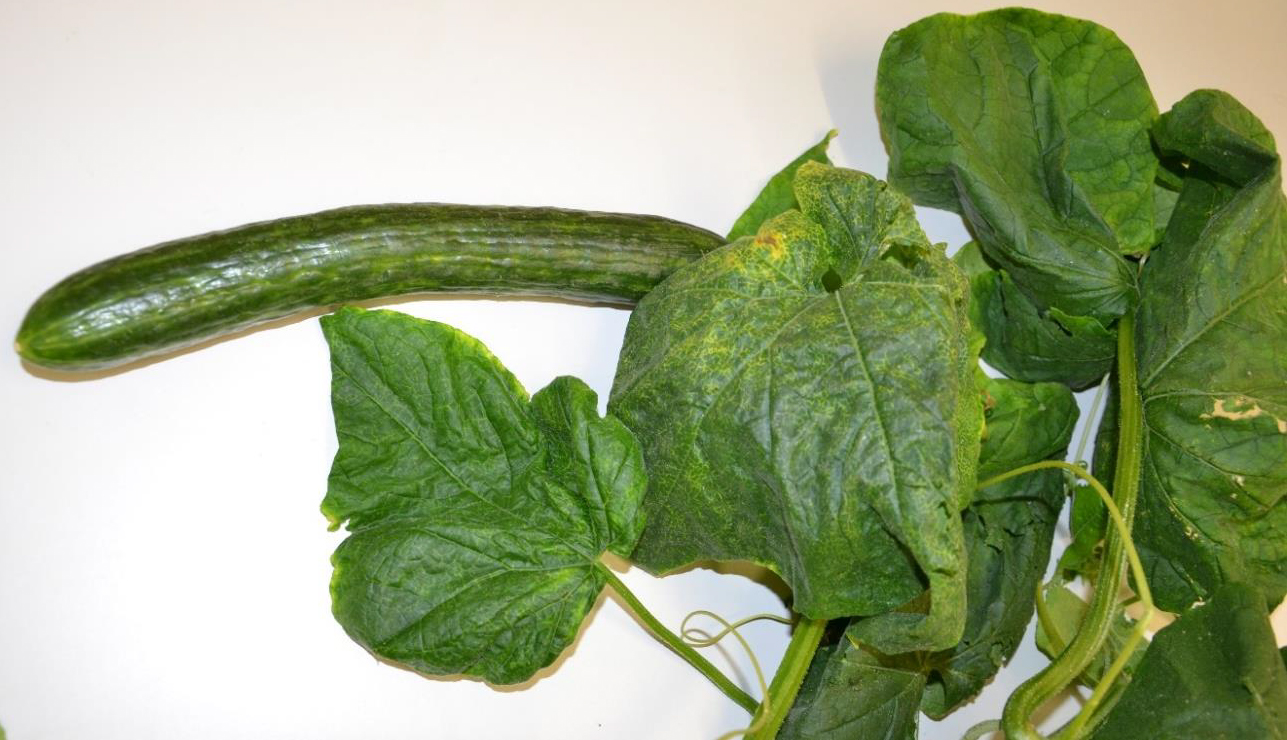
_-_Hinrichs-Berger.jpg)
Describe the distortion before naming a cause
Check whether the oldest leaves or the newest growth changed first. A firm curl on older leaves is a different decision from a puckered growing tip with small, twisted leaves.
Look from the side and underneath. Record the direction of the curl, leaf colour, stippling or sticky residue, webbing, stem distortion, and whether one plant, a row edge, or every cucumber is affected.
Match the curl to the strongest evidence
Heat, moisture, or root-zone stress
- Curling occurs with droop or after hot, dry, windy, or saturated conditions.
- The soil below the surface is unusually dry or wet, or roots were recently disturbed.
More likely if
- New growth becomes more normal after the confirmed stress is corrected and care is kept steady.
Less likely if
- Tender growth remains severely twisted or mottled while the root zone is suitable.
Correct the observed root-zone problem gradually and judge recovery from new growth.
Aphids or mites
- Tender leaves curl or pucker where small insects are feeding.
- Sticky honeydew or aphid clusters, or fine stippling and webbing associated with mites, are visible underneath.
More likely if
- A hand lens confirms the pest or its characteristic evidence on newly damaged tissue.
Less likely if
- Repeated inspection finds no pest, residue, stippling, webbing, or feeding concentration.
Identify the organism before selecting a label-compliant control.
Possible herbicide or chemical injury
- New leaves or stems are unusually narrow, cupped, twisted, bent, or stunted.
- The pattern follows a drift-facing edge, shared sprayer, or plants receiving the same compost, manure, hay, or mulch.
More likely if
- Timing and distribution match a documented exposure.
Less likely if
- Only older leaves curl and the growing tip remains normally shaped.
Stop the suspected exposure and ask a local extension or diagnostic service to assess the pattern; curl alone cannot identify a chemical.
Disease or virus warning pattern
- Severe distortion occurs with yellow-green mosaic, ring patterns, vein changes, or persistent stunting.
- Successive new leaves develop abnormally rather than improving with stable care.
More likely if
- Several companion signs match an authoritative cucumber disease description and a local diagnosis supports it.
Less likely if
- The plant has a clear, reversible environmental trigger and new leaves form normally.
Photograph the whole plant and close-ups and seek diagnosis; visual curl by itself does not confirm a virus.
A safe inspection sequence
- Compare old, middle, and newest leaves and mark where the first abnormal growth appears.
- Check moisture below the surface and whether the root zone drains freely before adding water.
- Use a hand lens on leaf undersides and growing tips; look for aphids, honeydew, cast skins, fine stippling, mites, or webbing.
- Compare nearby cucumbers and other broadleaf plants for a shared edge, row, or material-use pattern.
- Review recent spray use, shared equipment, compost, manure, mulch, root disturbance, and unusual weather.
- Do not use one photograph to confirm a virus, mite infestation, or herbicide injury.
When another cucumber answer is the better route
- Yellow or pale colour is the main concern and distortion is secondary: Use leaf age, colour pattern, root-zone condition, and lesion clues.Why Are Cucumber Leaves Turning Yellow?
- The main uncertainty is how to maintain moisture rather than why a leaf distorted: Use the routine watering owner and adjust from the actual root zone.How Often and How Much Should Cucumbers Be Watered?
Act on the evidence you found
- For a confirmed dry root zone, water slowly at soil level; for saturated soil, pause irrigation and restore drainage.
- Reduce an identified heat or root disturbance and keep care steady while the next leaves unfold.
- If aphids or mites are confirmed, use an authoritative pest guide and the least disruptive label-compliant response for that pest.
- If exposure or disease is plausible, stop moving suspect plant material or using the suspected input, document the pattern, and obtain local diagnostic guidance.
GardenSolved checkpoint
Do not do this yet
Do not treat curl as a diagnosis
- Do not water already wet soil because leaves are curled.
- Do not apply fertilizer to force distorted growth to recover.
- Do not spray for aphids, mites, fungus, or virus without confirming a target and a permitted product use.
- Do not identify herbicide injury or a virus from curl alone.
- Do not remove most of the canopy while the cause is uncertain.
Confirm the likely cause first, then choose the treatment.
Judge the next growth, not only the damaged leaf
- Correct only the cause supported by your observations.
- Photograph the growing tip and compare newly opened leaves over time; existing distorted tissue may not flatten.
- Escalate when each new leaf is more distorted, the vine becomes stunted, or a shared exposure pattern appears.
When local diagnosis matters
Contact a local extension office or plant-diagnostic service when distortion is severe or progressive, mosaic or ring patterns accompany it, the plant stops growing, or several plants show a spray- or material-related pattern. Ask for a diagnosis before making irreversible crop, pesticide, or food-use decisions.