Cucumbers
Downy Mildew on Cucumbers
The short answer
Downy mildew is supported when cucumber leaves develop angular, vein-bounded yellow to pale-green lesions that turn brown and coalesce, with dark or fuzzy growth possible on the underside in humid conditions. Compare both surfaces and progression, and separate this route from powdery surface growth and ordinary yellowing before acting.
Angular yellow or pale-green lesions on cucumber leaves may indicate downy mildew, but colour alone is not enough. Inspect lesion geometry on the upper surface, then turn the leaf over for discoloured or fuzzy sporulation and follow how the pattern progresses.
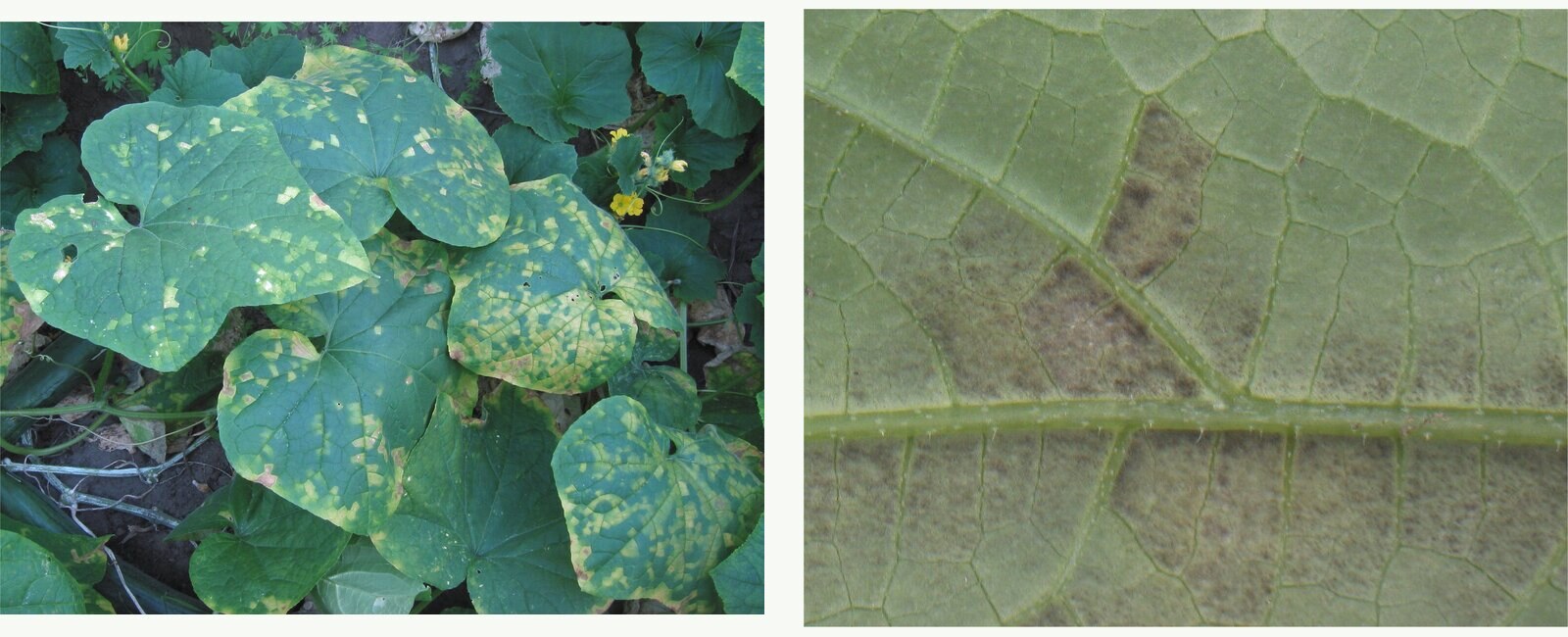
.jpg)
Compare the upper and underside evidence
| Where to look | Recognition clue |
|---|---|
| Upper leaf surface | Angular, vein-bounded yellow to pale-green spots support the downy-mildew branch; they may turn brown and merge as disease progresses. |
| Directly beneath lesions | Discoloured or fuzzy sporulation may be visible in humid conditions and adds useful evidence. |
| Across the canopy | Repeated lesions and progression through cucumber foliage are more informative than one yellow patch. |
| Leaves without distinct lesions | Uniform yellowing needs the general yellow-leaf diagnosis rather than a disease name from colour alone. |
Separate downy mildew from nearby lookalikes
Downy mildew pattern
- Upper lesions are angular because veins limit their shape.
- Underside sporulation may align with the upper lesions in humid conditions.
More likely if
- The pattern progresses from pale lesions to brown, coalescing tissue across cucumber foliage.
Document both surfaces and obtain local guidance quickly when spread is active.
Powdery mildew pattern
- White powder-like fungal growth is visible on leaf surfaces, stems, or petioles.
- Surface powder—not angular lesion geometry—is the defining clue.
Less likely if
- Vein-bounded yellow lesions with underside growth are the stronger evidence.
Use the powdery-mildew specialist route.
Ordinary or nonspecific yellowing
- Leaves fade more uniformly or follow root-zone, nutrient, pest, or aging patterns.
- No repeatable angular lesion and underside pairing is present.
Return to the general cucumber yellow-leaf diagnosis.
Checks before deciding what to do
- Inspect the same lesions from above and below in good light; underside evidence can change the diagnosis.
- Photograph lesion boundaries and progression, confirm cucumber identity, and compare the whole pattern with current regional Extension guidance.
Respond to a supported downy-mildew pattern
- Photograph upper and lower leaf surfaces and mark affected vines so the speed and direction of spread are recorded.
- Avoid overhead irrigation and unnecessary leaf wetness; apply water at soil level while keeping drainage functional.
- Maintain practical plant spacing and airflow, and avoid moving from wet affected foliage to unaffected vines with hands or tools.
- Choose resistant varieties when reliable supplier information is available for future planting.
- Contact local Extension or a plant-diagnostic service for current regional risk and management; use no fungicide unless a current label expressly covers cucumber and downy mildew.
Follow the evidence to the right owner
- White powder-like surface growth is the defining symptom: Use the powdery-mildew guide.Powdery Mildew on Cucumbers
- Yellowing lacks angular lesions or underside evidence: Return to the broad yellow-leaf diagnosis.Why Are Cucumber Leaves Turning Yellow?
- Crowding is blocking inspection and airflow: Use the spacing owner for the next layout decision.How Much Space Do Cucumber Plants Need?
- Unsupported vines are tangled or contacting wet soil: Use the trellis owner for a safe support decision.How to Trellis Cucumbers
GardenSolved checkpoint
Do not do this yet
Avoid colour-only diagnosis and unsupported treatment
- Do not diagnose downy mildew from a yellow leaf or one photograph alone.
- Do not use a powdery-mildew image or generic yellow leaf as downy-mildew evidence.
- Do not invent pesticide rates, intervals, legal-use claims, or universal cures.
- Do not rely on alarmist urgency; use actual spread, current local reports, and diagnostic evidence.
Confirm the likely cause first, then choose the treatment.
When another assessment is needed
Seek prompt local diagnostic guidance when angular lesions spread rapidly, multiple vines are affected, or a pesticide decision for an edible crop is being considered.