Cucumbers
How Much Space Do Cucumber Plants Need?
The short answer
Separate plant-center spacing from row, path, and vine-spread space. University of Minnesota Extension gives 8–12 inches between plants after thinning for vining cucumbers, with about 2–3 feet of vine allowance on each side of a ground-grown row; it places bush-type rows or hills 2–3 feet apart. Treat these as system-specific examples and follow cultivar guidance when it differs.
There is no one spacing distance for every cucumber setup. Decide from cultivar habit, whether vines run on the ground or a support, what is being measured, and how you will reach plants in a bed, row, or container.
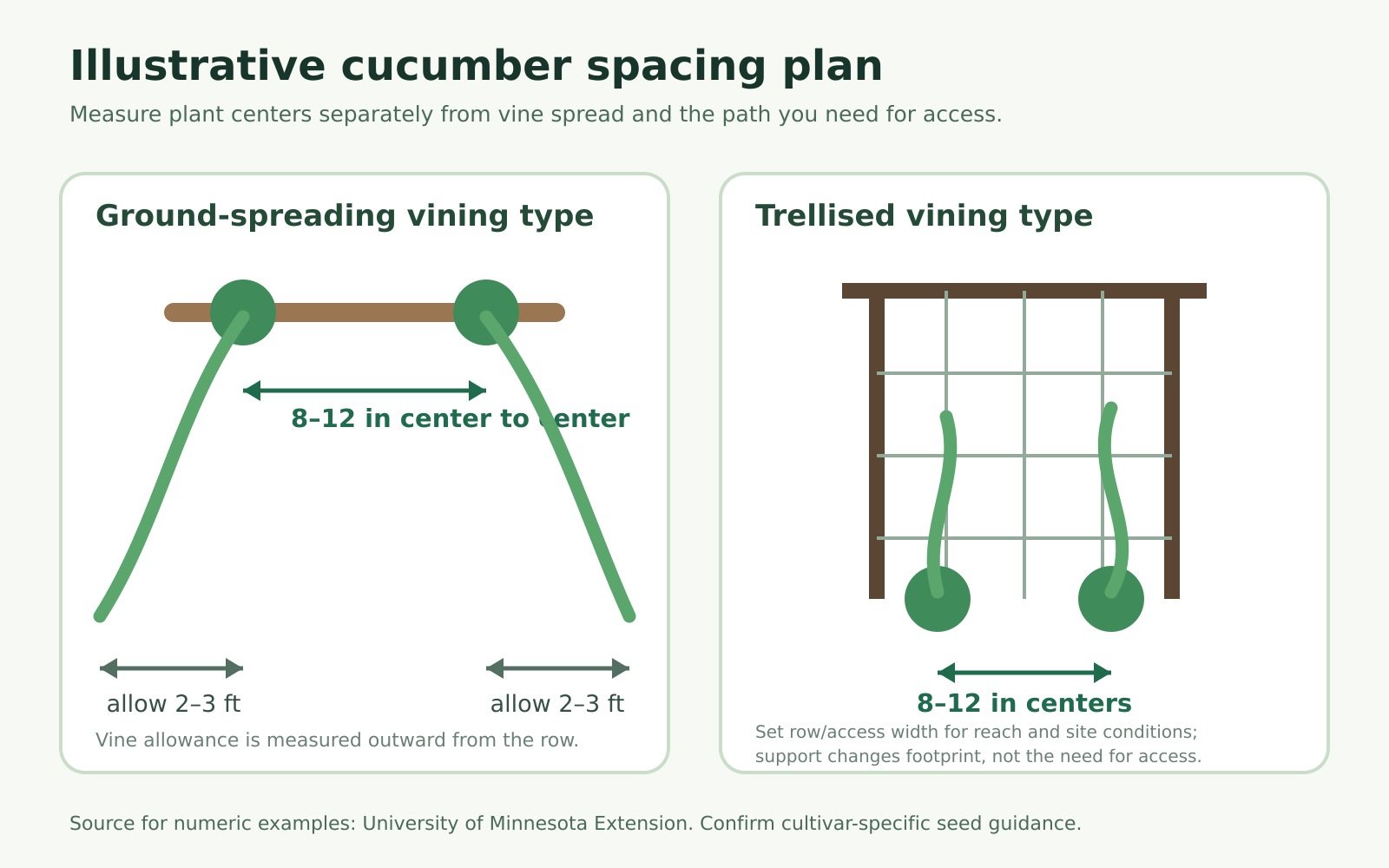
Match the number to what is being measured
| Setup and measurement | Verified guidance and assumption |
|---|---|
| Vining plants, center to center after thinning | 8–12 inches between plants in the University of Minnesota home-garden row system. |
| Ground-grown vining plants, outward vine allowance | Allow about 2–3 feet on each side of the row for vines; this is footprint, not plant-center spacing. |
| Vining cucumbers planted in hills | Space hills 5–6 feet apart in the cited University of Minnesota home-garden system. |
| Bush-type rows or hills | Space rows or hills 2–3 feet apart; verify the selected bush cultivar's own guidance. |
| Irrigated row-production reference | Utah State University lists 12–18 inches in-row as typical for cucumber while stressing that cultivar, growth habit, irrigation, and equipment change spacing. |
| Trellised rows and access path | Support reduces ground footprint and can allow closer rows, but neither source supplies one universal access width; leave room to reach both sides and inspect fruit. |
Checks before deciding what to do
- Read the cultivar packet and identify the growing system before transferring any distance into a layout.
- Mark plant centers, the support line, expected vine footprint, and access path as separate measurements.
Lay out the spacing before planting
- Read the cultivar's recommended spacing and choose ground culture or trellising before marking the bed.
- Mark plant centers, row or support positions and a separate access path. Check the expected mature vine footprint against neighboring plants.
- Adjust the layout before planting if vines or supports would block access; do not crowd plants to fit an arbitrary count.
Choose the layout branch
- The cultivar is bush or compact: Use its row or hill guidance and preserve access; do not apply a vining footprint automatically.
- Vines will run on the ground: Reserve plant-center spacing plus outward vine spread and a separate route for access.
- Vines will be trellised: Place plants along the support line and use the trellis guide before reducing the ground footprint.How to Trellis Cucumbers
- Containers determine the layout: Use cultivar-aware spacing here, then return to the container-system guide for stability, drainage, medium, and care.How to Grow Cucumbers in Containers
Spacing supports access and airflow; it is not a mildew cure
Crowding can make inspection, watering, training, and air movement harder. Practical spacing is one cultural factor, but it does not guarantee disease prevention.
If white surface powder or angular yellow lesions with underside growth are already present, use the separate powdery- or downy-mildew owner rather than treating spacing as the diagnosis or cure.
Route an existing mildew pattern
- White powder-like growth is spreading on cucumber foliage: Use the powdery-mildew guide.Powdery Mildew on Cucumbers
- Angular yellow lesions and underside growth define the pattern: Use the downy-mildew guide.Downy Mildew on Cucumbers
GardenSolved checkpoint
Do not do this yet
Avoid spacing shortcuts
- Do not publish one distance without naming the measurement and growing system.
- Do not confuse plant-center spacing with row, hill, vine-spread, or path spacing.
- Do not assume closer spacing always improves yield or wider spacing always prevents disease.
- Do not use a decorative garden scene as a measured plan.
Confirm the likely cause first, then choose the treatment.
When another assessment is needed
Use local Extension or cultivar-specific guidance when a production system, intensive planting method, or named cultivar differs from the home-garden examples here.