Cucumbers
Why Are Cucumber Plants Not Producing Fruit?
The short answer
First identify the stage where fruit production stops. Young vines may not yet have female flowers; later, limited pollination or stress around flowering and early fruit set may prevent fruit from developing. Match the action to the flower or fruit stage instead of adding fertilizer or hand-pollinating automatically.
A cucumber plant can reach a no-fruit outcome at several different stages. The right next step depends on whether the vine has no flowers, only male flowers, female flowers that drop, or tiny cucumbers that begin and then fail.
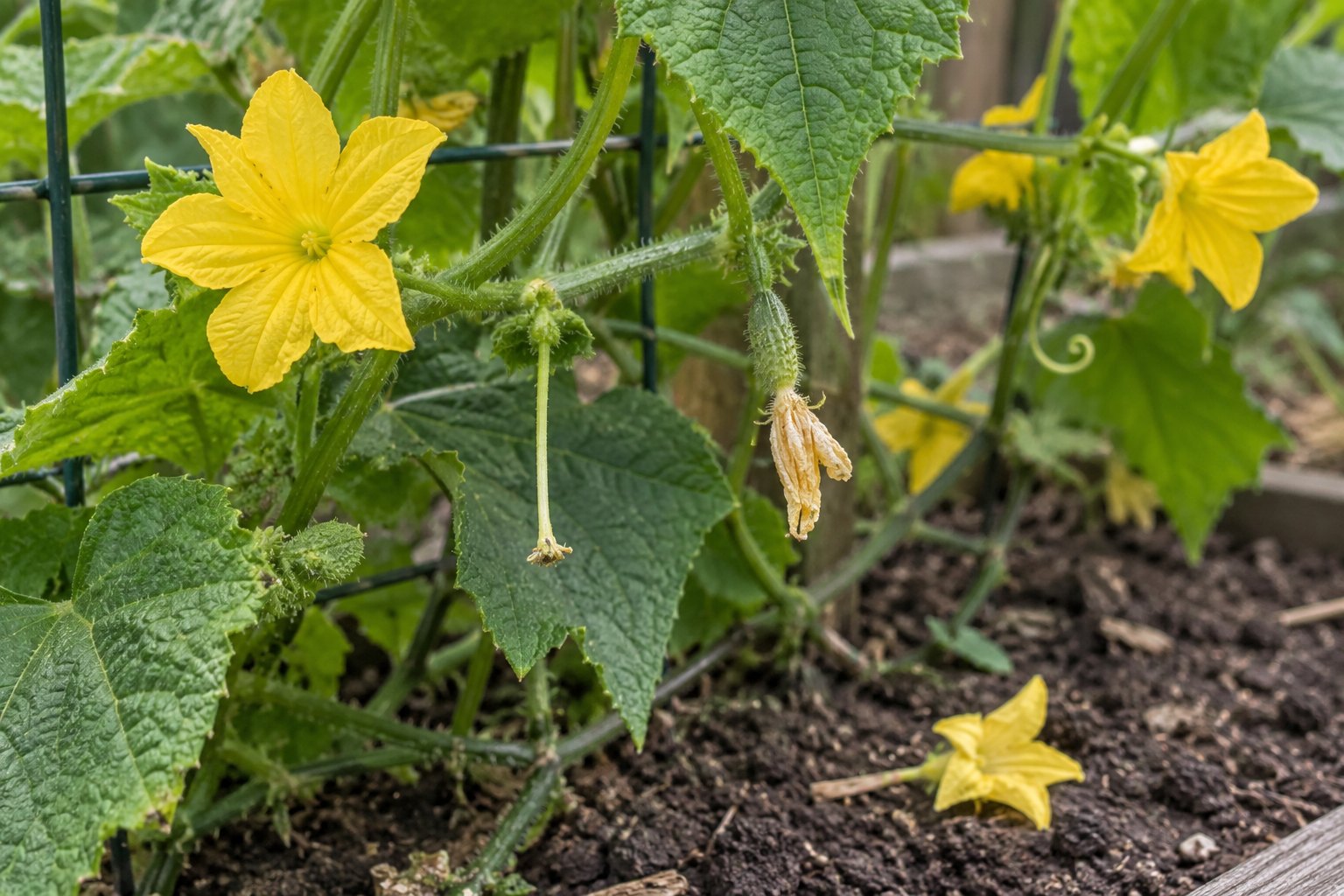
Find the stage where fruiting stops
| What you see | What it means for the next check |
|---|---|
| No flowers | Check plant maturity, growth, light, temperature stress, and whether excess nitrogen is favouring vines over flowers. |
| Male flowers only | Look for a long flower stem without a miniature cucumber behind the petals; early male flowering can be normal. |
| Female flowers present | Confirm the small ovary behind the flower, then check whether pollinators can reach open flowers and whether stress is interrupting set. |
| Flowers are dropping | Separate normal male-flower drop from repeated female-flower failure. |
| Tiny cucumbers start, then stall | Treat this as an early fruit-set or fruit-development problem; check pollination evidence, moisture, stress, and plant health. |
Know which flower you are looking at
A female cucumber flower has a small cucumber-like ovary directly behind the petals. A male flower lacks that swelling and is carried on a slimmer stem. Male flowers commonly appear before female flowers on many garden cucumbers, so an early run of male flowers is not by itself crop failure.
Variety matters. Some cucumber types differ in flower balance or their need for pollination, so use the seed packet or supplier description when it provides variety-specific instructions.
Compare the main no-fruit branches
The plant has not reached female flowering
- The vine is still establishing, or only male flowers are visible.
- New growth is otherwise healthy and conditions are not severely stressful.
More likely if
- Female flowers begin to appear as the plant matures.
Less likely if
- A mature vine repeatedly forms female flowers that fail to set.
Keep care steady and monitor for flowers with the small ovary behind them.
Pollination may be incomplete
- Female flowers open but the ovary fails to enlarge or young fruit is misshapen.
- Few pollinating insects are observed during flowering or weather has limited their activity.
More likely if
- The variety requires pollination and pollen transfer is visibly limited.
Less likely if
- There are no female flowers yet, or the supplier identifies the variety as able to set fruit without pollination.
Protect pollinators and observe several fresh female flowers before concluding that pollination is the cause.
Environmental or root-zone stress
- Flowers or tiny fruit fail during unusual heat, cold, drought, saturated soil, or rapid moisture swings.
- The whole plant also droops, yellows, or slows.
More likely if
- The root zone confirms a moisture or drainage problem, or failure follows a clear weather event.
Less likely if
- The plant is vigorous, conditions are steady, and only flower type explains the observation.
Stabilize the confirmed stress and judge the next flowers rather than trying to rescue tissue that has already aborted.
Growth balance or plant-health problem
- The vine is very leafy with little flowering after repeated high-nitrogen feeding, or overall growth is weak because pests or disease are active.
- Distorted leaves, lesions, feeding damage, or persistent yellowing accompany poor fruiting.
More likely if
- Care history or direct pest and disease evidence supports the branch.
Less likely if
- The plant is young and has only recently begun to flower.
Stop unneeded feeding and diagnose the dominant plant-health symptom rather than treating no fruit as a separate disease.
Checks that decide the next action
- Inspect several open flowers and identify whether a miniature cucumber is present behind each blossom.
- Note whether the problem is no flowers, male flowers only, female flowers dropping, or fruit failing after it starts.
- Watch open flowers for pollinator visits and review any pesticide use during bloom.
- Check whether the plant receives adequate direct light for its growing system and whether unusual heat or cold coincided with flower failure.
- Check root-zone moisture and drainage, then review fertilizer—especially repeated nitrogen-rich feeding.
- Read the variety description for flower and pollination traits before generalising from another cucumber type.
Route the problem by stage
- Flowers are the part falling and you need to distinguish normal male drop from female failure: Use the flower-drop diagnosis.Why Are Cucumber Flowers Falling Off?
- The root zone or routine irrigation is the main uncertainty: Use the watering guide without turning this page into a watering schedule.How Often and How Much Should Cucumbers Be Watered?
What to do for the stage you found
- If the plant is young or has only male flowers, keep light, moisture, and feeding steady and watch for female flowers rather than forcing growth.
- If female flowers are present, protect access for pollinators, avoid insecticide use during bloom unless a label and local guidance make it necessary, and observe the next flowers.
- Correct confirmed dry soil, saturation, poor drainage, or another environmental stress gradually.
- Pause unnecessary high-nitrogen feeding and use soil, media, or local crop guidance before changing the fertilizer program.
- When another symptom dominates, follow that symptom's diagnostic owner.
GardenSolved checkpoint
Do not do this yet
Avoid no-fruit shortcuts
- Do not assume every flower should become a cucumber; male flowers do not have an ovary to enlarge.
- Do not hand-pollinate before confirming female flowers, variety needs, and evidence that pollen transfer is limited.
- Do not add nitrogen simply because fruit is absent.
- Do not water a saturated root zone or spray flowers without a confirmed target and label-compliant use.
- Do not treat tiny fruit that has stopped growing as proof of one cause.
Confirm the likely cause first, then choose the treatment.
Support the next flowering cycle
- Give the variety suitable light, root space, drainage, and steady moisture for its growing system.
- Avoid unnecessary nitrogen-rich feeding once vines are established.
- Protect flowering plants and pollinating insects from avoidable pesticide exposure.
- Inspect flowers and tiny fruit regularly so the failing stage is recorded before the tissue drops.
When no fruit points elsewhere
Move to a specific symptom diagnosis or local extension service when mature plants never flower, female flowers repeatedly fail under otherwise suitable conditions, leaves are distorted or diseased, or tiny fruit repeatedly stops after set. The broad no-fruit outcome cannot by itself confirm pollination failure, a nutrient problem, or disease.