Cucumbers
How to Hand-Pollinate Cucumbers
The short answer
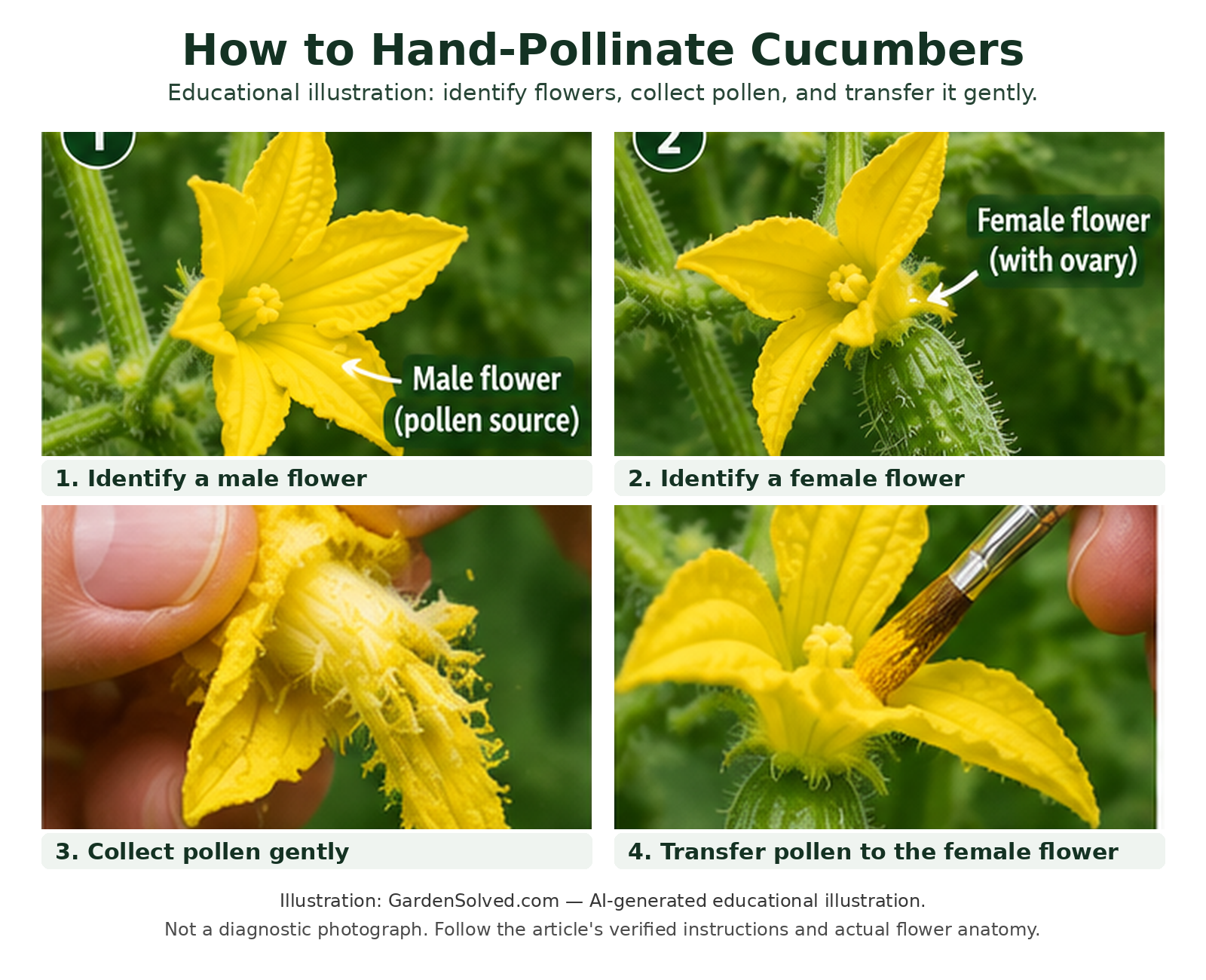
Find a freshly open male flower with pollen-bearing anthers and a freshly open female flower with a small cucumber-shaped ovary behind it. Transfer pollen gently from the male anthers to the female flower's stigma with the male flower or a clean soft brush, then leave the flower and observe whether the young fruit continues developing.
Hand pollination is a targeted procedure for a cucumber vine that has receptive female flowers but limited pollen transfer. Identify the flower first and rule out missing female flowers, severe plant stress, or a variety that does not need this intervention.
Decide whether to hand-pollinate
- Fresh female flowers and pollen-bearing male flowers are present, but pollen transfer is the supported concern: Continue with the procedure below.
- There are no female flowers, or the vine has no flowers at all: Use the flower or broad no-fruit diagnosis; hand pollination cannot create a receptive female flower.Why Are Cucumber Plants Not Producing Fruit?
- Fruit formed but is now small, narrow, or stalled: Use the fruit-development diagnosis alongside any pollination check.Why Are Cucumbers Small or Stunted?
Identify the two flowers
Male cucumber flower
- The yellow flower is carried on a slender stem and has no miniature cucumber-shaped ovary behind the petals.
- Look for pollen on the anthers inside the flower.
Use this flower as the pollen source only when it is fresh and pollen is available.
Female cucumber flower
- A small cucumber-shaped ovary is visible between the flower and the vine.
- The flower must be open and receptive for contact to be useful.
Touch pollen to the stigma inside this flower without crushing the petals or ovary.
Minimal materials and preparation
Use either a fresh male flower or a clean, soft small brush or cotton swab. Avoid wet tools, dirty tools, and anything stiff enough to scrape the flower.
Inspect the flowers before handling them and work carefully so the vine, ovary, petals, anthers, and stigma remain intact. If the variety description says the plant sets fruit without pollination, confirm that manual transfer is actually the unresolved decision.
Checks before deciding what to do
- Identify several flowers before touching them: male flowers lack the small ovary behind the petals; female flowers have it.
- Confirm that hand pollination addresses the supported next decision and that the vine is not primarily failing because of missing female flowers, severe stress, pest damage, or disease.
Transfer pollen gently
- Choose a freshly open male flower with visible pollen and a freshly open female flower with the small ovary behind it.
- If using the male flower directly, remove or fold back petals only as needed to expose the pollen-bearing anthers without tearing the flower.
- Touch the male anthers with the soft brush or the inside of the male flower so pollen is picked up; do not scrape or wet the pollen.
- Gently touch the pollen to the stigma inside the female flower, using light contact around the receptive surface rather than pushing into the ovary.
- Withdraw the tool or male flower without twisting the female flower, then leave the bloom undisturbed and record which flower you treated.
What to observe next
After transfer
The flower may close or fade as part of its normal progression; that alone does not prove success or failure.
On the young fruit
Watch whether the small ovary remains firm and continues enlarging rather than yellowing, shriveling, or becoming misshapen.
If the pattern repeats
Repeat the observation on another fresh flower only when the same decision still fits. Do not promise a fixed success rate or assume one treated flower represents the whole vine.
GardenSolved checkpoint
Do not do this yet
Common failure points
- Do not hand-pollinate a male flower, a closed flower, or a flower with no visible receptive female structure.
- Do not assume every cucumber variety requires manual pollen transfer; check the variety information.
- Do not press a tool into the ovary or scrub across delicate flower tissue.
- Do not treat hand pollination as a cure for drought, saturated roots, heat, disease, pests, missing female flowers, or general plant decline.
- Do not infer success from a single flower's appearance or promise that every treated fruit will develop.
Confirm the likely cause first, then choose the treatment.
If fruit still does not develop
- The main issue is flower drop and you need to interpret male versus female failure: Use the flower-drop diagnosis.Why Are Cucumber Flowers Falling Off?
- The plant has no fruit at any stage: Use the broad no-fruit diagnosis.Why Are Cucumber Plants Not Producing Fruit?
- Fruit formed but enlargement fails: Use the small-fruit diagnosis.Why Are Cucumbers Small or Stunted?
When another assessment is needed
Use diagnosis or local extension help when fruit still fails after repeated careful observations, the vine is declining, flowers are absent, or pests and disease symptoms dominate.