Cucumbers
Why Are Cucumber Flowers Falling Off?
The short answer
First check whether the fallen bloom was male or female. Male flowers can fall normally, especially early in flowering. If a female flower or its small ovary fails, incomplete pollination or stress around flowering may be involved, but the flower alone does not prove which cause is responsible.
A fallen cucumber flower is not automatically a failed fruit. Male flowers naturally shed after they release pollen, while a female flower has a small cucumber-like ovary behind it and needs a different check if that ovary yellows, shrivels, or drops.
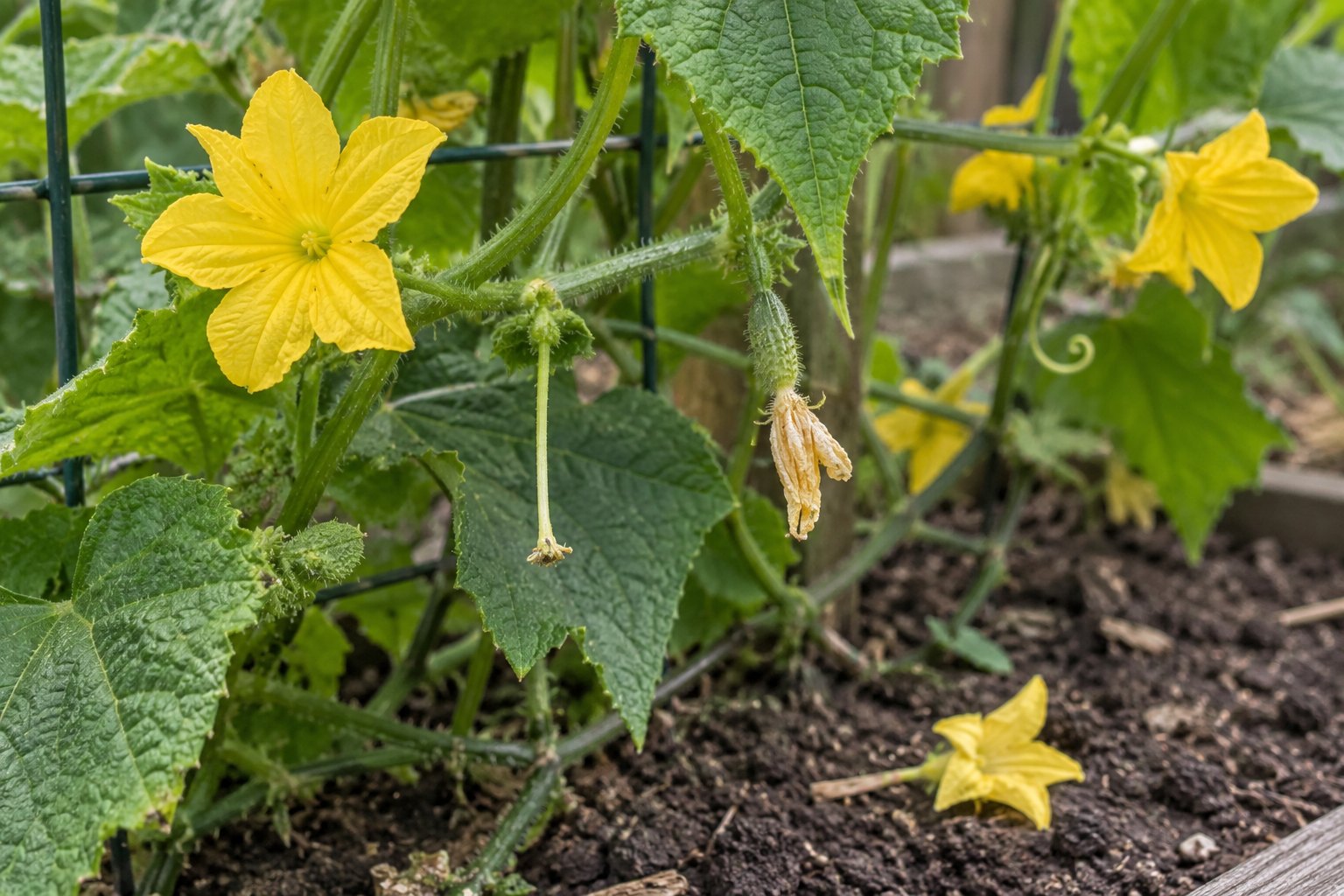
Was the fallen flower male or female?
Male flower
- The petals sit on a slim stalk with no miniature cucumber behind them.
- Several male flowers may appear before female flowers on many garden cucumbers.
More likely if
- Only the spent blossom falls and the vine continues to form new flowers.
Less likely if
- A cucumber-like ovary was attached directly behind the petals.
No rescue is needed for a spent male bloom; keep conditions steady and watch for female flowers.
Female flower
- A small cucumber-like ovary sits immediately behind the petals.
- The decision is whether the blossom alone closes or the ovary also yellows, shrivels, or stops enlarging.
More likely if
- The young ovary is clearly visible on attached flowers of the same type.
Less likely if
- The bloom is carried on a slender stalk with no swelling.
Check pollinator access, recent weather, root-zone moisture, and whether the next female flowers set.
Follow what happens after the flower opens
Male bloom opens
The flower supplies pollen. After flowering it may close and fall without ever having a fruit behind it.
Female bloom opens
The small ovary is already visible behind the petals. For pollination-dependent varieties, adequate pollen transfer supports continued fruit development.
The blossom closes
A closed or fallen blossom is not the whole diagnosis; check whether the ovary remains green and enlarges.
The ovary fails
If it yellows, shrivels, or drops, investigate pollination evidence and environmental or root-zone stress around flowering.
If female flowers are failing, check these branches
Incomplete pollination
A pollination-dependent female flower may fail to develop when too little compatible pollen reaches it. Low pollinator activity or disruptive weather can contribute, but the failed ovary alone does not confirm this branch.
Temperature or moisture stress
Unusual heat or cold, a dry root zone, saturation, or rapid moisture swings can coincide with flower or early fruit abortion. Confirm the environmental or soil condition rather than assuming stress from the fallen flower.
Excess nitrogen or weak overall plant health
Repeated nitrogen-rich feeding can favour leafy growth over reproductive growth, while pests, disease, poor light, or root problems can reduce the plant's ability to set fruit. Follow the dominant evidence rather than treating the flower alone.
Checks for the next open flowers
- Compare several flowers and identify the ovary behind female blooms; one detached flower may be hard to classify after it dries.
- Mark a newly opened female flower and check whether its ovary stays green and begins enlarging after the petals close.
- Observe whether bees or other pollinating insects can reach open flowers, and review pesticide use during bloom.
- Note heat, cold, wind, or heavy rain around bloom and check moisture below the soil surface and drainage.
- Review recent fertilizer use and whether the vine is producing abundant leaves but few female flowers.
- Check the seed packet or supplier description for variety-specific flowering or pollination behaviour.
Match the immediate action to the flower
- For spent male flowers, leave the vine's care steady and wait for female flowers; no treatment is required for normal shedding.
- For female flowers, protect access for pollinators and avoid unnecessary insecticide exposure during bloom.
- Correct only a confirmed root-zone or environmental stress, then watch the next female flowers rather than trying to restore an ovary that has already failed.
- If female flowers repeatedly fail and pollination is the strongest supported branch, follow an approved cucumber hand-pollination procedure when that owner is available; do not improvise the full procedure here.
- If the broader result is persistent absence of fruit, use the no-fruit diagnosis.
When this is a broader problem
- The main question is why the plant has no fruit at any stage: Use the broad no-fruit pathway to separate maturity, flower type, pollination, stress, and early fruit failure.Why Are Cucumber Plants Not Producing Fruit?
- The main uncertainty is routine moisture care: Use the cucumber watering owner rather than turning flower drop into a watering schedule.How Often and How Much Should Cucumbers Be Watered?
GardenSolved checkpoint
Do not do this yet
Avoid common flower-drop mistakes
- Do not label a fallen male flower as a failed female flower.
- Do not assume poor pollination until a female flower and failing ovary have been identified.
- Do not add nitrogen or increase watering without evidence from the plant and root zone.
- Do not apply insecticide to open flowers without a confirmed target, label-compliant use, and attention to pollinator risk.
- Do not turn this diagnosis into a complete hand-pollination tutorial.
Confirm the likely cause first, then choose the treatment.
Support future flowers
- Keep moisture and drainage steady through flowering while adjusting for weather and the growing system.
- Avoid unnecessary high-nitrogen feeding after the vine is established.
- Protect flower access for pollinators and check product labels before any pest treatment during bloom.
- Inspect both flower types regularly so normal male shedding is not confused with repeated female failure.
When flower drop needs another diagnosis
Use the broad no-fruit page when the vine persistently produces no cucumbers, or seek local help when mature plants never form female flowers, female ovaries repeatedly fail despite suitable conditions, or leaf, root, pest, or disease symptoms are also present. Flower drop by itself cannot establish a treatment target.