Cucumbers
Why Are Cucumber Fruits Turning Yellow?
The short answer
A large fruit that has reached or passed its expected picking stage may be changing color normally for that type, while a small or stalled fruit that turns yellow needs a closer look at pollination, moisture, roots, pests, and disease clues. Color alone does not prove cause, quality, safety, or edibility.
Yellow cucumber fruit needs a stage-and-variety check, not a color-only diagnosis. Compare the fruit with the cultivar description, its age and size, firmness and shape, and the condition of the vine before deciding whether it is normal maturity or premature abnormal yellowing.
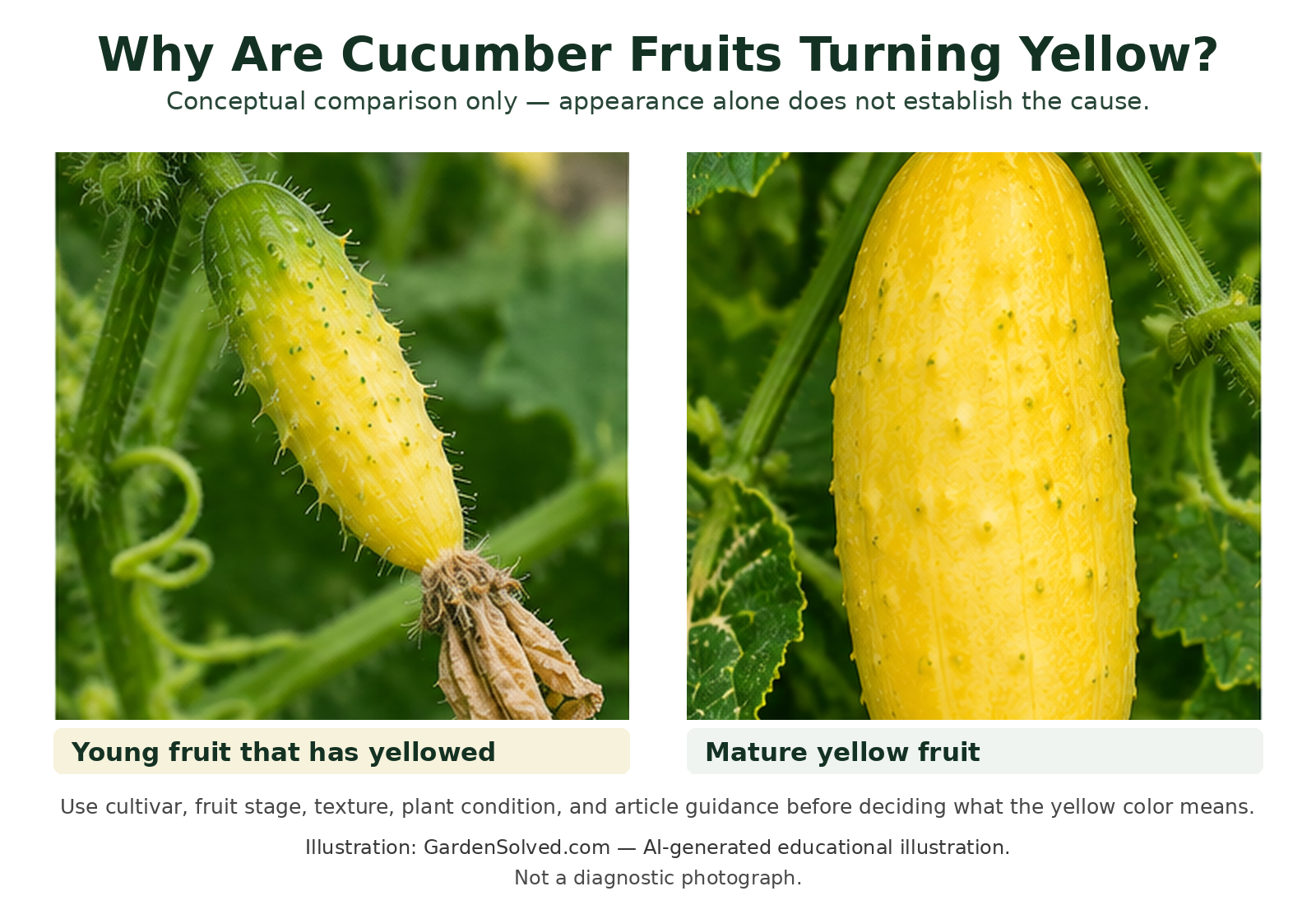
Compare maturity with abnormal early yellowing
Expected maturity or overmaturity
- The fruit is at or beyond the variety's expected harvest stage.
- It is otherwise consistent with the type and may be larger, less firm, or more seed-filled than a market-stage fruit.
Use the variety's harvest guidance; do not treat color alone as disease.
Premature or stalled yellowing
- The fruit is small, poorly developed, misshapen, or stops enlarging before the expected stage.
- The vine also shows moisture, root, pest, disease, or pollination clues.
More likely if
- Several young fruits show the same pattern.
Check fruit development and plant-health clues; use the small-fruit diagnosis when failed enlargement is dominant.
Expected color for the cultivar
- The seed packet or supplier describes yellow, pale, white, or another non-green mature fruit.
- Healthy fruits on the same plant share the expected color and develop normally.
Keep the cultivar context attached to the observation; a yellow variety is not evidence of disease.
Checks before choosing a response
- Confirm the fruit is attached to the cucumber plant and identify the variety if possible.
- Compare several fruits for size, shape, firmness, age, and whether yellowing begins before or after the expected picking stage.
- Inspect leaves and stems separately for wilt, holes, powdery growth, spots, mosaic-like patterns, or pests; yellow fruit is not yellow leaves.
- Check root-zone moisture and drainage without turning this page into a watering schedule.
- Review the flower and fruit history: a small fruit that never enlarges belongs on the fruit-development branch, not the maturity branch.
Act on the stage you confirmed
- If the fruit is at the variety's picking stage, follow harvest guidance for that type and inspect hidden fruit regularly.
- If the fruit is naturally yellow for its cultivar, record the expected color and avoid treating it as a disease symptom.
- If fruit is small and stalled, check the small-fruit diagnosis for pollination, moisture, vigor, and crop-load branches.
- If the vine is stressed, correct only the confirmed root-zone or plant-health issue and do not infer a cause from color alone.
- Do not make a food-safety or edibility conclusion from color, size, or a single photograph.
Choose development or harvest guidance
- The yellow fruit is small, misshapen, or stalled before the expected stage: Use the cucumber small-fruit diagnosis.Why Are Cucumbers Small or Stunted?
- The fruit matches a yellow-skinned cultivar or has reached its expected maturity stage: Use the cultivar-aware harvest guide rather than treating yellow as universally abnormal.When and How to Harvest Cucumbers
What yellow fruit does—and does not—tell you
A yellow cucumber photograph can show color and context, but it cannot establish the cultivar, fruit age, cause of yellowing, quality, safety, or edibility. Use the plant history and direct observations to make those distinctions.
This page concerns cucumber fruit attached to the plant. Yellow leaves are owned by the cucumber yellow-leaves diagnosis; bitterness and routine harvest care remain separate decisions.
When another assessment is needed
Seek a local diagnosis when small fruit yellows while the vine is declining, symptoms spread across the plant, or pest or disease evidence is present.
GardenSolved checkpoint
Do not do this yet
Avoid unsupported shortcuts
- Do not call every yellow cucumber diseased or unsafe without cultivar and maturity context.
- Do not treat an older yellow fruit as proof that the whole vine needs fertilizer or pesticide.
Confirm the likely cause first, then choose the treatment.