Cucumbers
Why do my cucumber leaves have holes?
The short answer
Inspect the newest damage on both leaf surfaces, flowers, stems, and the soil line. Small jagged holes with striped or spotted beetles point toward cucumber beetles; larger ragged loss with larvae or pellet-like droppings points toward caterpillars; smooth-edged night damage with a shiny trail points toward slugs or snails. If spots turn dead and their centers fall out, use a disease diagnosis instead of assuming active chewing.
Holes in cucumber leaves usually come from chewing, but the hole alone does not identify the feeder. Fresh edges, where damage begins, and evidence such as beetles, larvae, droppings, slime, or surface etching are more useful than spraying first and identifying later.
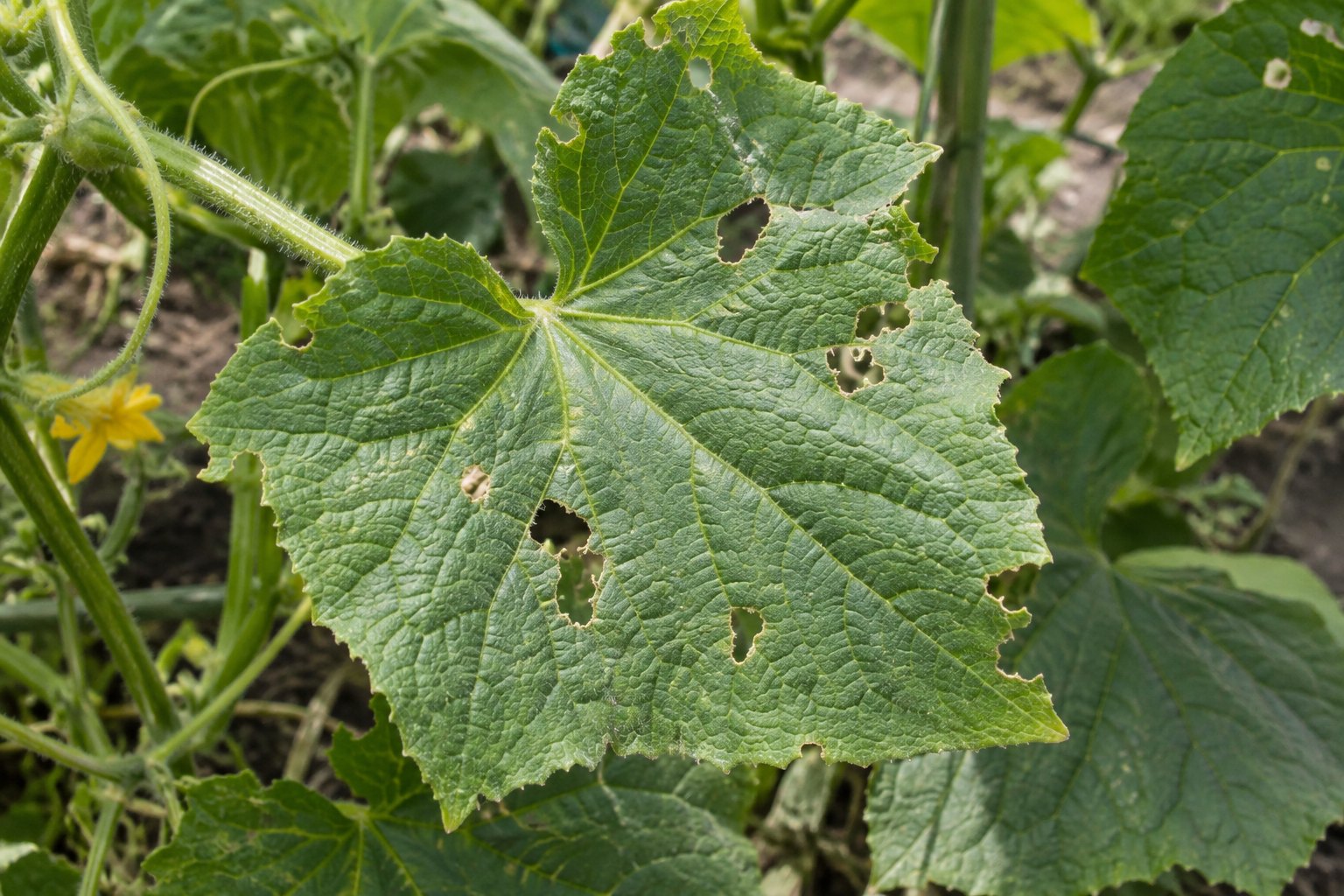
Match the damage pattern to evidence
| Damage pattern | Evidence to look for | First branch |
|---|---|---|
| Small irregular or jagged holes; feeding may extend to flowers or stems | Striped or spotted yellow-green beetles on or below moved leaves | Cucumber beetles |
| Surface looks etched, scraped, or partly skeletonized between veins | Beetles or larvae on the underside; fresh pale scraping beside older brown tissue | Other beetle feeding |
| Larger ragged holes or missing leaf edges | Caterpillars, webbing, or pellet-like droppings near new damage | Caterpillar or another chewing feeder |
| Smooth-edged irregular holes that increase overnight | Shiny slime trails; slugs or snails hiding in damp shelter by day | Slug or snail feeding |
| Tan, gray, or angular spots appear before centers fall away | A halo, repeated lesion pattern, or spreading discoloration without an active feeder | Shot-hole lookalike from leaf disease |
Decide whether feeding is active
Cucumber beetles
- Holes are small, irregular, or jagged and may also appear on petals or stems.
- Striped or spotted beetles are found on leaves, flowers, or the soil below a disturbed plant.
More likely if
- Fresh damage is forming where beetles are repeatedly observed, especially on a young plant.
Less likely if
- Night checks show slime trails or caterpillars and no beetles are found.
Record beetle numbers and new damage; protect vulnerable young plants and use thresholds or local IPM guidance before pesticide treatment.
Caterpillars or another chewing feeder
- Leaf edges or large areas are missing rather than finely stippled.
- Larvae, webbing, eggs, or pellet-like droppings are close to fresh damage.
More likely if
- A dusk or underside inspection finds the feeder where new holes are appearing.
Less likely if
- The holes were preceded by expanding tan or angular spots.
Identify the feeder; hand removal may be enough for a small garden infestation.
Slugs or snails
- Irregular holes have relatively smooth edges and damage increases overnight.
- A shiny slime trail crosses the leaf, pot, mulch, or soil.
More likely if
- The site is damp and the animal is found after dusk or under nearby shelter.
Less likely if
- Beetles, larvae, or a lesion pattern explain the new damage more directly.
Remove hiding places where practical and confirm night activity before choosing a control.
Old damage or a shot-hole lookalike
- No new holes appear after the damaged leaves are marked.
- Tan, gray, or angular spots and halos precede tissue dropping out.
More likely if
- The lesion pattern continues on leaves that have no chewing evidence.
Less likely if
- A feeder is present beside fresh green cut edges.
Stop treating the hole as proof of insects; document the spot pattern and use the appropriate symptom or disease route.
Confirm the feeder before treatment
- Circle a few existing holes in a photo or mark the leaf margin with a small non-damaging reference, then compare new damage the next day.
- Look under leaves and inside flowers, then gently disturb the plant and check the soil below for beetles that drop when disturbed.
- Inspect at dusk or with a flashlight after dark for caterpillars, beetles, earwigs, slugs, or snails that hide during the day.
- Match physical evidence: pellet-like droppings or webbing support caterpillars; a shiny trail supports slugs or snails; stripes or spots on a small yellow-green beetle support cucumber beetles.
- Check whether pale, tan, gray, or angular lesions appeared before tissue fell out. That sequence supports a leaf-spot lookalike rather than fresh chewing.
- Estimate whether the plant is losing a few older leaf areas or whether active feeding is threatening a seedling or new growth; urgency depends on plant stage and continuing damage.
Route companion symptoms to their existing owners
- Persistent wilt or runner collapse is more important than the holes: Use the cucumber wilting diagnosis and include any cucumber-beetle evidence.Why are my cucumber plants wilting?
- Yellowing or a spreading spot pattern is the main change: Use the yellow-leaf diagnosis to separate root, pest, and lesion patterns.Why Are Cucumber Leaves Turning Yellow?
- Yellow or tan angular lesions are bounded by veins, with discoloured growth beneath: Compare both leaf surfaces in the downy-mildew owner.Downy Mildew on Cucumbers
- White powdery growth is the defining sign: Use the powdery-mildew owner rather than treating holes as the primary problem.Powdery Mildew on Cucumbers
Respond to the confirmed branch
- For a few visible beetles, caterpillars, slugs, or snails, hand removal and continued monitoring may be sufficient in a home garden.
- Protect young plants with a suitable barrier before flowering where practical; remove covers when flowers need pollinator access.
- Keep plant care steady and retain useful leaf area. Remove only leaves that are dead, heavily diseased, or no longer functioning without stripping the vine.
- If active damage is substantial enough to justify a pesticide, identify the pest first and use only a product labeled for both that pest and cucumbers, following timing and harvest directions.
- If no feeder is found and lesions are expanding, stop the insect branch and pursue a disease diagnosis.
GardenSolved checkpoint
Do not do this yet
Do not spray from the hole alone
- Do not treat every hole as cucumber beetle damage; caterpillars, slugs, other beetles, old feeding, and dead lesion centers leave different evidence.
- Do not spray an insecticide without confirming active feeding or a likely pest and reading the crop label.
- Do not remove every damaged leaf; minor old feeding may not justify sacrificing functioning foliage.
- Do not let this page absorb powdery mildew, downy mildew, yellowing, curling, or generic leaf-spot ownership when those patterns are dominant.
Confirm the likely cause first, then choose the treatment.
Judge recovery from new growth
- Existing holes will not close. Use the rate of new damage and the condition of new leaves to judge whether control worked.
- A mature, otherwise vigorous vine can often continue with limited old feeding; seedlings and newly established plants have less leaf area to spare.
- If marked leaves remain unchanged and new growth is intact, continue monitoring rather than escalating treatment.
- If feeding stops but spots continue to enlarge or tissue keeps falling out, switch to the disease-lookalike branch.
Make new damage easier to catch
- Inspect seedlings, leaf undersides, and flowers regularly so fresh feeding is separated from old holes.
- Use row cover or fine mesh on young plants where appropriate and remove it for pollination when flowers open.
- Reduce damp daytime hiding places for slugs and snails without letting the cucumber root zone dry out.
- Remove badly diseased or infested debris and manage nearby weeds that may shelter cucumber beetles while preserving beneficial habitat thoughtfully.
When to get a closer diagnosis
Escalate when a seedling is losing leaf area rapidly, feeding reaches stems or the growing tip, wilt persists after the root zone is checked, or holes follow expanding tan, gray, or angular lesions. Record both leaf surfaces and any insect, larva, droppings, slime, or beetle evidence so an extension or plant clinic can distinguish active chewing from disease-related tissue loss.