Cucumbers
Powdery Mildew on Cucumbers
The short answer
Inspect several cucumber leaves in good light. Powdery mildew may begin on older or shaded foliage and appear as white powder-like fungal growth on leaves, stems, or petioles. Photograph the progression, rule out removable residue, and use the separate downy-mildew guide when angular yellow lesions or underside growth—not surface powder—define the pattern.
White powder-like growth on cucumber leaves is consistent with powdery mildew, especially when it develops and spreads across leaf surfaces, stems, or petioles. Appearance alone is not proof: confirm the plant, location, pattern, and progression, and compare residue and downy mildew before managing it as a disease.
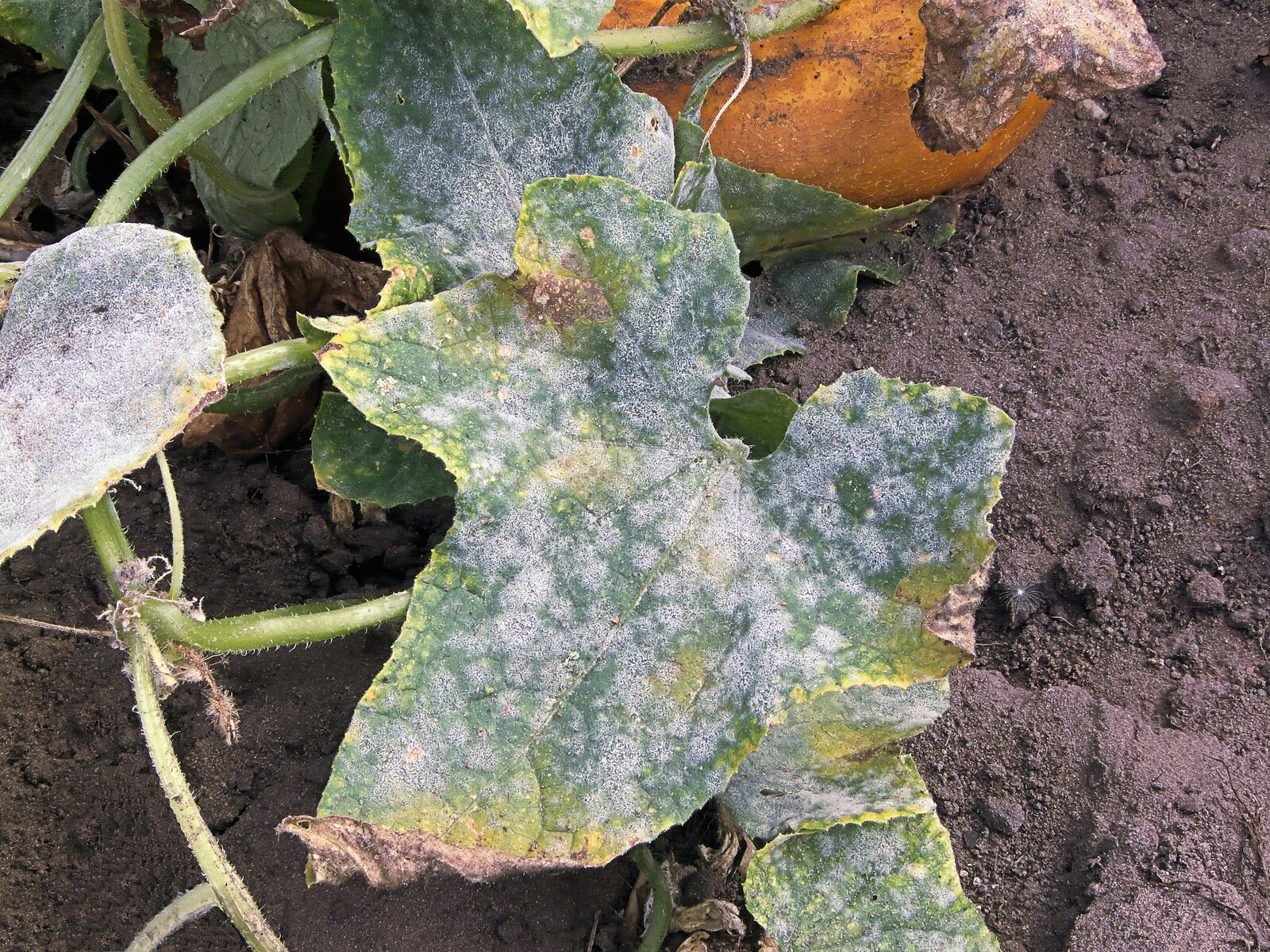

Read the white growth before treating
| Observation | What it supports |
|---|---|
| White powder-like patches expand across cucumber leaf surfaces | This is consistent with powdery mildew when the plant identity and progression also fit. |
| Growth is also visible on petioles or stems | That distribution supports the powdery-mildew branch more than a one-off splash mark. |
| A mark wipes away and does not return or spread | Consider dust, dried spray, hard-water residue, or another deposit before calling it disease. |
| Yellow areas are angular and bounded by veins, with discoloured or fuzzy growth below | Use the separate downy-mildew comparison; downy mildew is not the same disease. |
Powdery mildew, downy mildew, or residue?
Powdery mildew pattern
- White powder-like fungal growth develops on cucumber foliage.
- Older or shaded leaves may show the first visible growth.
More likely if
- The growth progresses across leaves, petioles, or stems in a pattern matching authoritative cucumber guidance.
Less likely if
- The defining pattern is vein-bounded yellow lesions with underside sporulation.
Document progression and use low-risk cultural management while confirming the diagnosis.
Downy mildew pattern
- Upper leaf surfaces show angular, vein-bounded yellow to pale-green lesions.
- The underside may show dark or fuzzy sporulation in humid conditions.
More likely if
- Both lesion geometry and underside evidence are present and progressing.
Use the cucumber downy-mildew specialist page rather than treating generic mildew.
Residue or another lookalike
- Marks follow splash, spray, or dust exposure and lack a disease-like progression.
- A careful comparison finds no consistent growth pattern across plant tissue.
Keep observing clean, marked tissue before applying a disease treatment.
Checks before deciding what to do
- Confirm that the plant is cucumber and inspect multiple leaves, both surfaces, stems, and petioles in good light.
- Photograph the same marked leaves over time and compare the pattern with authoritative cucumber guidance; one view alone cannot establish pathogen certainty.
Manage a supported powdery-mildew pattern
- Photograph and mark affected leaves so progression can be compared rather than inferred from one image.
- Improve spacing and airflow where plants are crowded, and remove weeds or volunteers that restrict inspection and circulation.
- Remove badly affected debris without stripping the vine of functioning foliage, and clean tools after handling suspect tissue.
- Choose resistant or tolerant cultivars for future plantings when reliable supplier information is available.
- If a fungicide is being considered, confirm the diagnosis locally and use only a current product label that expressly covers cucumber and the target disease; this guide supplies no product, rate, or interval.
Choose the correct disease route
- Angular yellow or pale lesions and underside growth define the pattern: Compare the upper and lower leaf surfaces in the downy-mildew guide.Downy Mildew on Cucumbers
- General yellowing is stronger than white powder-like growth: Return to the symptom-first yellow-leaf diagnosis.Why Are Cucumber Leaves Turning Yellow?
- Crowding is blocking inspection and airflow: Use the spacing owner for the next layout decision.How Much Space Do Cucumber Plants Need?
- Unsupported vines are tangled or lying on wet soil: Use the trellis owner for a safe support decision.How to Trellis Cucumbers
GardenSolved checkpoint
Do not do this yet
Avoid unsupported mildew shortcuts
- Do not diagnose a pathogen from one photograph or call every white mark powdery mildew.
- Do not combine powdery and downy mildew into one treatment decision.
- Do not publish or improvise home-remedy recipes, universal cures, product promises, rates, or spray intervals.
- Do not use the diagnostic photograph as proof that an unseen plant has the same disease.
Confirm the likely cause first, then choose the treatment.
When another assessment is needed
Use a local Extension or plant-diagnostic service when the pattern is uncertain, spreads rapidly, affects several plants, or treatment is being considered for an edible crop.