Hydrangeas
When should I prune hydrangeas?
The short answer
Identify the hydrangea type before a hard prune. Bigleaf, oakleaf, mountain, and climbing hydrangeas commonly bloom on old wood and are generally pruned after flowering if needed. Panicle and smooth hydrangeas bloom on new wood and can usually be pruned in late winter or early spring. Reblooming cultivars need cultivar-specific guidance.
There is no single pruning date for every hydrangea. The correct timing depends on whether the plant flowers on old wood, new wood, or both, and whether the goal is deadwood removal, shaping, renewal, or deadheading.
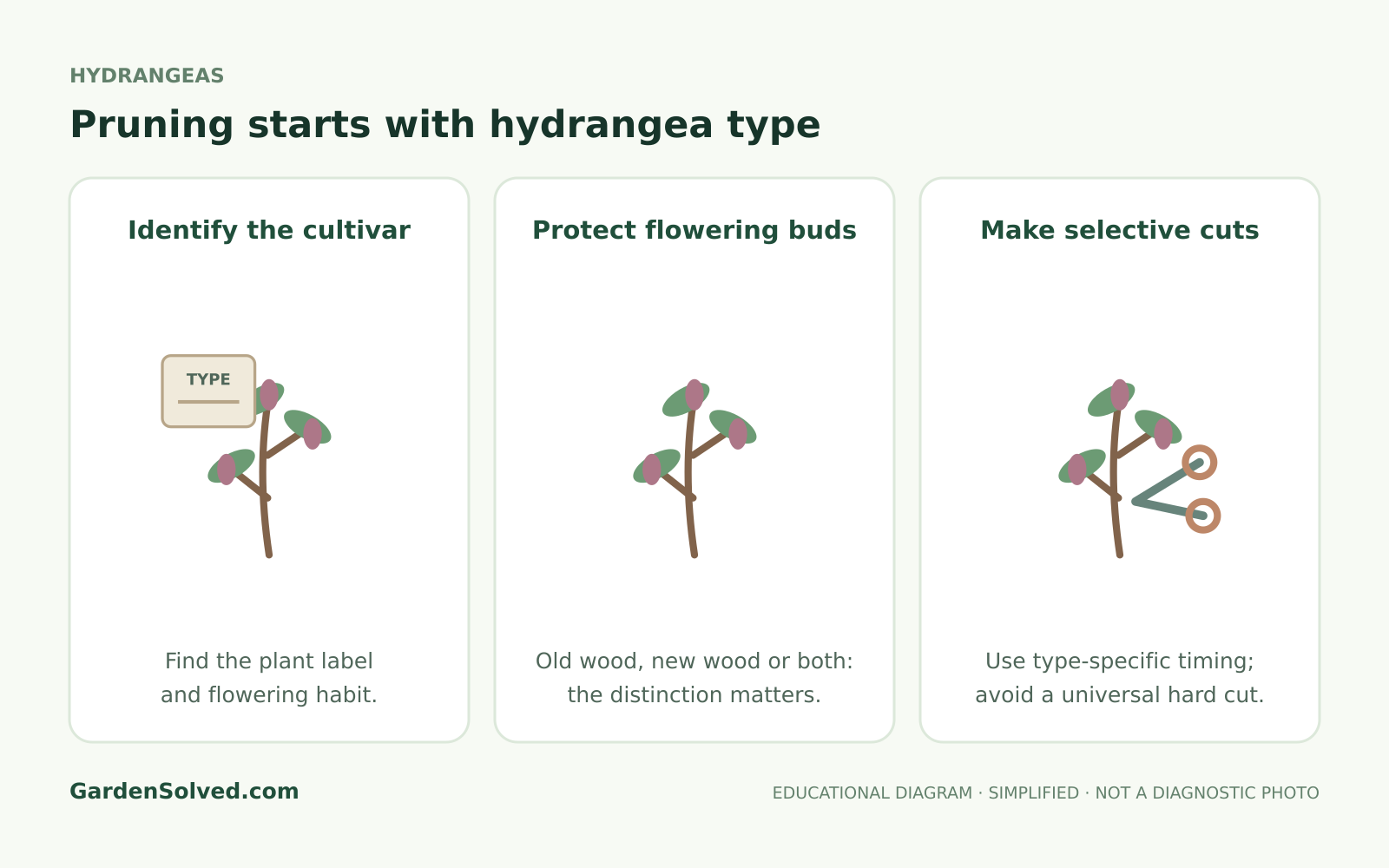
Match pruning time to hydrangea type
| Hydrangea or goal | General timing logic |
|---|---|
| Bigleaf, oakleaf, mountain, or climbing hydrangea | Usually prune after flowering if pruning is needed because flower buds are on older wood. |
| Panicle or smooth hydrangea | Usually prune in late winter or early spring because flowers form on new growth. |
| Reblooming cultivar | May flower on both old and new wood; follow cultivar guidance and avoid unnecessary hard pruning. |
| Dead or damaged stem | Remove when clearly dead or hazardous without treating the whole shrub as a hard-pruning project. |
| Unknown hydrangea | Limit pruning until the plant is identified. |
What kind of pruning are you doing?
Old-wood pruning
- Flower buds are carried on last year's stems.
- Removing stems before bloom can remove the display.
More likely if
- The plant is bigleaf, oakleaf, mountain, or climbing hydrangea.
Less likely if
- It is a known panicle or smooth hydrangea.
Prune after flowering only as needed and preserve healthy bud-bearing stems.
New-wood pruning
- Flowers form on current-season shoots.
- Late-winter or early-spring pruning is generally compatible.
More likely if
- The plant is panicle or smooth hydrangea.
Less likely if
- It is an old-wood bloomer.
Prune before new growth according to plant size and vigor without assuming it must be cut hard.
Sanitation only
- A few stems are dead, damaged, or crossing.
- The main goal is plant health rather than size.
More likely if
- The rest of the shrub is healthy.
Less likely if
- A major renovation is actually needed.
Remove only the affected stems with clean tools.
Checks before a major cut
- Identify species or cultivar.
- Confirm old-wood, new-wood, or reblooming habit.
- Look for live buds on older stems.
- Decide whether the goal is sanitation, renewal, size, or deadheading.
- Check whether winter damage is truly dead tissue before removal.
Route pruning-related problems
- The hydrangea stopped flowering after pruning: Use the no-bloom pathway.Why is my hydrangea not blooming?
- Flowers are simply aging and turning brown: Use the brown-flower pathway before assuming pruning is needed.Why are my hydrangea flowers turning brown?
- The shrub is drooping during bloom: Check watering and stem support before a drastic cut.Why are my hydrangea flowers drooping?
How to prune safely
- Identify the hydrangea first.
- Remove clearly dead, damaged, or diseased stems before cosmetic shaping.
- For old-wood bloomers, wait until after flowering for size or renewal pruning.
- For panicle and smooth hydrangeas, prune in late winter or early spring if needed.
- Use clean sharp tools and avoid removing more healthy growth than the plant needs.
GardenSolved checkpoint
Do not do this yet
Avoid pruning shortcuts
- Do not use one pruning date for every hydrangea.
- Do not cut an unidentified hydrangea to the ground.
- Do not remove healthy old stems from an old-wood bloomer before flowering.
- Do not assume deadheading and structural pruning are the same task.
- Do not repeatedly hard-prune a weak shrub.
Confirm the likely cause first, then choose the treatment.
What good pruning looks like afterward
- Healthy buds remain on the correct flowering wood.
- New growth develops from a balanced framework.
- The shrub flowers in its normal season.
- No progressive dieback develops below pruning cuts.
Make future pruning easier
- Keep the cultivar label.
- Photograph the shrub in bloom to help identify type and timing.
- Record when it flowers and where flower buds appear.
- Prune only for a clear reason.
- Remove deadwood without turning every maintenance session into hard pruning.
When pruning needs local guidance
Get local or cultivar-specific advice for mature climbing hydrangeas, valuable old shrubs, severe winter injury, or repeated flowering loss after pruning.