Hydrangeas
Why is my hydrangea changing color?
The short answer
First identify the hydrangea. Bigleaf and some mountain hydrangeas can shift between blue, purple, and pink as soil pH changes aluminum availability. Lower-pH soil generally favors bluer flowers; higher-pH soil favors pinker flowers. Aging blooms can also turn green, pink, muted, or brown without any soil problem. Test soil before trying to alter color.
Hydrangea flowers can change color for two very different reasons: normal aging and, in some bigleaf or mountain hydrangeas, soil chemistry that changes aluminum availability. White-flowered cultivars and many other hydrangea types do not respond the same way.
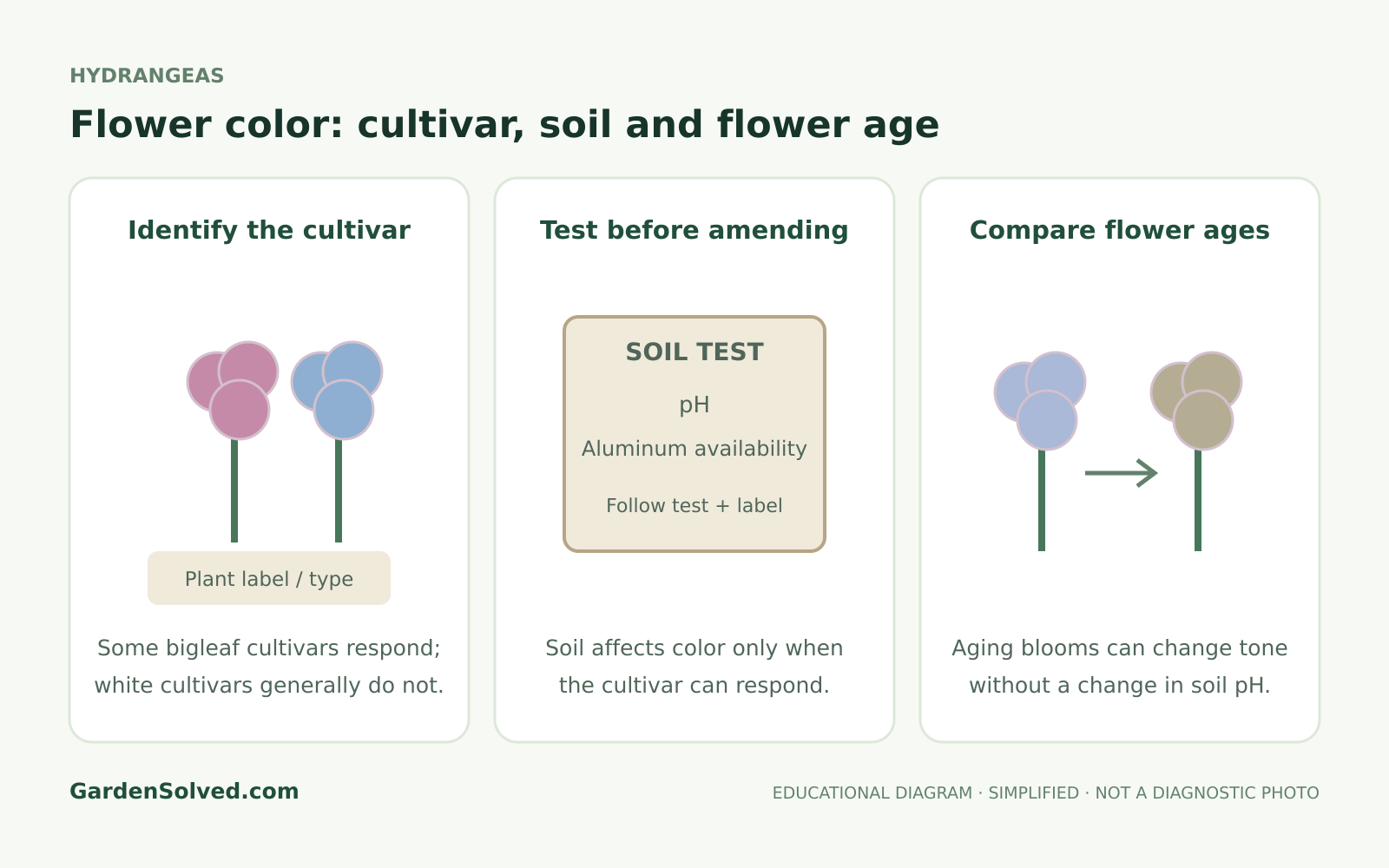
Why hydrangea flowers change color
| Pattern | What it suggests |
|---|---|
| Bigleaf or mountain hydrangea shifts pink-purple-blue | Soil pH and aluminum availability may be driving the change. |
| Older flowers turn green, muted, tan, or brown | Natural aging is likely. |
| White cultivar stays white or ages without turning blue/pink | Genetics limit pH-driven color change. |
| Different colors appear in different parts of a bed | Local soil chemistry may differ. |
| Color change occurs with wilt or leaf decline | Check plant health separately; color alone is not the whole diagnosis. |
Soil chemistry or normal aging?
pH-related color shift
- The plant is a responsive bigleaf or mountain hydrangea.
- New flowers shift between blue, purple, and pink.
More likely if
- Soil pH differs or has changed.
Less likely if
- The cultivar is white-flowered or a nonresponsive type.
Test soil before changing pH and make any correction gradually.
Normal flower aging
- Older flower heads change color while new flowers begin normally.
- The change progresses as blooms mature.
More likely if
- Leaves and stems remain healthy.
Less likely if
- Fresh new flowers are unexpectedly affected along with plant decline.
Leave aging blooms for interest or deadhead according to pruning guidance.
Cultivar genetics
- Flower color remains stable despite soil differences.
- The cultivar is white or selected for a particular color habit.
More likely if
- The plant label indicates fixed or limited color response.
Less likely if
- It is a classic responsive bigleaf type.
Choose a cultivar for desired color rather than forcing an unsupported change.
Checks before changing soil pH
- Identify species and cultivar.
- Compare fresh flowers with older flowers.
- Test soil pH.
- Check plant health and drainage.
- Review whether the color change is seasonal and gradual.
Route overlapping concerns
- Flowers are turning fully brown or gray: Use the brown-flower pathway to separate aging from disease or weather injury.Why are my hydrangea flowers turning brown?
- The plant is not blooming at all: Use the no-bloom pathway instead of changing soil color chemistry.Why is my hydrangea not blooming?
- Leaves are yellow between green veins: Use the yellow-leaf pathway before changing pH.Why are my hydrangea leaves turning yellow?
What to do now
- Identify the hydrangea type and whether it is color-responsive.
- Test soil before trying to shift flower color.
- Treat aging flower color as normal unless other symptoms are present.
- Make soil changes gradually and prioritize root health and drainage.
- Monitor new flower heads rather than expecting old flowers to reverse color.
GardenSolved checkpoint
Do not do this yet
Avoid color-change shortcuts
- Do not assume every hydrangea can be turned blue or pink.
- Do not change soil pH without a soil test.
- Do not repeatedly add amendments to chase rapid color changes.
- Do not treat natural aging as a disease.
- Do not prioritize flower color over root health.
Confirm the likely cause first, then choose the treatment.
What to expect after a soil change
- Existing flowers may not change back.
- Color response is judged on future flower heads.
- Soil chemistry changes can take time and may not be uniform across a bed.
- Healthy foliage and roots remain more important than achieving a particular shade.
Keep color management predictable
- Keep the cultivar label.
- Test soil before amendments.
- Choose naturally suitable cultivars for the desired color.
- Maintain healthy drainage and moisture.
- Accept normal seasonal aging of mature blooms.
When to seek local advice
Get local soil-test or extension guidance before large pH changes, especially if the shrub is already chlorotic, root-stressed, or growing in an unusual soil environment.