Hydrangeas
Why are my hydrangea leaves turning brown?
The short answer
Crispy brown margins after hot sun, frost, or dry soil point first toward scorch or water stress. Round purple-to-brown spots with tan or gray centers fit Cercospora, while larger sunken brown lesions with ringed centers can fit anthracnose. Check root-zone moisture and lesion shape before changing irrigation or applying disease treatment.
Brown hydrangea leaves can come from leaf-edge scorch, frost injury, dry roots, or true leaf spots. The key distinction is whether browning begins at the margins, follows a weather event, or appears as separate expanding lesions.
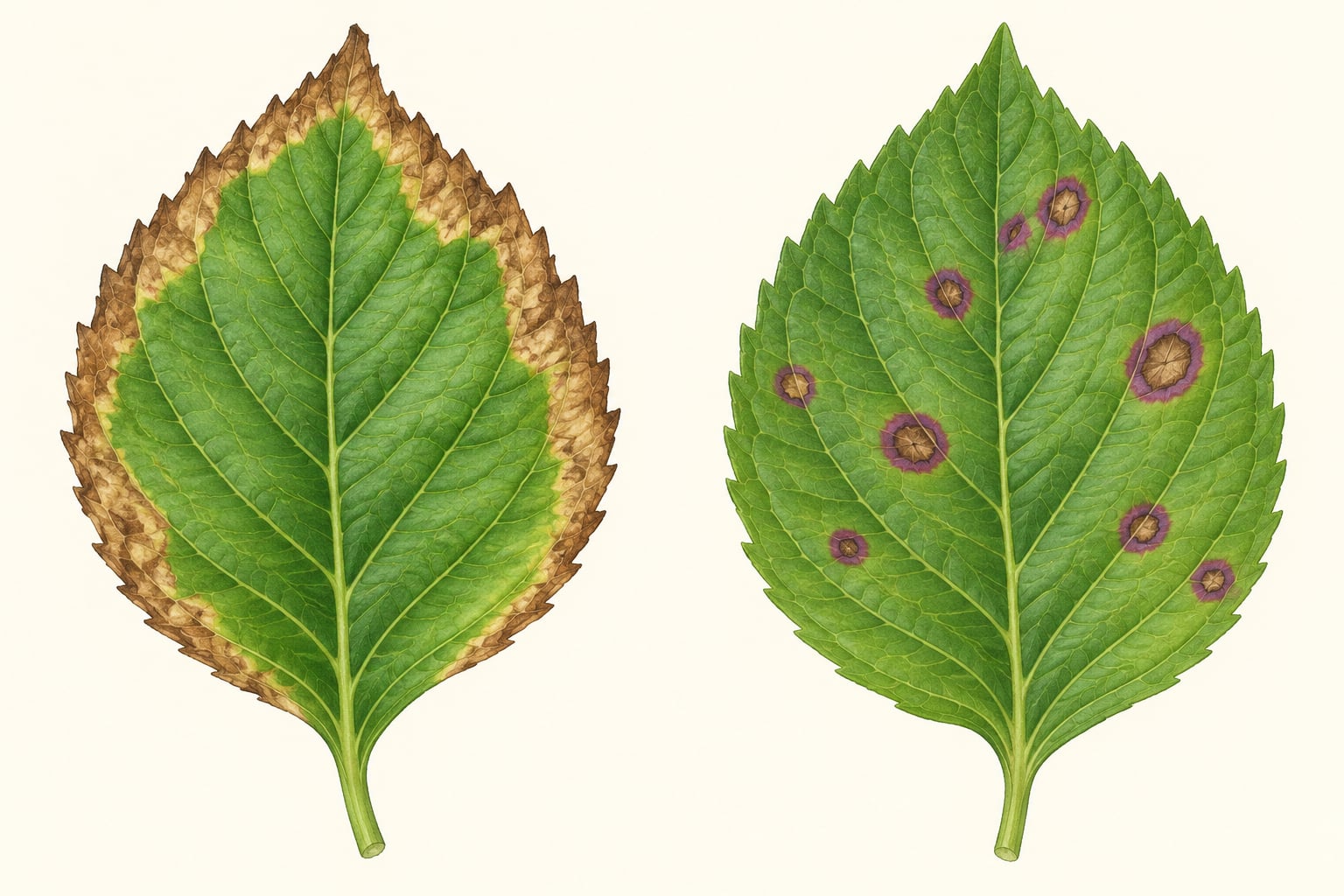
Read the brown pattern
| Pattern | What it suggests |
|---|---|
| Crispy brown margin or edge after heat or frost | Scorch or weather injury is more likely. |
| Round purple-brown spots with tan or gray centers | Cercospora leaf spot becomes more likely. |
| Larger sunken brown lesions with ringed centers | Anthracnose becomes more likely. |
| Browning plus wilt in dry soil | Root-zone drought is likely contributing. |
| Browning and decline while soil stays wet | Check drainage and root stress before watering again. |
Scorch or leaf disease?
Leaf-edge scorch
- Damage begins at margins or tips.
- Tissue is dry and crisp rather than a discrete lesion.
More likely if
- The shrub recently experienced frost, hot sun, drought, or intense heat.
Less likely if
- Round lesions with colored borders are multiplying.
Correct the confirmed site or moisture stress and judge recovery from new growth.
Cercospora leaf spot
- Spots are purple-brown and may develop tan or gray centers.
- Lower leaves may be affected first.
More likely if
- Symptoms build in warm, wet conditions or dense foliage.
Less likely if
- Only exposed margins are browned.
Reduce prolonged leaf wetness, improve airflow, and use disease treatment only if diagnosis and severity justify it.
Anthracnose
- Lesions can be larger and slightly sunken.
- Dark rings can create a bull's-eye appearance.
More likely if
- Similar lesions occur on leaves and flower petals.
Less likely if
- Damage is uniformly edge-burned after heat.
Use local identification because anthracnose and Cercospora are different diseases.
Checks before treatment
- Photograph the newest brown tissue.
- Check whether browning starts at the edge or as separate spots.
- Inspect lower foliage for matching lesions.
- Feel soil several inches below the surface and test drainage.
- Review recent weather and overhead watering.
Route the strongest clue
- Leaves are limp as well as brown: Use the wilting pathway to separate heat or drought from wet-root stress.Why are my hydrangea leaves wilting?
- Leaves are mostly yellow rather than brown: Use the yellow-leaf pathway.Why are my hydrangea leaves turning yellow?
- Watering frequency is uncertain: Use the hydrangea watering guide before changing the schedule.How often should I water hydrangeas?
What to do now
- If soil is dry, water deeply at the root zone; if saturated, pause irrigation and address drainage.
- Remove only badly damaged or fallen leaves when practical.
- Water at soil level and reduce unnecessary leaf wetness.
- Improve airflow without hard-pruning an unidentified hydrangea.
- Use disease treatment only after the lesion pattern fits the diagnosed problem.
GardenSolved checkpoint
Do not do this yet
Avoid brown-leaf shortcuts
- Do not assume every brown hydrangea leaf needs more water.
- Do not diagnose leaf spot from brown color alone.
- Do not apply disease treatment to simple heat- or frost-scorched tissue.
- Do not strip most foliage from a shrub with cosmetic late-season spotting.
- Do not fertilize a waterlogged plant to force recovery.
Confirm the likely cause first, then choose the treatment.
What improvement looks like
- Existing brown tissue stays brown; recovery is measured by healthier new leaves.
- New marginal scorch slows after root-zone and exposure stress improves.
- New leaf-spot lesions slow when disease pressure is reduced.
- Continued browning on fresh growth means the diagnosis or site conditions need reassessment.
Reduce future browning
- Maintain even moisture with mulch over the root zone, kept away from stems.
- Match sun exposure to the hydrangea type and local climate.
- Water at the base and allow foliage to dry promptly.
- Provide adequate spacing and airflow.
- Clean up diseased foliage when leaf-spot pressure is significant.
When to seek local help
Get a local extension or plant-clinic diagnosis when lesions progress rapidly, stems die back, or the spot pattern does not clearly match scorch, Cercospora, or anthracnose.