Hydrangeas
Why are my hydrangea leaves turning yellow?
The short answer
First decide whether yellowing is interveinal and strongest on young leaves. That pattern fits iron chlorosis, which often reflects high soil pH or impaired root uptake rather than a simple shortage of fertilizer. If leaves are uniformly yellow, wilted, stippled, or mottled, check drainage, roots, and pests before amending the soil.
Yellow hydrangea leaves are a pattern to decode, not an automatic fertilizer diagnosis. New leaves that turn yellow while veins stay green fit iron chlorosis, while whole-leaf yellowing can come from root stress, poor drainage, mites, or other causes.
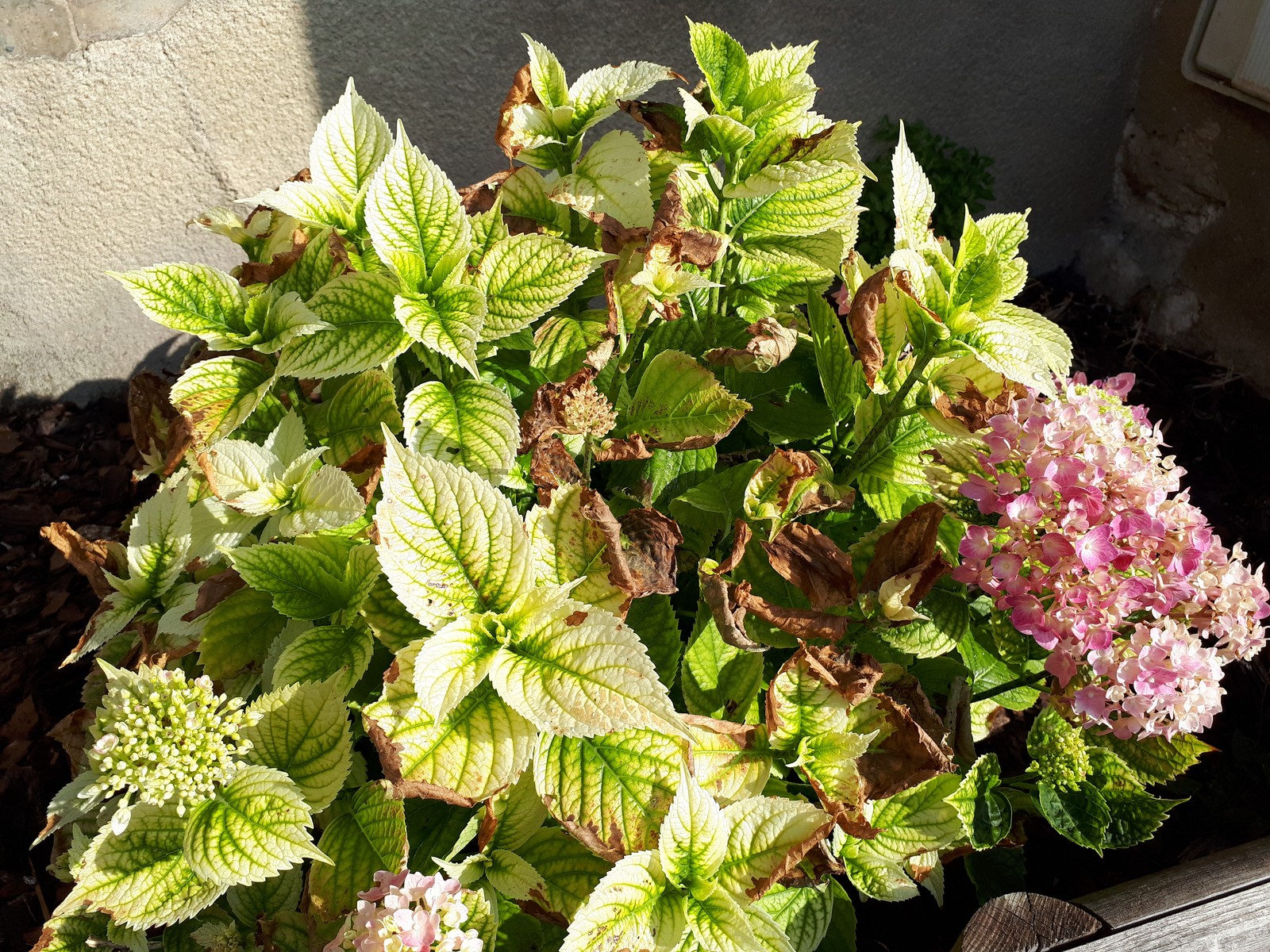

Read where the yellowing starts
| Pattern | What it suggests |
|---|---|
| Young leaves yellow between green veins | Iron chlorosis is a strong possibility. |
| Fine yellow-white stippling with webbing | Check two-spotted spider mites. |
| Yellowing plus persistent wet soil and wilt | Check drainage and root function before fertilizing. |
| Severe pale new growth that becomes stunted | The chlorosis needs closer soil and root investigation. |
| Yellowing with brown margins or spots | Route to the brown-leaf diagnosis too. |
Chlorosis or another stress?
Iron chlorosis
- New leaves are yellow with clearly greener veins.
- Symptoms are strongest on terminal growth.
More likely if
- Soil pH is high, soil is heavy, or roots are impaired.
Less likely if
- Leaves are uniformly yellow without interveinal contrast.
Test soil and root-zone conditions before changing pH or applying iron.
Spider mites
- Upper leaf surfaces are finely stippled yellow or pale.
- Webbing may appear during heavy infestations.
More likely if
- Weather is hot and dry.
Less likely if
- The yellowing is a clean interveinal pattern on young leaves.
Confirm mites with close inspection before pest control.
Root or drainage stress
- Yellowing occurs with wilt or weak growth.
- Soil remains saturated or roots are physically stressed.
More likely if
- Water drains poorly or irrigation is frequent.
Less likely if
- Root-zone moisture and drainage are suitable.
Correct the root-zone problem before adding fertilizer.
Checks before adding iron or fertilizer
- Compare the youngest and oldest leaves.
- Look for green veins within yellow young tissue.
- Inspect undersides for mites, scale, and webbing.
- Check soil pH with a reliable test.
- Check drainage and whether the root zone stays wet.
Route overlapping symptoms
- Leaves are yellow and limp: Use the wilting pathway to check heat, drought, and wet-root stress.Why are my hydrangea leaves wilting?
- Leaf edges are also brown or spotted: Use the brown-leaf pathway.Why are my hydrangea leaves turning brown?
- Watering is uncertain: Use the hydrangea watering guide before changing frequency.How often should I water hydrangeas?
What to do now
- Correct obvious drainage or watering stress first.
- If the pattern fits iron chlorosis, test soil pH and root-zone conditions before applying iron or sulfur.
- If mites are present, use targeted low-disruption control appropriate to the infestation.
- Remove only leaves that are fully dead or diseased; retain healthy foliage for recovery.
GardenSolved checkpoint
Do not do this yet
Avoid yellow-leaf shortcuts
- Do not automatically add fertilizer because leaves are yellow.
- Do not add aluminum sulfate as a general treatment for chlorosis.
- Do not change soil pH without a soil test.
- Do not spray for mites without confirming the pest or characteristic damage.
- Do not keep watering saturated soil because yellow leaves look stressed.
Confirm the likely cause first, then choose the treatment.
What recovery looks like
- Existing chlorotic leaves may stay pale; healthier new growth is the key signal.
- Interveinal yellowing becomes less severe after pH and root uptake are corrected.
- Stippling stops expanding after mite pressure is controlled.
- Persistent severe chlorosis on new growth needs further diagnosis.
Reduce future yellowing
- Plant hydrangeas in well-drained soil appropriate to their pH needs.
- Avoid repeated overwatering and soil compaction.
- Use soil tests before major pH or nutrient corrections.
- Scout leaf undersides during hot dry weather for mites.
When yellow leaves need local diagnosis
Get local help when new growth turns nearly white, chlorosis persists despite suitable pH and drainage, or yellowing occurs with branch dieback or widespread decline.