Roses
Why are my rose buds not opening?
The short answer
Open one affected bud and inspect it. Brown wet petals or gray fuzzy growth in cool wet weather fit Botrytis gray mold. White powder on buds and distorted young growth fits powdery mildew. Brown or pale streaking with tiny insects inside the flower can fit thrips. Remove badly damaged buds, improve airflow and sanitation, and treat only an identified problem.
A rose bud can stay closed because petals are being damaged by gray mold, powdery mildew, thrips, or weather before the flower opens. The bud surface and the petals inside tell you more than the closed shape alone.
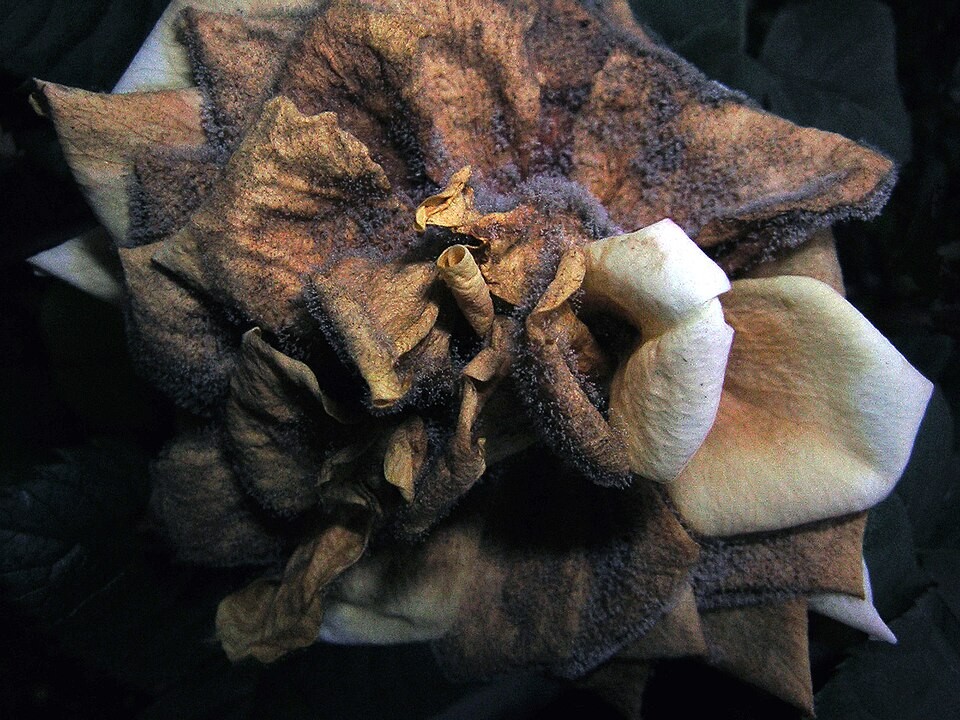

What is keeping the bud closed?
| Bud clue | Likely branch |
|---|---|
| Brown soft petals and gray fuzzy growth | Gray mold / Botrytis. |
| White powder on bud and distorted young leaves | Powdery mildew. |
| Brown streaks on petals with tiny insects | Thrips. |
| Outer petals damaged after rain, frost, or heat but no spreading mold | Weather injury is more plausible. |
| Bud and shoot both brown or black without clear mold | Check other bud pests or stem injury locally. |
Compare the main closed-bud causes
Gray mold
- Petals spot, rot, or turn fully brown.
- Gray fuzzy spores can develop in cool wet weather.
More likely if
- Flowers stayed wet and crowded.
Less likely if
- A dry white powder coats healthy green tissue.
Remove infected flowers and buds, improve drying and sanitation, and use disease-specific control only if necessary.
Powdery mildew
- White powder occurs on buds, flower stalks, and young leaves.
- Young growth may curl or distort.
More likely if
- Similar white growth appears on foliage.
Less likely if
- Buds are wet, brown, and gray-fuzzy.
Use the powdery-mildew pathway and improve airflow.
Thrips
- Petals show brown or pale streaking.
- Tiny insects hide inside buds and flowers.
More likely if
- Damage repeats through summer on fresh flowers.
Less likely if
- Gray spores or powdery growth are obvious.
Confirm thrips before considering control; minor home-garden damage can often be tolerated.
Weather or water stress
- Bud failure follows frost, prolonged rain, heat, or drought.
- No characteristic pest or disease sign is present.
More likely if
- New buds improve with better weather and root-zone care.
Less likely if
- Mold or insects continue on new buds.
Correct the confirmed environmental stress and monitor the next bud cycle.
Checks before spraying
- Open one failed bud and inspect inner petals.
- Check nearby young leaves and shoots for powdery growth.
- Look for gray fuzzy spores on dead petals and stems.
- Tap flowers over white paper to expose tiny thrips.
- Review recent rainfall, humidity, frost, heat, and root-zone moisture.
- Compare a newly forming bud with an old failed bud.
Route the strongest clue
- Buds turn fully brown or black: Use the brown-bud pathway.Why are my rose buds turning brown?
- White powder covers buds or young leaves: Use the powdery-mildew pathway.Why do my roses have white powder on the leaves?
- The whole bush is producing few or no buds: Use the no-bloom pathway.Why is my rose bush not blooming?
What to do now
- Remove badly rotted or dead buds and spent flowers.
- Keep irrigation at the soil line and improve airflow around flowers.
- Avoid leaving infected petals caught in dense foliage.
- If thrips are confirmed, use monitoring and targeted control rather than treating every closed bud.
- Use a rose-labeled fungicide only when a fungal disease is confirmed and cultural management is insufficient.
GardenSolved checkpoint
Do not do this yet
Avoid closed-bud shortcuts
- Do not force a closed bud open and then diagnose from the damaged petals alone.
- Do not call every wet brown bud Botrytis without checking for gray growth and weather context.
- Do not spray insecticide for thrips unless the insects or characteristic damage are present.
- Do not confuse powdery mildew with gray mold.
- Do not overwater the root zone in an attempt to force buds open.
Confirm the likely cause first, then choose the treatment.
What recovery looks like
- New buds open normally after weather or disease pressure improves.
- Fresh petals remain unspotted and free of gray mold.
- New buds carry less powdery growth after mildew management.
- Thrips damage declines on later flowers when pressure is reduced.
Reduce future bud failure
- Provide light and airflow and avoid crowding.
- Remove spent flowers and infected buds promptly.
- Water at the base and avoid prolonged wet flowers where practical.
- Scout buds for thrips and disease before damage becomes widespread.
- Keep the plant evenly watered without waterlogging roots.
When unopened buds need local help
Seek local diagnosis when most buds repeatedly fail, stems develop lesions or dieback, or bud failure is accompanied by systemic distortion or abnormal shoot growth.