Roses
Why do my roses have white powder on the leaves?
The short answer
Powdery mildew is most likely when a superficial white-gray coating spreads over young foliage and buds and affected leaves curl or twist. It often develops with warm days and cool humid nights and does not require free water on leaves. Improve airflow, avoid excessive nitrogen, remove badly affected tissue where practical, and use a rose-labeled treatment only when needed.
A white or gray powdery coating on young rose leaves, shoots, buds, and flower stalks is a classic powdery-mildew pattern, especially when new leaves curl or distort. But dried spray residue, dust, and other deposits can look pale, so check whether the growth is spreading with new symptoms.
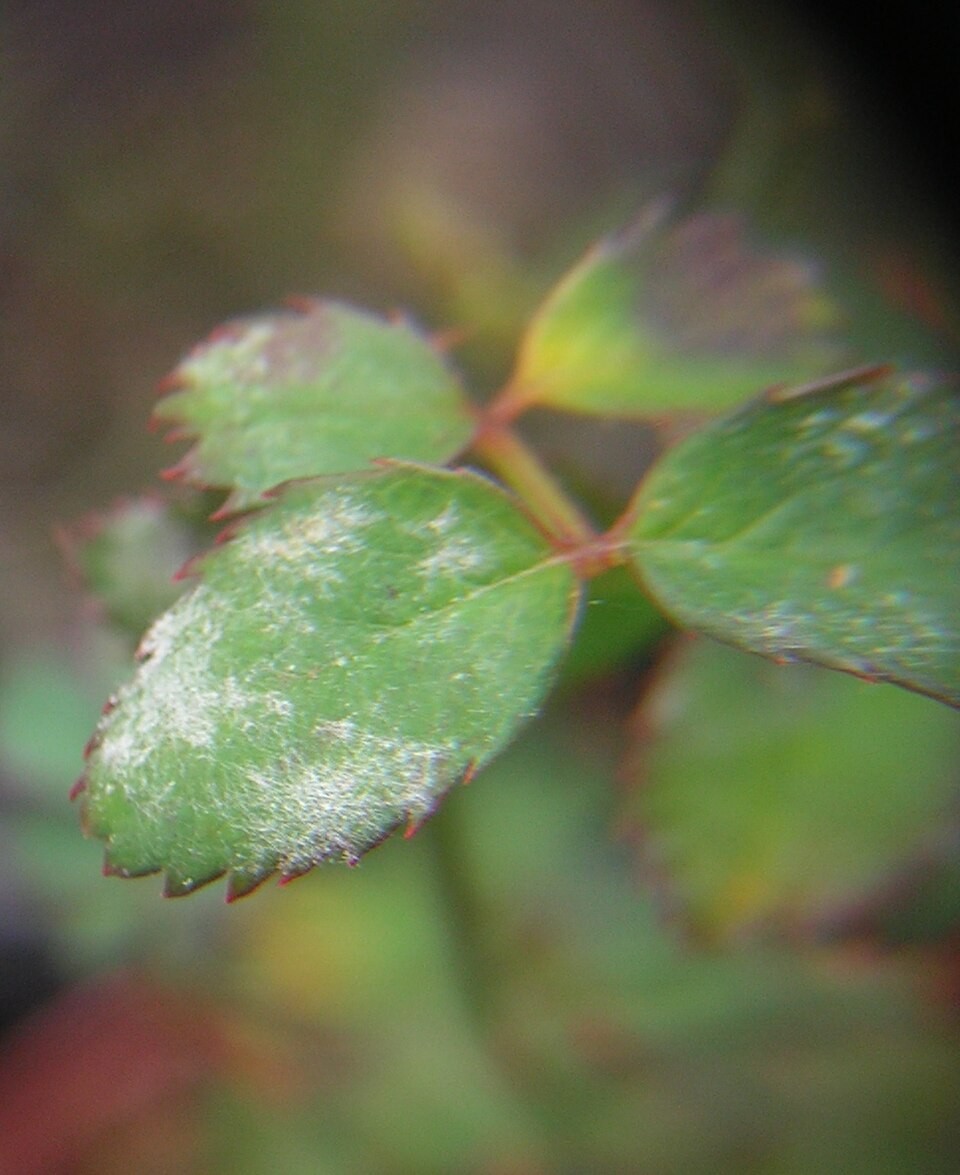

Powdery mildew or residue?
| What you see | What it means |
|---|---|
| Spreading white-gray powder on young leaves and shoots | Powdery mildew is likely. |
| Curled or twisted young leaves with surface powder | Supports powdery mildew. |
| White growth on buds and flower stalks | Powdery mildew can involve flowering tissue. |
| One-time chalky film after a spray or dusty event | Residue is more plausible if it does not spread or distort growth. |
| Gray fuzzy decay on brown flowers or buds | Think gray mold rather than powdery mildew. |
Compare powdery mildew with lookalikes
Powdery mildew
- White powder coats young foliage or buds.
- New leaves may curl or twist.
More likely if
- Symptoms recur on new growth during humid nights and mild temperatures.
Less likely if
- Only dead brown flowers carry dense gray fuzz.
Improve airflow and use disease-specific management only when needed.
Spray or mineral residue
- A uniform pale film follows a treatment or hard-water spray.
- No new distortion or spreading growth occurs.
More likely if
- The deposit wipes away and does not return on fresh growth.
Less likely if
- Young leaves are increasingly coated and distorted.
Stop unnecessary treatment and monitor clean new growth.
Gray mold
- Flowers or buds turn brown and decay.
- Dense gray fuzzy spores appear in cool wet conditions.
More likely if
- Petals and buds are rotting rather than carrying a dry white powder.
Less likely if
- Young green foliage has a superficial powdery coating.
Use the bud/brown-bud pathway for Botrytis-like damage.
Checks before treatment
- Inspect new growth with good light and a hand lens if available.
- Compare coated and clean leaves for curling or distortion.
- Check buds and flower stalks for the same powdery growth.
- Review whether the white material appeared after a spray.
- Check plant spacing and airflow and whether growth is very lush from heavy nitrogen feeding.
Route overlapping symptoms
- Buds remain closed or fail to open: Use the bud-opening pathway to compare powdery mildew, gray mold, thrips, and weather stress.Why are my rose buds not opening?
- Buds or petals are brown with gray fuzzy decay: Use the brown-bud pathway.Why are my rose buds turning brown?
- Dark leaf spots dominate: Use the black-spot pathway.Why do my rose leaves have black spots?
What to do now
- Remove badly affected or dead tissue where practical without stripping the plant.
- Improve spacing and airflow around new growth.
- Avoid excessive nitrogen that drives very soft susceptible growth.
- Keep the plant otherwise healthy with even root-zone moisture while avoiding unnecessary canopy wetting late in the day.
- If disease remains damaging, use a product labeled for powdery mildew on roses and follow all label directions.
GardenSolved checkpoint
Do not do this yet
Avoid powdery-mildew shortcuts
- Do not assume every white film is mildew.
- Do not overfeed with nitrogen in response to distorted growth.
- Do not confuse dense gray decay on dead flowers with powdery mildew.
- Do not rely on keeping foliage wet overnight as a disease strategy.
- Do not apply a pesticide without confirming the target disease and rose label.
Confirm the likely cause first, then choose the treatment.
What improvement looks like
- Existing distorted leaves may remain misshapen.
- Healthy new leaves emerge with less or no powdery growth.
- Bud and shoot growth resumes without new coating.
- Persistent heavy infection on fresh growth means management or diagnosis should be reassessed.
Reduce future powdery mildew
- Choose disease-resistant rose cultivars where practical.
- Provide good air circulation and adequate light.
- Avoid excessive nitrogen and crowded tender growth.
- Remove diseased canes and debris as part of normal sanitation.
When to investigate further
Use local extension or plant-clinic help when white growth is atypical, severe bud or stem damage accompanies the coating, or repeated rose-labeled management does not slow infection on new growth.