Roses
Why is my rose bush not blooming?
The short answer
Start by identifying the rose and its normal bloom cycle, then check sunlight and pruning history. Many roses flower best with at least about six hours of direct sun, while once-blooming roses may naturally finish after one flush. Excess nitrogen can favor leafy growth, and pruning at the wrong time can remove flower-producing wood. Correct the confirmed limitation instead of adding bloom fertilizer by default.
A rose with healthy leaves but few or no flowers is not automatically nutrient-deficient. Rose type and bloom cycle, sunlight, pruning timing, excessive nitrogen, winter injury, water stress, and disease can all affect flowering.
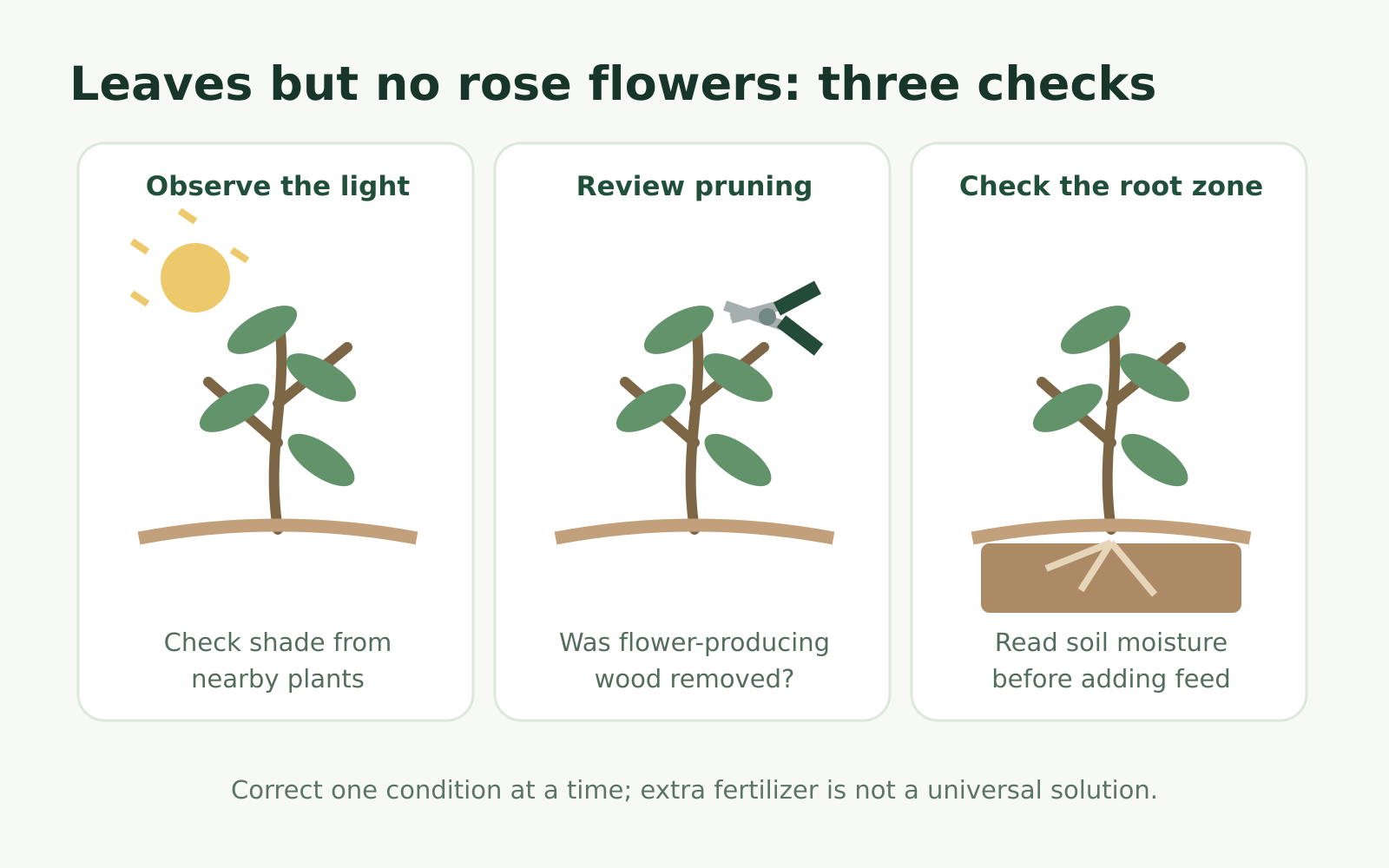
Why a rose may have leaves but no flowers
| Clue | What to check |
|---|---|
| Healthy leafy growth in shade | Light may be limiting flower production. |
| Very lush soft foliage after feeding | Excess nitrogen may be favoring vegetative growth. |
| Bloom stopped after pruning | Check whether flowering wood was removed at the wrong time. |
| One strong early flush, then no repeat | The cultivar may be once-blooming or between normal bloom cycles. |
| Distorted clustered red shoots and unusual thorns | Use the rose-rosette pathway rather than treating this as ordinary poor flowering. |
Compare the main no-bloom branches
Insufficient light
- The rose is healthy but shaded for much of the day.
- Canes stretch toward open light.
More likely if
- Nearby trees or structures reduce direct sun.
Less likely if
- The plant receives strong direct sun and still fails to bud.
Improve light where practical or consider a more suitable site at an appropriate transplanting time.
Pruning or rose-type timing
- Flowering stopped after a hard prune or the plant blooms on old wood.
- The rose is a once-blooming type.
More likely if
- The timing matches the cultivar's flowering habit.
Less likely if
- No pruning occurred and the rose is a known repeat bloomer.
Identify the rose class and adjust pruning timing rather than cutting again.
Excess nitrogen or stress
- Foliage is lush while buds are scarce, or the plant is recovering from drought, root stress, or winter damage.
- Growth is imbalanced rather than simply shaded.
More likely if
- Heavy feeding or recent stress is documented.
Less likely if
- Care is moderate and the plant is structurally healthy.
Stop unnecessary feeding, correct stress, and judge the next growth cycle.
Disease or abnormal growth
- New shoots are distorted, clustered, excessively thorny, or flowers abort.
- The plant shows dieback or systemic abnormal growth.
More likely if
- Multiple abnormal symptoms occur together.
Less likely if
- Growth is otherwise normal and only flowering is delayed.
Use the appropriate disease pathway or local diagnosis.
Checks before adding fertilizer
- Identify rose class and normal bloom schedule.
- Count hours of direct sunlight on a representative clear day.
- Review exactly when the plant was pruned and whether old canes were removed.
- Check fertilizer history and whether growth is unusually lush.
- Inspect buds and new shoots for pests, disease, or rose-rosette warning signs.
- Check root-zone moisture and drainage if the plant is broadly stressed.
Route the strongest clue
- Pruning timing is uncertain: Use the rose-pruning guide before making another major cut.When should I prune roses?
- Buds form but stay closed: Use the bud-opening pathway.Why are my rose buds not opening?
- New growth is clustered, distorted, red, and unusually thorny: Use the rose-rosette pathway.What does rose rosette disease look like?
What to do now
- Confirm the rose type and normal flowering habit.
- Improve sunlight exposure where practical without abruptly stressing an established plant.
- Pause unnecessary high-nitrogen feeding and base nutrient correction on soil or plant evidence.
- Correct drought, drainage, or disease stress before trying to force flowers.
- Delay major pruning until the rose type and flowering wood are understood.
GardenSolved checkpoint
Do not do this yet
Avoid no-bloom shortcuts
- Do not add phosphorus or 'bloom booster' simply because flowers are absent.
- Do not hard-prune an unidentified rose to force blooms.
- Do not assume a once-blooming rose should flower continuously.
- Do not ignore distorted or excessively thorny new growth.
- Do not move or heavily feed a stressed rose before checking roots and site conditions.
Confirm the likely cause first, then choose the treatment.
What improvement looks like
- Healthy new canes develop appropriate flower buds for the rose type.
- Repeat bloomers resume buds after their normal rest interval.
- Growth becomes less excessively leafy after overfeeding stops.
- A stressed rose may need a full growth cycle before flowering normalizes.
Support reliable flowering
- Plant roses where their cultivar can receive suitable direct sun and airflow.
- Keep the cultivar label and note whether it blooms on old or new wood.
- Use fertilizer only as needed and avoid excessive nitrogen.
- Prune according to rose class and flowering habit.
- Maintain even root-zone moisture and monitor disease and winter damage.
When poor flowering needs diagnosis
Seek local help when a rose remains nonflowering despite suitable light and correct pruning, or when poor bloom occurs with cane dieback, severe root stress, distorted shoots, aborted flowers, or excessive thorniness.