Roses
When should I prune roses?
The short answer
Remove dead, diseased, damaged, and crossing canes as needed with clean tools. Many repeat-flowering roses are pruned as growth begins in late winter or early spring, but once-blooming old garden roses and ramblers flower on older wood and are generally pruned after flowering. Identify the rose type before a hard cut.
There is no single pruning date or height for every rose. The correct timing depends on rose class, whether it flowers on old or new wood, climate, and whether the goal is removing dead tissue, shaping, renewal, or deadheading.
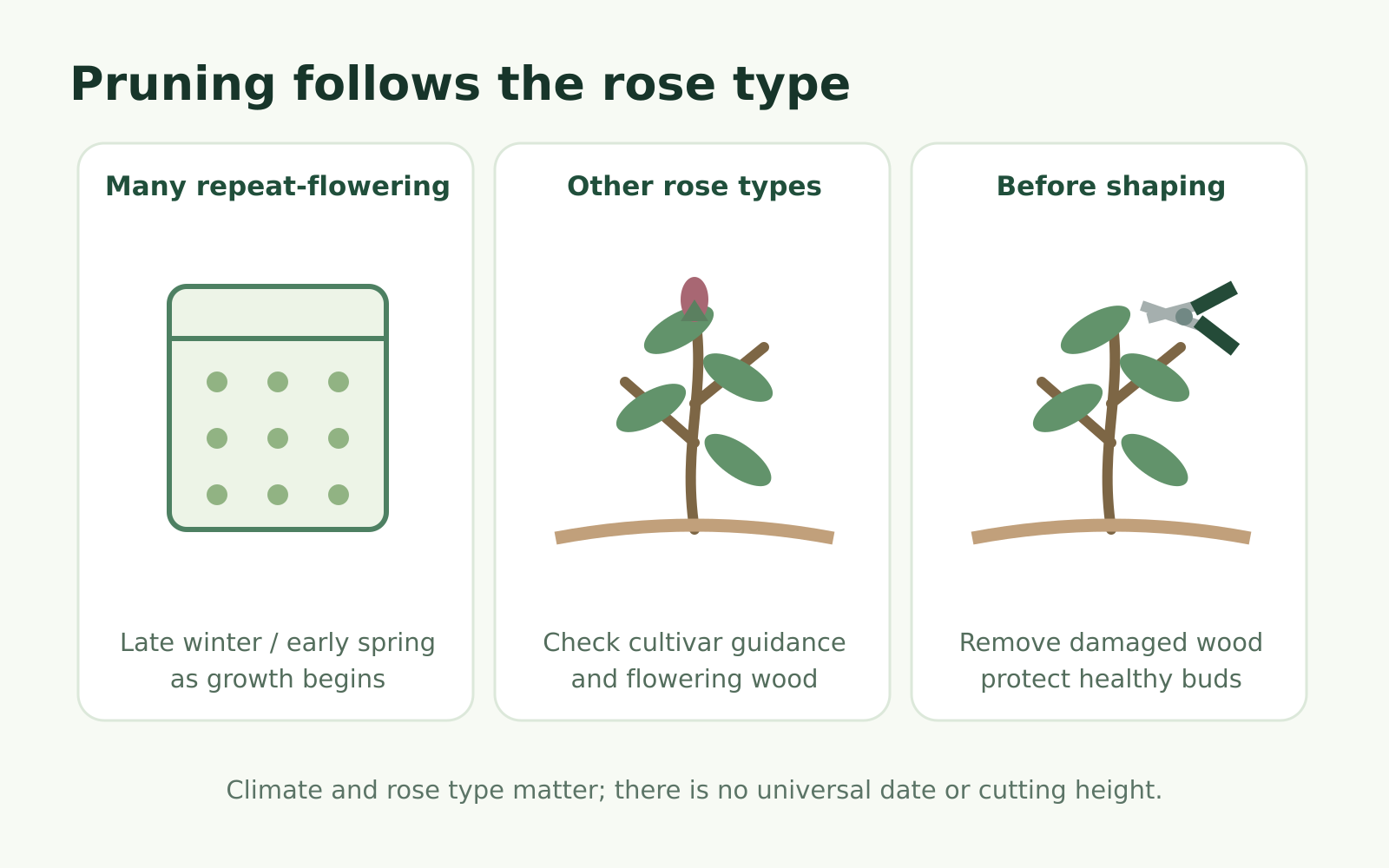
Match pruning time to rose type
| Rose or goal | General timing logic |
|---|---|
| Dead or diseased cane | Remove when identified, using clean tools and appropriate sanitation. |
| Repeat-flowering shrub or modern rose | Major shaping is commonly done as growth begins in late winter or early spring, adjusted for climate. |
| Once-blooming old garden rose | Prune after flowering so old flower-producing wood is not removed beforehand. |
| Rambler | Prune after its once-yearly flowering. |
| Repeat-blooming climber | Prune and train in early spring according to cultivar and support system. |
What kind of pruning are you doing?
Sanitation
- A cane is dead, diseased, broken, or crossing badly.
- The goal is plant health, not size.
More likely if
- Wood is clearly dead or damaged.
Less likely if
- Healthy flower-producing canes are being removed only for convenience.
Remove the affected cane with clean sharp tools and minimize unnecessary wounds.
Spring shaping or renewal
- The rose is a repeat bloomer or modern shrub type.
- The goal is opening the plant and renewing older canes.
More likely if
- The cultivar flowers on new growth.
Less likely if
- It is a once-blooming old rose or rambler before flowering.
Prune as local spring growth begins, preserving an open balanced framework.
After-flowering pruning
- The rose blooms once on old wood.
- Flowers have finished for the season.
More likely if
- It is a rambler or once-blooming old garden rose.
Less likely if
- It is a repeat-blooming climber that needs early-season training.
Thin and shape after flowering while retaining healthy renewal canes.
Checks before a hard cut
- Find the cultivar label or identify the rose class.
- Confirm once-blooming versus repeat-blooming habit.
- Look for live buds and healthy cane tissue before removing winter-damaged wood.
- Decide whether the goal is sanitation, renewal, size, training, or deadheading.
- Use clean sharp bypass pruners and plan cuts around healthy buds.
- For climbers, distinguish main structural canes from flowering laterals.
Route pruning-related problems
- The rose stopped blooming after pruning: Use the no-bloom pathway to check whether flowering wood was removed.Why is my rose bush not blooming?
- Canes show abnormal distorted red growth and excessive thorns: Use the rose-rosette pathway before ordinary pruning.What does rose rosette disease look like?
- Heavy leaf disease is driving sanitation pruning: Use the black-spot pathway for disease management too.Why do my rose leaves have black spots?
How to prune safely
- Remove dead, diseased, damaged, and crossing canes first.
- Use clean sharp tools sized for the cane.
- Make cuts just above an appropriate healthy bud without leaving long dead stubs.
- Keep an open balanced framework rather than reducing every cane to one universal height.
- For climbers and ramblers, retain and train structural canes according to flowering habit.
- Deadhead repeat bloomers only as appropriate for the rose and season.
GardenSolved checkpoint
Do not do this yet
Avoid pruning shortcuts
- Do not prune every rose on the same calendar date.
- Do not hard-prune an unidentified once-blooming rose before flowering.
- Do not remove healthy structural climbing canes as if they were hybrid-tea canes.
- Do not make large unnecessary wounds with dull tools.
- Do not assume pruning can cure systemic rose rosette disease.
Confirm the likely cause first, then choose the treatment.
What good pruning looks like afterward
- New shoots emerge from healthy retained buds.
- The canopy is open enough for light and airflow without being stripped.
- Flowering matches the cultivar's normal cycle.
- No progressive dieback develops below pruning cuts.
Make future pruning easier
- Keep the cultivar name and flowering notes.
- Remove dead and diseased wood before it becomes tangled in healthy growth.
- Train climbing canes early while they are manageable.
- Clean tools after diseased material.
- Avoid excessive fertilizer that creates weak crowded growth needing correction.
When pruning needs cultivar-specific help
Get local or cultivar-specific guidance for old garden roses, large climbers and ramblers, severe winter injury, graft complications, recurring cane dieback, or roses whose flowering habit is unknown.