Roses
Why do my rose leaves have holes?
The short answer
Inspect the newest damage and leaf undersides before spraying. Windowpane or lace-like scraping with small green larvae fits roseslug sawflies. Skeletonized leaves with large metallic green beetles fit Japanese beetles. Smooth half-moon cuts can be leafcutter bees and usually do not need control. Treat only an identified pest and preserve beneficial insects.
Rose leaf holes are often feeding damage, but the pattern matters. Roseslug sawfly larvae can create translucent windowpane patches that later become holes, Japanese beetles skeletonize tissue between veins, caterpillars make ragged bites, and old disease spots can sometimes lose dead centers.
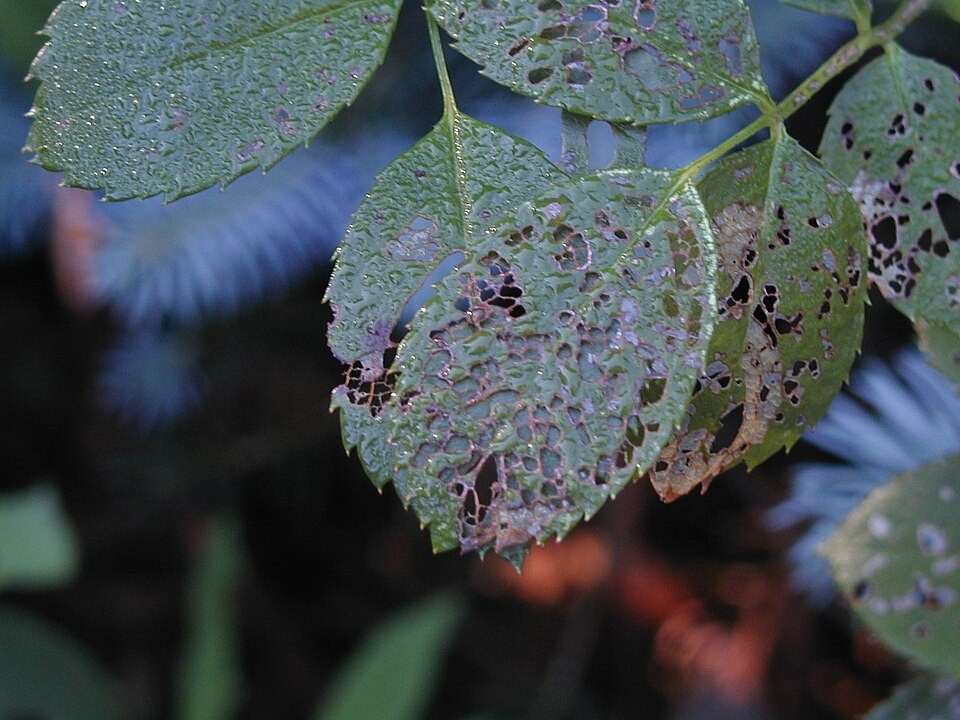

Match the hole pattern
| Damage | Best next check |
|---|---|
| Translucent windowpane patches, later brown or holed | Look under leaves for roseslug sawfly larvae. |
| Skeletonized tissue between veins | Look for Japanese beetles or rose chafers. |
| Large ragged bites | Search for caterpillars or other chewing insects. |
| Smooth half-moon cuts at leaf edges | Leafcutter bees are likely and control is usually unnecessary. |
| A dark lesion existed before the center fell out | Use the leaf-spot pathway rather than insect treatment. |
Compare the common rose leaf chewers
Roseslug sawfly
- Young larvae scrape one surface, creating windowpane damage.
- Older larvae can make open holes.
More likely if
- Small greenish larvae are on leaf undersides.
Less likely if
- Large metallic beetles are feeding between veins.
Handpick or dislodge light infestations; if control is warranted, target the identified sawfly and leaf undersides.
Japanese beetle or rose chafer
- Tissue between veins is chewed away, creating skeletonization.
- Adult beetles may also damage flowers.
More likely if
- Adult beetles are visibly feeding in groups.
Less likely if
- Only translucent surface scraping is present.
Handpick where practical and use targeted IPM rather than routine broad-spectrum spraying.
Leafcutter bee
- Clean round or half-moon sections are removed from leaf edges.
- The rest of the leaf remains healthy.
More likely if
- Cuts are smooth and repeated rather than ragged.
Less likely if
- Leaves are skeletonized or larvae are present.
Usually tolerate the cosmetic damage; leafcutter bees are pollinators.
Leaf-spot tissue loss
- A brown, tan, or purple lesion develops before the center drops out.
- No fresh chewing edge or pest is found.
More likely if
- Intact lesions remain on other leaves.
Less likely if
- Active chewers are visible.
Use the leaf-spot diagnosis instead of insecticide.
Checks before pest control
- Inspect fresh damage early in the day and check leaf undersides.
- Use a hand lens for small roseslug larvae.
- Look for adult beetles on both leaves and flowers.
- Check for frass and ragged feeding from caterpillars.
- Compare smooth leafcutter-bee cuts with irregular chewing.
- Look for intact disease lesions matching holes elsewhere on the plant.
Route the damage
- Dark lesions and yellowing appear before holes: Use the black-spot/leaf-spot pathway.Why do my rose leaves have black spots?
- Yellowing is widespread without clear chewing: Use the yellow-leaf pathway.Why are my rose leaves turning yellow?
- Heavy leaf loss follows the damage: Use the leaf-drop pathway to check disease and root stress too.Why are my rose leaves falling off?
What to do now
- Handpick visible beetles, caterpillars, or sawfly larvae when practical.
- For light sawfly infestations, remove larvae or use a forceful water spray as appropriate.
- Preserve healthy foliage; do not remove leaves only because they are cosmetically imperfect.
- Tolerate typical leafcutter-bee cuts unless another pest pattern is also present.
- If pesticide control is justified, use the least-disruptive product labeled for the identified pest and rose, and protect pollinators and beneficial insects.
GardenSolved checkpoint
Do not do this yet
Avoid leaf-hole shortcuts
- Do not spray just because a rose leaf has holes.
- Do not use caterpillar-specific Bt for sawfly larvae; sawflies are not caterpillars.
- Do not treat smooth leafcutter-bee cuts like a destructive infestation.
- Do not assume skeletonization identifies a single beetle without checking the insect.
- Do not remove most healthy foliage for cosmetic feeding damage.
Confirm the likely cause first, then choose the treatment.
What recovery looks like
- Existing holes remain but fresh leaves suffer less new damage.
- New windowpane injury stops after sawfly larvae are removed or controlled.
- Skeletonization slows when adult beetle pressure drops.
- A healthy established rose continues growing despite modest cosmetic feeding.
Reduce future damaging infestations
- Scout leaf undersides regularly during active growth.
- Catch light sawfly infestations while larvae are small.
- Handpick Japanese beetles early when practical.
- Keep roses healthy so minor feeding is easier to tolerate.
- Avoid unnecessary broad-spectrum insecticides that can reduce natural enemies.
When leaf holes need local help
Seek local help when a young rose is rapidly defoliated, damage extends strongly into flowers or stems, or fresh tissue keeps disappearing even though no chewing insect can be found.