Strawberries
Why Are My Strawberries Misshapen?
The short answer
Look at the seeds and the pattern of undeveloped tissue. Strawberry flesh expands around successfully developed achenes, so incomplete pollination can leave uneven areas. Frost-damaged flowers and tarnished plant bug feeding are important lookalikes.
Misshapen strawberries often develop when portions of a flower are not fully pollinated, but frost, tarnished plant bug feeding, disease, and other flower injury can create similar uneven berries.
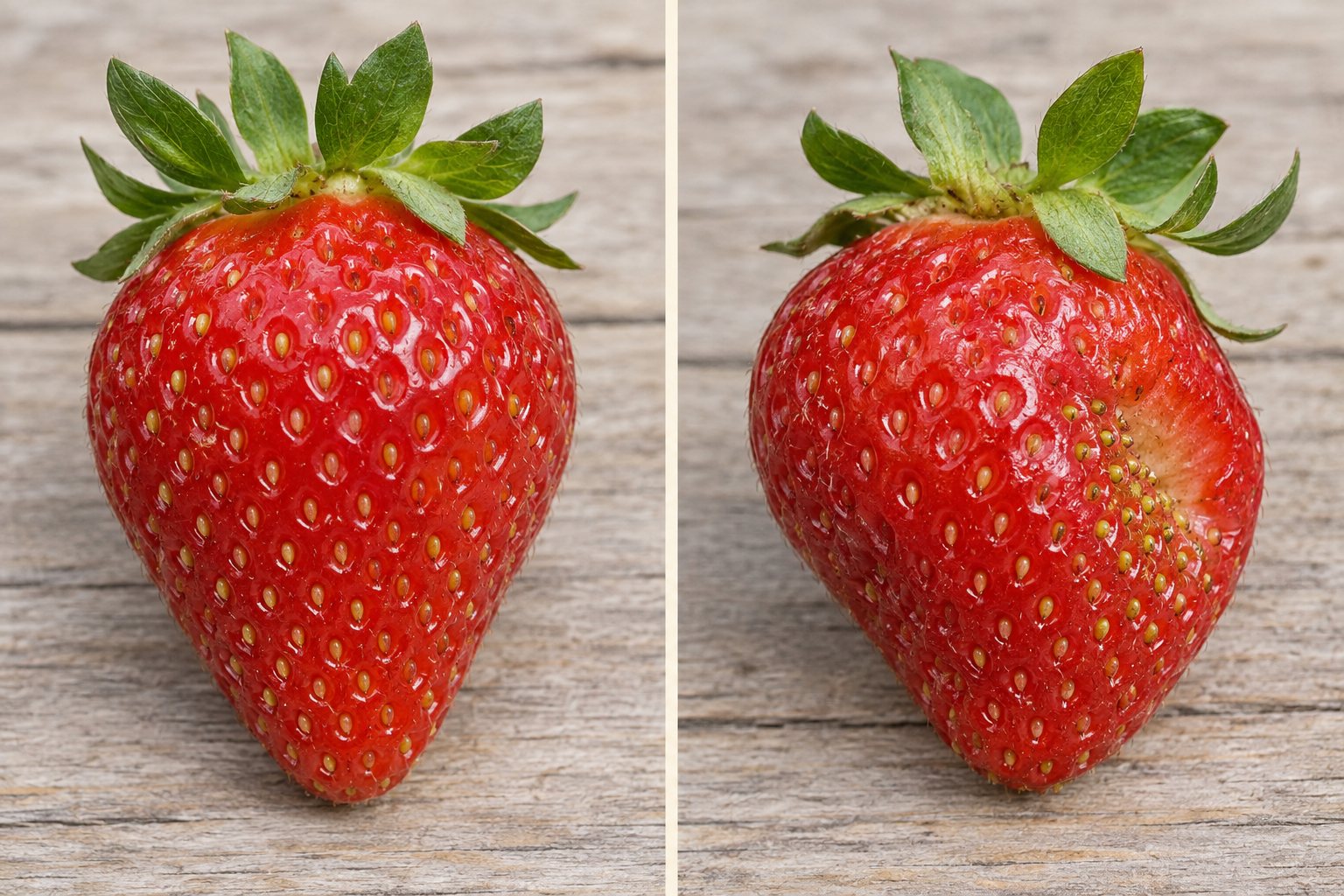
Compare the main causes of uneven berries
Incomplete pollination
- Fruit expansion is uneven around poorly developed seed areas.
- Weather or limited insect activity reduced pollen transfer.
Protect pollinator access during future bloom.
Frost injury
- Open flowers were exposed to freezing temperatures.
- The same bloom period produced damaged centers or poor fruit set.
Use local frost-protection guidance for future flowers.
Tarnished plant bug
- Young fruit develops characteristic feeding-related deformation.
- Plant bugs or nymphs are found around bloom and young fruit.
Confirm the pest before selecting control.
Disease or flower injury
- Flowers or fruit also show powdery growth, lesions, rot, or other abnormal tissue.
Diagnose the visible disease pattern separately.
How to confirm the problem
- Review weather and pollinator activity during the specific bloom that produced the affected fruit.
- Compare several berries rather than using one unusual fruit as proof of a cause.
- Inspect young fruit and flowers for plant bugs or other feeding damage.
Reduce repeat deformation
- Keep row covers off once flowering begins when pollinator access is needed.
- Avoid insecticide exposure to bees during bloom and follow every product label.
- Protect blossoms from damaging frost where practical.
- Scout flowers and young fruit for plant bugs rather than waiting until harvest.
GardenSolved checkpoint
Do not do this yet
Do not overdiagnose one odd berry
- Do not assume a misshapen fruit proves nutrient deficiency.
- Do not label every uneven berry as insect damage without finding the pest or feeding pattern.
- Do not expect an already misshapen berry to become symmetrical later.
Confirm the likely cause first, then choose the treatment.
What improvement to look for
- Already deformed berries will not reshape into symmetrical fruit.
- Compare berries from later bloom periods after correcting the cause.
How to reduce repeat problems
- Scout flowers and young fruit for feeding pests.
- Protect pollinator access and prepare for bloom-time frost.
Which check comes next?
- Flowers fail to set any fruit: Inspect flower centers and pollinator access.Why Are My Strawberry Plants Flowering but Not Fruiting?
- Normally shaped berries are also small: Compare cultivar, crowding and plant vigor.Why Are My Strawberries So Small?
When to investigate further
Escalate when deformity is widespread across multiple bloom periods or appears with broader plant decline or disease signs.