Christmas cactus
Why is my Christmas cactus turning red or purple?
The short answer
New Christmas cactus segments can appear reddish without being diseased. If older segments change colour, compare recent strong light, temperature changes, watering and root condition. Stress can accompany reddening, but red or purple alone does not prove sunburn or a nutrient deficiency. Check firmness and the pattern before moving the plant or adding fertilizer.
Start with the age and firmness of the coloured tissue. A small red new segment is not the same observation as older stems becoming purple after a change of position.
Diagnostic snapshot
What to check before you act
What you are seeing
- Small developing tips; older segments and base firm
- Colour appeared after brighter placement, possibly with bleaching or dry damage
Check first
Photograph tips and older stems in neutral daylight. Note whether only new small segments are red or whether previously green mature segments changed; compare exposed and shaded sides.
Compare first
- Reddish new growth
- Change on older exposed stems
- Colour plus loss of firmness
Hold off for now
Do not apply magnesium, Epsom salts or a high fertilizer dose solely for red or purple stems.
Investigate further if
Investigate spreading lesions, collapsing segments, a soft base or continued decline despite suitable conditions. For persistent colour changes with poor growth, seek a review of roots, growing conditions and feeding history. Colour alone cannot identify a pathogen or establish the nutrient that is missing.
Photograph this before you act
- Photograph the whole plant and its growing area so the overall pattern is visible.
- Take one close-up of the clearest symptom and one wider view that shows the surrounding area for comparison.

Next best check
Check two visible clues before you act.
This mini-check narrows the match using the same canonical diagnostic clues as this answer. It does not confirm a diagnosis from one or two clicks, and it does not make a photo-only diagnosis.
Two quick observations can tell you whether to keep reading this diagnosis closely or compare other possibilities first.
Red new tips or a change in mature stems?
Reddish new growth
- Small developing tips; older segments and base firm
Less likely if
- Previously green mature segments also change colour or lose firmness.
Observe development without treating the colour as disease.
Change on older exposed stems
- Colour appeared after brighter placement, possibly with bleaching or dry damage
Less likely if
- Colour is confined to firm new tips, without a change in the light exposure.
Reduce harsh direct exposure and compare shaded growth.
Colour plus loss of firmness
- Older stems change colour while mix remains wet or very dry
Less likely if
- Stems remain firm and only small new segments are reddish.
Use moisture and root checks; colour does not establish the cause.
Safe confirmation checks
- Photograph tips and older stems in neutral daylight. Note whether only new small segments are red or whether previously green mature segments changed; compare exposed and shaded sides.
- Record recent moves and light or temperature changes. Check moisture below the surface, drainage and basal firmness. Do not infer a specific deficiency from a photograph or from red colour alone.
Respond to the pattern, not colour alone
- If the colour is limited to firm new growth, keep suitable care and watch the new segments develop. Aerial roots can also occur; they do not by themselves establish disease or starvation.
- If older exposed tissue changed after strong sun, move out of harsh direct rays into bright indirect light. Avoid replacing excess sun with deep darkness or exposing the plant to cold drafts.
- If stems are also limp, choose the dry- or wet-root branch before changing nutrition. Correct the observed problem rather than adding several remedies at once.
GardenSolved checkpoint
Do not do this yet
- Do not apply magnesium, Epsom salts or a high fertilizer dose solely for red or purple stems.
- Do not cut off firm reddish new segments solely because of their colour; first compare their age, firmness and subsequent growth.
Confirm the likely cause first, then choose the treatment.
Judge new growth, not an instant return to green
- Keep photos in comparable daylight and check whether additional mature segments change or new growth stays firm. Old injured tissue may remain discoloured; lack of an immediate return to green is not a reason to add another remedy.
- A soft base, spreading lesions or worsening wilt changes the priority to root and tissue assessment. Do not keep treating colour as a stand-alone light or fertilizer problem.
Context and follow-up
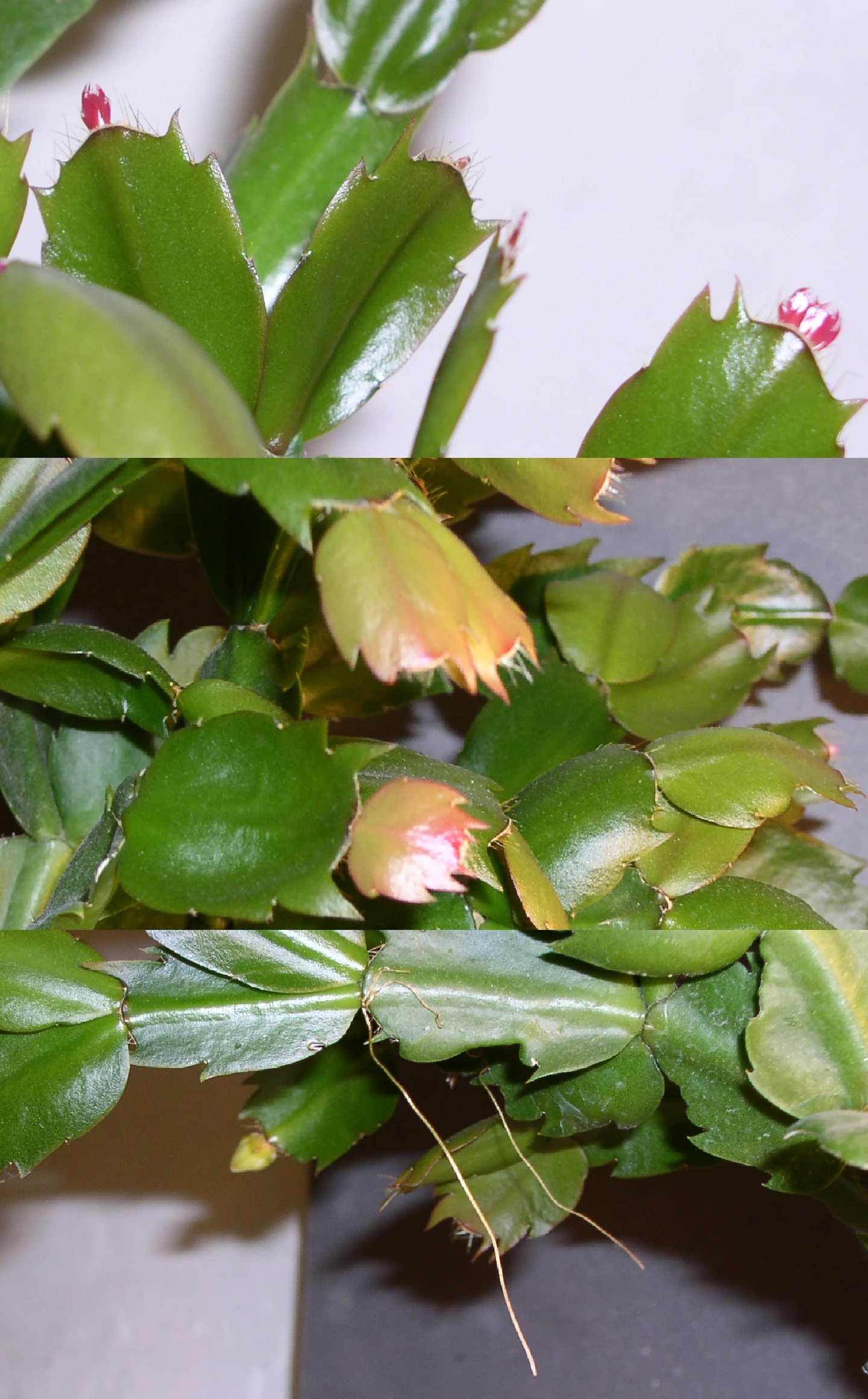
UC's horticultural guidance links redness with stress including strong sun and overwatering. This supports checking those conditions, not asserting that every red segment has that cause. The photographs of new growth document a separate, potentially normal appearance.
Do not confuse a red flower bud with a new flat stem segment. Cultivar and developmental variation matter, and no photograph here establishes the cause of redness on another plant.
When to seek more help
Investigate spreading lesions, collapsing segments, a soft base or continued decline despite suitable conditions. For persistent colour changes with poor growth, seek a review of roots, growing conditions and feeding history. Colour alone cannot identify a pathogen or establish the nutrient that is missing.
Follow the next useful clue
- Coloured segments also lose firmness: Check moisture before watering.Why is my Christmas cactus limp and wrinkled?
- The base is soft or tissue is collapsing: Assess root-health warning signs.Does my Christmas cactus have root rot, and can it be saved?
Consulted horticultural sources
Save & recheck
Compare what changes before changing course.
Save this diagnosis only in this browser, then come back and compare the same clues. No account, reminder subscription, or server-stored diagnostic record is created.
Your baseline
- Small developing tips; older segments and base firm
- Colour appeared after brighter placement, possibly with bleaching or dry damage
Check again when you return
- Photograph tips and older stems in neutral daylight. Note whether only new small segments are red or whether previously green mature segments changed; compare exposed and shaded sides.
- Record recent moves and light or temperature changes. Check moisture below the surface, drainage and basal firmness. Do not infer a specific deficiency from a photograph or from red colour alone.
Tip: photograph the same area from a similar angle so the visible pattern is easier to compare.
Related questions
Diagnostic Finder
Still not sure this answer fits?
Open the Diagnostic Finder with the relevant growing subject or care context preselected and compare other published GardenSolved diagnoses.
Compare other possibilities