Christmas cactus
Why are my Christmas cactus segments falling off?
The short answer
Identify the fallen part and inspect its point of separation. A firm green segment after a knock suggests a different problem from repeated shedding with soft tissue or wet-root wilt. Large old branches can also break under their weight. Check the remaining base and pot before watering, pruning or trying to propagate every fallen piece.
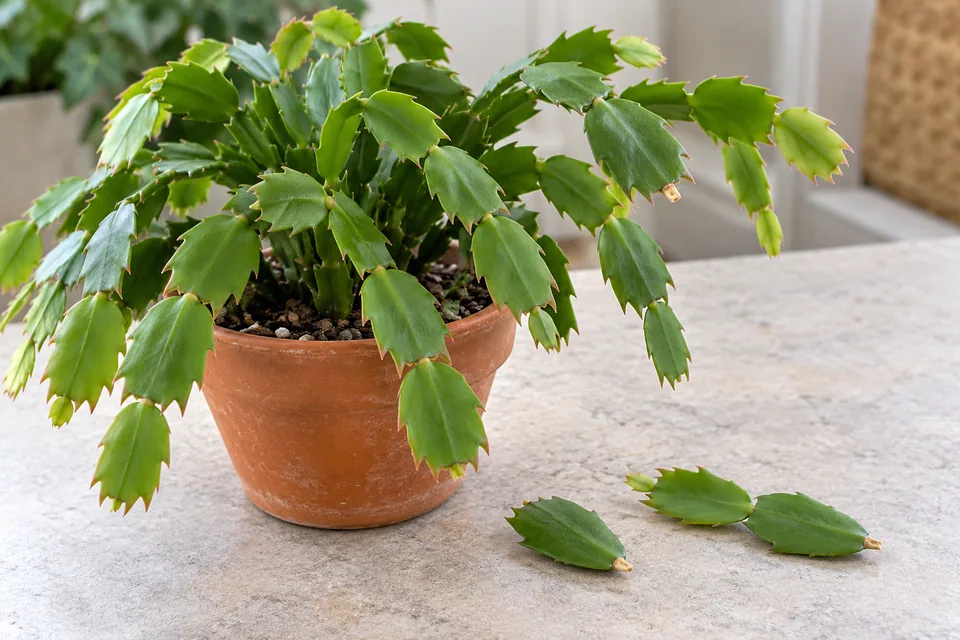
The flat parts often called leaves are stem segments. Determine whether one joint broke after handling or whether several branches are declining and detaching.
Diagnostic snapshot
What to check before you act
What you are seeing
- Firm green piece detached after handling; remaining joint stable
- Large branch broke while other growth stays firm
Check first
Place an already detached piece beside the plant and identify whether it is a flat stem, a bud or a finished flower. Photograph the break; do not pull more segments off to test the joints.
Compare first
- Single fresh break
- Heavy mature branch
- Repeated losses with deterioration
Hold off for now
Do not tug on healthy joints, remove all hanging branches or diagnose rot from a clean break alone.
Investigate further if
Seek further diagnosis when several branches collapse, the base becomes soft, or segment loss continues without a clear handling event. Preserve photos of the plant and detached tissue. If pest signs accompany the damage, obtain identification before applying a general spray.
Photograph this before you act
- Photograph the whole plant and its growing area so the overall pattern is visible.
- Take one close-up of the clearest symptom and one wider view that shows the surrounding area for comparison.
Next best check
Check two visible clues before you act.
This mini-check narrows the match using the same canonical diagnostic clues as this answer. It does not confirm a diagnosis from one or two clicks, and it does not make a photo-only diagnosis.
Two quick observations can tell you whether to keep reading this diagnosis closely or compare other possibilities first.
A mechanical break or repeated segment loss?
Single fresh break
- Firm green piece detached after handling; remaining joint stable
Less likely if
- More segments detach without handling, or nearby joints become soft.
Protect the branch and watch for further losses.
Heavy mature branch
- Large branch broke while other growth stays firm
Less likely if
- A small young plant sheds several individual segments without heavy branches.
Reduce handling and consider careful pruning after flowering.
Repeated losses with deterioration
- Several joints soften or collapse; mix may stay wet
Less likely if
- One clean break followed a known knock, while the remaining plant stays firm.
Assess root and basal health before attempting propagation.
Safe confirmation checks
- Place an already detached piece beside the plant and identify whether it is a flat stem, a bud or a finished flower. Photograph the break; do not pull more segments off to test the joints.
- Inspect the remaining base and nearby joints for firm versus soft tissue. Record handling, pets, branch weight and the recent moisture history; check for hidden water inside the decorative pot.
Protect sound growth and assess the parent plant
- After an isolated mechanical break, steady the pot and stop catching or bending the remaining branches. Observe whether losses stop without changing the whole care routine.
- If branches are large and sound, plan limited shaping after flowering rather than stripping the plant during bud development. A heavy branch is a mechanical clue, not proof that every fallen piece is normal.
- If repeated loss accompanies wilt or soft basal tissue, isolate the suspect material and investigate roots and drainage. Discard deteriorating pieces rather than treating all detached tissue as propagation stock.
- A firm, unblemished detached piece may be suitable for a separate propagation attempt. Let the cut surface dry and use clean, well-draining propagation media; rooting is not guaranteed, and taking cuttings does not cure the parent plant.
GardenSolved checkpoint
Do not do this yet
- Do not tug on healthy joints, remove all hanging branches or diagnose rot from a clean break alone.
- Do not propagate soft, discoloured or deteriorating segments alongside healthy plants; first assess the parent plant.
Confirm the likely cause first, then choose the treatment.
Check whether fresh losses stop
- After correcting an obvious handling problem, leave sound joints alone and record any newly fallen pieces. No further loss with a firm base supports the mechanical explanation; it does not prove that every detached piece is healthy.
- Continued shedding, soft joints or basal collapse calls for root-health assessment. Rooting a separate cutting does not establish recovery of the parent plant.
Context and follow-up
Minnesota describes branch drop associated with excessive branch weight on large plants. This is one alternative, not a diagnosis for a young plant losing segments repeatedly.
A deliberately removed propagation cutting shows a procedure, not spontaneous shedding. Record how a detached piece came away before using it to explain the remaining plant's condition.
When to seek more help
Seek further diagnosis when several branches collapse, the base becomes soft, or segment loss continues without a clear handling event. Preserve photos of the plant and detached tissue. If pest signs accompany the damage, obtain identification before applying a general spray.
Follow the next useful clue
- What fell was an unopened flower bud: Use the bud-loss pathway.Why is my Christmas cactus dropping buds?
- Loss accompanies wet-root wilt or a soft base: Assess deterioration before saving cuttings.Does my Christmas cactus have root rot, and can it be saved?
- The remaining stems are wrinkled: Compare root-zone conditions.Why is my Christmas cactus limp and wrinkled?
Consulted horticultural sources
Save & recheck
Compare what changes before changing course.
Save this diagnosis only in this browser, then come back and compare the same clues. No account, reminder subscription, or server-stored diagnostic record is created.
Your baseline
- Firm green piece detached after handling; remaining joint stable
- Large branch broke while other growth stays firm
Check again when you return
- Place an already detached piece beside the plant and identify whether it is a flat stem, a bud or a finished flower. Photograph the break; do not pull more segments off to test the joints.
- Inspect the remaining base and nearby joints for firm versus soft tissue. Record handling, pets, branch weight and the recent moisture history; check for hidden water inside the decorative pot.
Tip: photograph the same area from a similar angle so the visible pattern is easier to compare.
Related questions
Diagnostic Finder
Still not sure this answer fits?
Open the Diagnostic Finder with the relevant growing subject or care context preselected and compare other published GardenSolved diagnoses.
Compare other possibilities