Phalaenopsis
Why Are My Phalaenopsis Orchid Leaves Turning Yellow?
The short answer
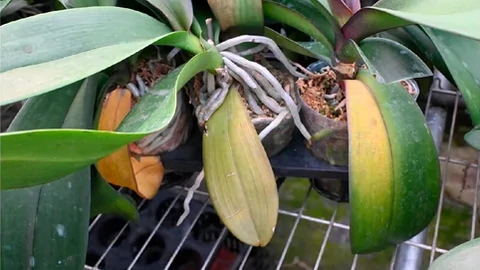
Start with which leaf is changing and how quickly. Gradual yellowing of an oldest lower leaf can accompany ageing; several leaves changing or new growth declining requires investigation.
The position, texture and speed of yellowing matter more than yellow colour by itself. Compare an ageing lower leaf with wider decline before changing care.
Diagnostic snapshot
What to check before you act
What you are seeing
- One oldest lower leaf changes gradually
- Several leaves change with poor roots
Check first
Record the affected leaf positions and photograph progress instead of judging a single moment.
Hold off for now
Do not pull off a partly living leaf.
Investigate further if
Rapidly spreading soft or wet areas, crown involvement or loss of several leaves needs prompt help.
Photograph this before you act
- Photograph the whole plant and its growing area so the overall pattern is visible.
- Take a sharp close-up of the affected leaf and a second photo of the underside.
Next best check
Check two visible clues before you act.
This mini-check narrows the match using the same canonical diagnostic clues as this answer. It does not confirm a diagnosis from one or two clicks, and it does not make a photo-only diagnosis.
Two quick observations can tell you whether to keep reading this diagnosis closely or compare other possibilities first.
Choose the situation that fits
| What you see | What it may mean | Next useful step |
|---|---|---|
| One oldest lower leaf changes gradually | Ageing is possible | Check that the rest of the plant remains stable |
| Several leaves change with poor roots | A wider supply problem may be involved | Inspect roots and medium |
| Rapid yellowing with wet or soft tissue | Active deterioration needs prompt assessment | Separate and seek help |
Check before changing care
- Record the affected leaf positions and photograph progress instead of judging a single moment.
- Inspect the roots and medium, and check recent changes in light and temperature.
What to do now
- Keep care steady if normal ageing is the best fit.
- Investigate drainage and roots when multiple leaves deteriorate.
- Correct a demonstrated environmental problem before adding treatment.
GardenSolved checkpoint
Do not do this yet
- Do not pull off a partly living leaf.
- Do not add Epsom salts or apply a disease treatment because the leaf is yellow.
Confirm the likely cause first, then choose the treatment.
Why the distinction matters
One old lower leaf with otherwise stable growth differs from widespread yellowing with damaged roots. Localised damage after changed exposure needs its own assessment. Colour alone does not prove a nutrient deficiency or infection.
When to ask for help
Rapidly spreading soft or wet areas, crown involvement or loss of several leaves needs prompt help.
Choose your next step
Sources and linked claims
Save & recheck
Compare what changes before changing course.
Save this diagnosis only in this browser, then come back and compare the same clues. No account, reminder subscription, or server-stored diagnostic record is created.
Your baseline
- One oldest lower leaf changes gradually
- Several leaves change with poor roots
Check again when you return
- Record the affected leaf positions and photograph progress instead of judging a single moment.
- Inspect the roots and medium, and check recent changes in light and temperature.
Tip: photograph the same area from a similar angle so the visible pattern is easier to compare.
Related questions
Diagnostic Finder
Still not sure this answer fits?
Open the Diagnostic Finder with the relevant growing subject or care context preselected and compare other published GardenSolved diagnoses.
Compare other possibilities