Cucumbers
How to Trellis Cucumbers
The short answer
Choose a stable frame and reachable mesh or strings, anchor it before planting or while vines are short, place it where neither wind nor fruit load can overturn it, and guide flexible shoots without forcing them. Let tendrils grip where they can; if ties are needed, use soft loose loops that cannot constrict the stem.
Trellising can keep vining cucumbers manageable and fruit off wet soil, but the support must suit the cultivar, site, wind, container or bed, and expected load. Compact bush types or exposed sites may not benefit from the same system.
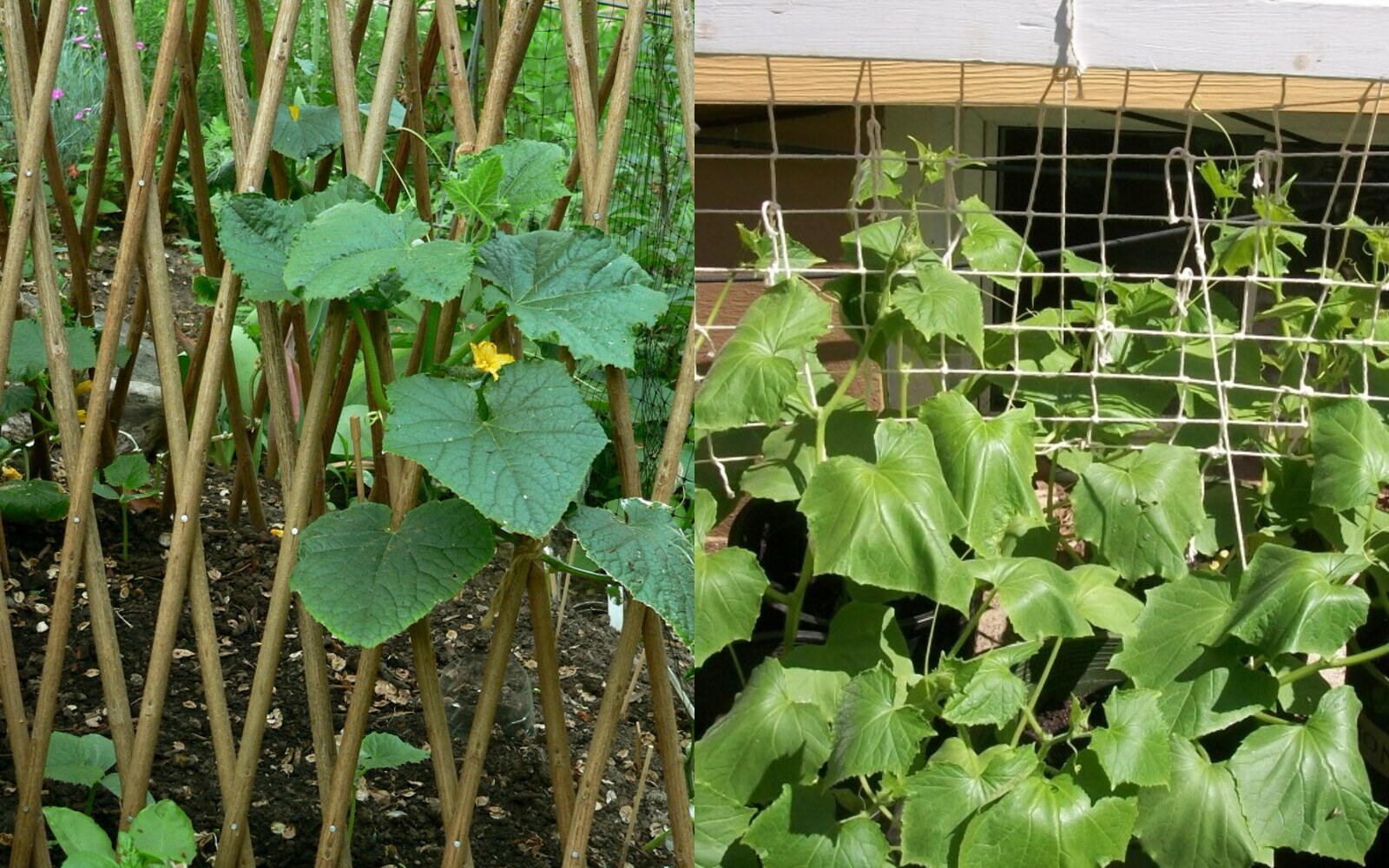

Choose the support from the site and vine
| Support choice | Best-use checks |
|---|---|
| Rigid panel or fence | Useful where posts or the existing structure are sound, openings are reachable, and attachment will not damage the fence or vine. |
| A-frame or angled lattice | Can widen the base and make hanging fruit accessible; both sides and all joints still need firm anchoring. |
| Netting or strings on a frame | Lightweight and easy for tendrils to reach, but only if the frame, top line, material, and attachments can resist sagging and load. |
| Container-integrated support | Use only when the pot and base remain stable as foliage catches wind; otherwise anchor support independently. |
| No trellis | Reasonable for some compact bush cultivars, deliberate ground-spreading layouts, or sites where no support can be secured safely. |
Checks before deciding what to do
- Push and pull the empty support from several directions before training vines; movement at the base needs correction first.
- Trace each intended vine route and confirm that mesh openings, ties, and harvest access will not trap stems or fruit.
Install and train without damaging the vine
- Set posts, frame, feet, or guying before long vines make the work hazardous; avoid driving anchors through an established root zone.
- Test the base, joints, mesh, and attachment points from several directions before adding the vine.
- Guide a young flexible shoot toward the support and place tendrils against mesh or string; never sharply bend or weave a stiff stem.
- Where a tie is necessary, make a loose figure-eight or similarly non-constricting loop with soft material, leaving room for stem growth and movement.
- Recheck ties, sag, anchors, abrasion points, wind movement, and fruit load throughout the season; loosen, redirect, or reinforce before damage develops.
Keep support, spacing, and container decisions separate
- Support changes the plant footprint or row layout: Use the spacing owner for plant-center and access decisions.How Much Space Do Cucumber Plants Need?
- The trellis stands in or beside a pot: Return to the container-system owner for stability, drainage, medium, and care.How to Grow Cucumbers in Containers
Airflow context is not a disease promise
A supported canopy can make leaves and fruit easier to inspect and can reduce contact with wet soil, but trellising does not guarantee disease prevention or yield.
If white powder-like growth or angular lesions with underside growth are already present, use the powdery- or downy-mildew specialist rather than treating support as a cure.
Route an existing leaf pattern
- White powder-like growth is the dominant sign: Use the powdery-mildew owner.Powdery Mildew on Cucumbers
- Angular yellow lesions and underside growth are present: Use the downy-mildew owner.Downy Mildew on Cucumbers
GardenSolved checkpoint
Do not do this yet
Avoid common trellis failures
- Do not rely on a weak base, loose joint, damaged mesh, or unsupported top line.
- Do not install through mature roots or tangled vines when early installation was possible.
- Do not cinch wire, plastic, or cord tightly around a growing stem.
- Do not force brittle vines or leave heavy fruit pulling on one attachment point.
- Do not copy one height, dimension, product ranking, or load rating as universal.
Confirm the likely cause first, then choose the treatment.
When another assessment is needed
Choose a different system or local structural advice when the site is highly exposed, the support cannot be anchored safely, or the mature load is unknown and could fall onto people or property.