Garlic
Why is my garlic not sprouting?
The short answer
No visible garlic shoot does not automatically mean the clove has failed. Autumn-planted garlic may establish below ground and emerge later. Compare planting date, soil temperature and drainage with nearby cloves of the same variety. Rotten cloves, persistent gaps after comparable plants emerge, or weak yellow seedlings need a closer establishment check.
Garlic can be making roots while the soil surface still looks empty. Start with the planting record and conditions, rather than digging up a whole row to look for shoots.
Diagnostic snapshot
What to check before you act
What you are seeing
- No above-ground shoot at a marked planting position
- An uneven stand after nearby cloves of the same planting emerge
Check first
Compare only plants with a similar planting date, cultivar and site. Mark the row and photograph the surface; an unmarked empty space may simply be a different planting position.
Compare first
- Seasonal delay
- Wet-site establishment problem
- Clove deterioration
Hold off for now
Do not excavate every healthy planting position or pull on an emerging shoot to check roots.
Investigate further if
Seek local advice when the appropriate emergence window has passed and comparable plants are growing, or when gaps accompany rotting cloves or weak yellow seedlings. Photograph the row pattern and any already failed material; ask a diagnostic service how to collect a sample.
Photograph this before you act
- Photograph the soil surface and root-zone or container context; do not disturb roots just to take a photo.
- Take one close-up of the clearest symptom and one wider view that shows the surrounding area for comparison.
Recommended diagnostic check
Environmental Stress Checker
Does the timing or exposure fit environmental stress?
Compare the symptom pattern with recent growing conditions before treating a lookalike as disease, pests, nutrient deficiency, or a watering problem.
First check
Compare only plants with a similar planting date, cultivar and site. Mark the row and photograph the surface; an unmarked empty space may simply be a different planting position.
Timing / exposure boundary
Check moisture beside the planting zone without probing the clove. Look for pooling, a crust or disturbance by birds. If uncertainty persists after the local emergence window, seek advice before sacrificing healthy plants for inspection.
Timing and exposure can support an environmental branch, but they do not rule out other causes. Use the factor labels and boundary above as clues, not as a diagnosis.
Match the situation before acting
Seasonal delay
- Cool soil, intact planting record and no collapse in neighboring plants
Observe through the locally expected emergence period.
Wet-site establishment problem
- Persistent saturation and gaps concentrated in the wettest patch
Correct drainage before adding water or new cloves.
Clove deterioration
- An already failed or exposed clove is soft, discolored or moldy
Keep suspect material separate and investigate stock and soil history.
Safe checks before acting
- Compare only plants with a similar planting date, cultivar and site. Mark the row and photograph the surface; an unmarked empty space may simply be a different planting position.
- Check moisture beside the planting zone without probing the clove. Look for pooling, a crust or disturbance by birds. If uncertainty persists after the local emergence window, seek advice before sacrificing healthy plants for inspection.
What to do next
- Wait when local conditions still favor root growth or dormancy and comparable cloves have not emerged. There is no reliable worldwide day count from planting to visible shoot.
- Keep the planting zone moist enough for establishment but freely draining. Do not water an empty-looking bed that is already saturated.
- Gently correct a surface obstruction without tearing a shoot. Protect exposed newly planted cloves from disturbance using a suitable cover that does not trap them.
- If a clove is already loose, exposed or clearly collapsed, document its condition and isolate it. Blue-green growth or decay is a reason to investigate, not to plant replacement cloves immediately into the same wet pocket.
GardenSolved checkpoint
Do not do this yet
- Do not excavate every healthy planting position or pull on an emerging shoot to check roots.
- Do not apply fertilizer or fungicide as a sprouting treatment before checking temperature, drainage and planting-stock history.
Confirm the likely cause first, then choose the treatment.
Scope and follow-up
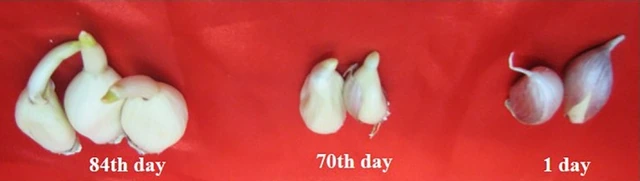
The photographed study compares internal bud development in stored cloves, not failed garden plantings. Its day labels are not an emergence deadline or a reason to cut healthy cloves. A surface photograph alone cannot establish why a marked planting has no shoot.
A clove is vegetative planting material, not a seed waiting to germinate. Autumn roots and spring shoots can be separated by a long cold period. A fixed two-week deadline would wrongly condemn many healthy plantings.
If shoots appeared and then died, this is no longer simply delayed emergence. Record the weather and whether the neck is firm, damaged or decaying before choosing the wilt pathway.
When to get more help
Seek local advice when the appropriate emergence window has passed and comparable plants are growing, or when gaps accompany rotting cloves or weak yellow seedlings. Photograph the row pattern and any already failed material; ask a diagnostic service how to collect a sample.
Follow the next useful clue
- The planting window or variety was uncertain: Check whether the original timing suited your region.When should I plant garlic?
- Healthy green shoots are already present in autumn: Use the winter-establishment answer instead.My garlic sprouted before winter: is that a problem?
Consulted horticultural sources
Save & recheck
Compare what changes before changing course.
Save this diagnosis only in this browser, then come back and compare the same clues. No account, reminder subscription, or server-stored diagnostic record is created.
Your baseline
- No above-ground shoot at a marked planting position
- An uneven stand after nearby cloves of the same planting emerge
Check again when you return
- Compare only plants with a similar planting date, cultivar and site. Mark the row and photograph the surface; an unmarked empty space may simply be a different planting position.
- Check moisture beside the planting zone without probing the clove. Look for pooling, a crust or disturbance by birds. If uncertainty persists after the local emergence window, seek advice before sacrificing healthy plants for inspection.
Tip: photograph the same area from a similar angle so the visible pattern is easier to compare.
Related questions
Diagnostic Finder
Still not sure this answer fits?
Open the Diagnostic Finder with the relevant growing subject or care context preselected and compare other published GardenSolved diagnoses.
Compare other possibilities