Garlic
When should I plant garlic?
The short answer
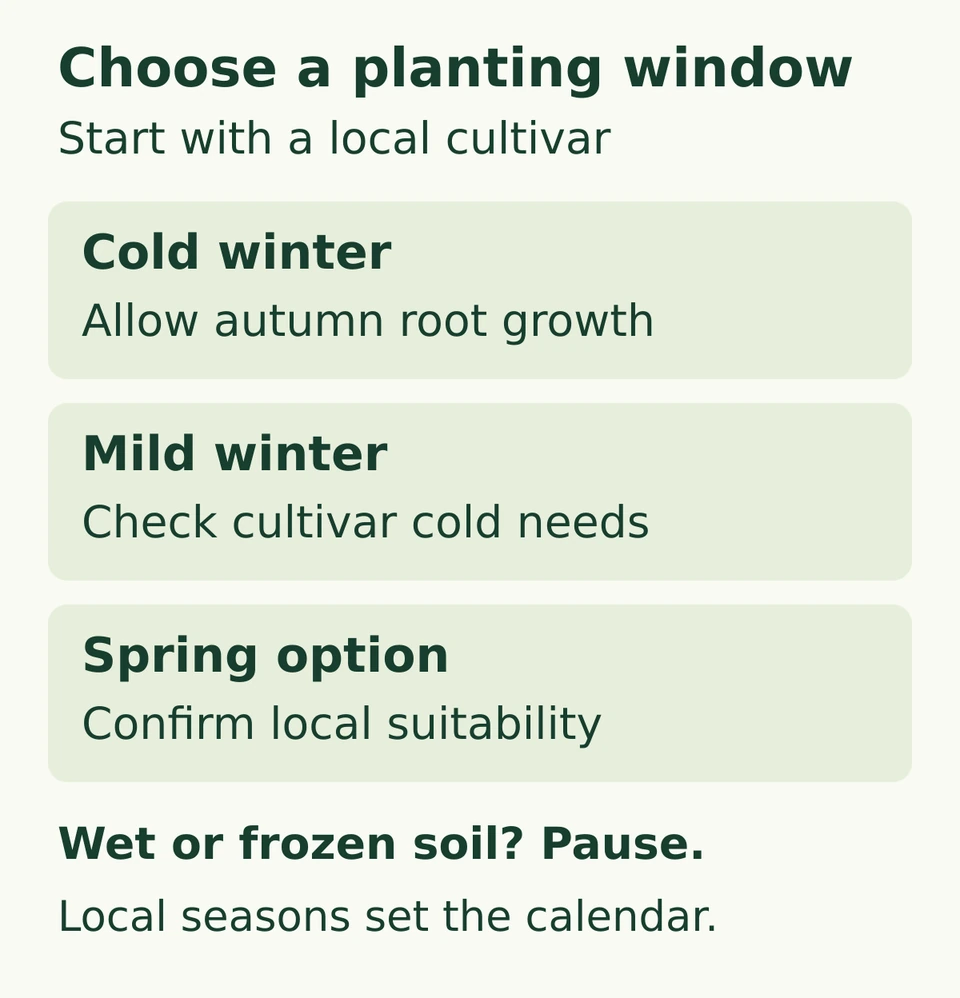
Plant a locally suitable garlic variety in its recommended autumn or spring window. In cold-winter areas, autumn planting usually lets roots establish before sustained freezing. Some varieties suit spring planting. Check the supplier's guidance and your soil before using a calendar date; warm climates and the southern hemisphere need their own local schedule.
The useful question is whether your cloves can establish in draining soil and receive the conditions their variety needs. A date copied from another climate cannot answer that.
Diagnostic snapshot
What to check before you act
What you are seeing
- Unplanted cloves and a known or unknown garlic variety
- Ground cooling, already frozen or remaining wet
Check first
Read the variety label: record hardneck or softneck, the recommended local planting season and any pre-chilling instructions. If those are missing, ask the planting-stock supplier before buying more.
Compare first
- Cold-winter autumn planting
- Mild-winter or spring option
- Wet, compacted or frozen bed
Hold off for now
Do not copy a northern-hemisphere October date into an Australian plan; confirm your local season.
Investigate further if
Ask a local growing adviser or supplier if the cultivar is unknown, the normal window has passed, or persistent winter waterlogging leaves no suitable planting site. A spring planting may give smaller bulbs, not necessarily a failed crop.
Photograph this before you act
- Photograph the soil surface and root-zone or container context; do not disturb roots just to take a photo.
- Take one close-up of the clearest symptom and one wider view that shows the surrounding area for comparison.
Next best check
Check two visible clues before you act.
This mini-check narrows the match using the same canonical diagnostic clues as this answer. It does not confirm a diagnosis from one or two clicks, and it does not make a photo-only diagnosis.
Two quick observations can tell you whether to keep reading this diagnosis closely or compare other possibilities first.
Match the situation before acting
Cold-winter autumn planting
- Locally adapted cloves; workable soil before prolonged freezing
Use regional frost guidance rather than a fixed worldwide month.
Mild-winter or spring option
- Supplier identifies a cultivar suitable for that planting season
Confirm its chilling and local bulbing requirements first.
Wet, compacted or frozen bed
- Water persists or the soil cannot be worked without damage
Prepare a draining alternative; forcing cloves into wet ground is not a timing solution.
Safe checks before acting
- Read the variety label: record hardneck or softneck, the recommended local planting season and any pre-chilling instructions. If those are missing, ask the planting-stock supplier before buying more.
- Inspect the intended bed after rain. Check a small unplanted patch below the surface for persistent saturation and whether the soil crumbles rather than smearing; do not dig over frozen or waterlogged soil.
What to do next
- Choose firm planting stock from a reputable supplier, suited to the region. A supermarket bulb's appearance does not establish variety suitability or disease status.
- Use local Extension or horticultural guidance to choose the window. Minnesota's frost-based advice and the RHS autumn-to-early-winter guidance describe different climates; neither is a universal deadline.
- Separate cloves shortly before planting, retain the protective skins and place them point upward. For a UK example, RHS spaces cloves 15 cm apart, with the pointed tip about 2.5 cm below the surface and rows 30 cm apart. Colder-climate guidance may use deeper planting and measure from the clove base instead: follow the local method and record its reference point, date and cultivar.
- If a heavy bed stays wet, consider an appropriate draining container or protected modules rather than repeatedly missing the window while waiting for that bed to improve.
GardenSolved checkpoint
Do not do this yet
- Do not copy a northern-hemisphere October date into an Australian plan; confirm your local season.
- Do not improvise a refrigerator treatment or plant a cold-demanding variety into a warm site until the supplier confirms an appropriate method and cultivar.
Confirm the likely cause first, then choose the treatment.
Scope and follow-up
For example, a gardener with workable autumn soil and a locally adapted hardneck has a different plan from someone with frozen ground or an unlabelled spring-sold bulb. Identify the stock and site before committing to a date. Elephant garlic is a leek relative, not true garlic.
Keep a simple record of cultivar, planting date and site. That record is more useful for next year's timing than comparing your harvest with a gardener in a different climate.
When to get more help
Ask a local growing adviser or supplier if the cultivar is unknown, the normal window has passed, or persistent winter waterlogging leaves no suitable planting site. A spring planting may give smaller bulbs, not necessarily a failed crop.
Follow the next useful clue
- Cloves are planted but no shoots are visible: Check emergence conditions before replanting.Why is my garlic not sprouting?
- The bed stays too wet: Review the container option and its winter limitations.Can I grow garlic in pots successfully?
Consulted horticultural sources
Save & recheck
Compare what changes before changing course.
Save this diagnosis only in this browser, then come back and compare the same clues. No account, reminder subscription, or server-stored diagnostic record is created.
Your baseline
- Unplanted cloves and a known or unknown garlic variety
- Ground cooling, already frozen or remaining wet
Check again when you return
- Read the variety label: record hardneck or softneck, the recommended local planting season and any pre-chilling instructions. If those are missing, ask the planting-stock supplier before buying more.
- Inspect the intended bed after rain. Check a small unplanted patch below the surface for persistent saturation and whether the soil crumbles rather than smearing; do not dig over frozen or waterlogged soil.
Tip: photograph the same area from a similar angle so the visible pattern is easier to compare.
Related questions
Diagnostic Finder
Still not sure this answer fits?
Open the Diagnostic Finder with the relevant growing subject or care context preselected and compare other published GardenSolved diagnoses.
Compare other possibilities