Garlic
Why are my garlic bulbs small?
The short answer
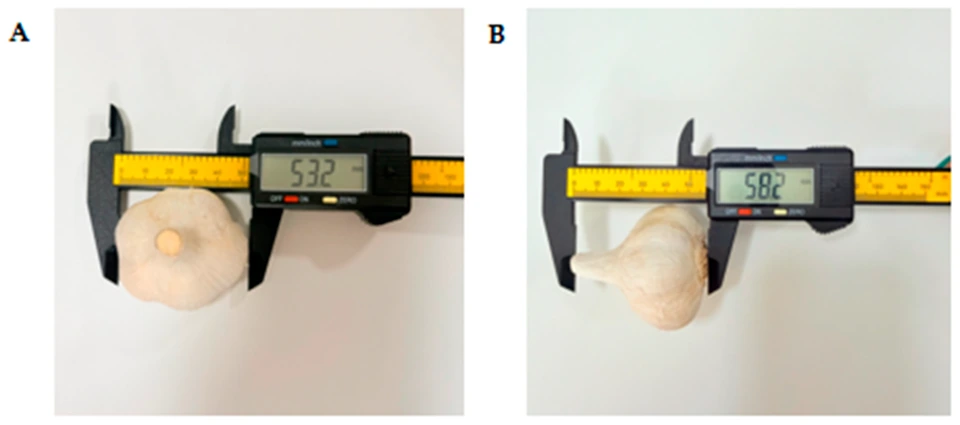
Check whether the garlic is actually mature, then review planting-stock size, planting date, spacing, leaf health, water and light. Small bulbs can follow a shortened growing season or stressed foliage. A single undivided round needs a different check. There is no universal bulb diameter that makes every variety a failed crop. Compare the actual bulb with the same cultivar, not with the illustrative sizes in an image.
A small bulb is an outcome, not a single disease. Compare a mature bulb with the same variety and growing system before trying to correct it with a late feed.
Diagnostic snapshot
What to check before you act
What you are seeing
- Mature divided bulbs smaller than comparable plants
- Small bulbs following weak or damaged foliage
Check first
Compare plants of the same cultivar and planting date. Use an already harvested sample, or a representative bulb at likely maturity; do not pull the whole row to inspect size.
Compare first
- Too early to judge
- Shortened or crowded growth
- Leaf or root stress
Hold off for now
Do not feed heavily or leave a mature crop in wet soil simply to chase larger bulbs.
Investigate further if
Get local help if most bulbs fail to develop despite suitable timing and conditions, or if small bulbs accompany root discoloration, leaf streaking, severe lesions or persistent plant decline. Some diseases and planting-stock problems need laboratory assessment.
Photograph this before you act
- Photograph the whole plant and its growing area so the overall pattern is visible.
- Take one close-up of the clearest symptom and one wider view that shows the surrounding area for comparison.
Next best check
Check two visible clues before you act.
This mini-check narrows the match using the same canonical diagnostic clues as this answer. It does not confirm a diagnosis from one or two clicks, and it does not make a photo-only diagnosis.
Two quick observations can tell you whether to keep reading this diagnosis closely or compare other possibilities first.
Match the situation before acting
Too early to judge
- Green active crop; cloves have not filled their wrappers
Confirm maturity before comparing final size.
Shortened or crowded growth
- Late planting, small starting cloves, dense spacing or shade
Record the constraints for the next planting.
Leaf or root stress
- Drought history, widespread leaf injury or abnormal roots
Investigate the observed stress rather than assuming a nutrient shortage.
One round instead of divided cloves
- Bulb structure is undivided, not merely small
Review cultivar, chilling and planting material separately.
Safe checks before acting
- Compare plants of the same cultivar and planting date. Use an already harvested sample, or a representative bulb at likely maturity; do not pull the whole row to inspect size.
- Review the season's records: starting clove size, spacing, shade, weeds, dry spells and leaf damage. Inspect still-growing foliage for distinctive lesions instead of making a diagnosis from bulb size.
What to do next
- If the crop is still actively developing and healthy, maintain suitable moisture and weed control while monitoring maturity. Do not assume leaving it indefinitely will produce a larger safe-to-store bulb.
- If mature, harvest appropriately and record which part of the bed performed poorly. A size comparison is meaningful only with cultivar and planting history attached.
- For the next cycle, choose suitable planting stock and a locally appropriate window, allow adequate space and avoid preventable competition.
- Investigate persistent pale growth or damaged leaves using the matching diagnostic answer and soil evidence. Late blanket nitrogen cannot undo a lost season.
GardenSolved checkpoint
Do not do this yet
- Do not feed heavily or leave a mature crop in wet soil simply to chase larger bulbs.
- Do not select planting stock from plants with unexplained disease signs just because a few bulbs are large.
Confirm the likely cause first, then choose the treatment.
Scope and follow-up
The photograph shows width and height measurement of one bulb. It is not a small-versus-large harvest comparison, a minimum grade or proof of why a bulb stayed small.
This page owns size and yield triage. The single-round answer owns clove division; the scape answer owns selective flower-stalk removal, not a promise to fix every small-bulb crop.
When to get more help
Get local help if most bulbs fail to develop despite suitable timing and conditions, or if small bulbs accompany root discoloration, leaf streaking, severe lesions or persistent plant decline. Some diseases and planting-stock problems need laboratory assessment.
Follow the next useful clue
- A bulb is one solid round: Review division and chilling rather than size alone.Why did my garlic form one round instead of cloves?
- You are unsure whether growth is complete: Check harvest readiness.When is garlic ready to harvest?
- A hardneck scape is emerging: Check whether and when to remove that stalk.Should I remove garlic scapes, and when?
Consulted horticultural sources
Save & recheck
Compare what changes before changing course.
Save this diagnosis only in this browser, then come back and compare the same clues. No account, reminder subscription, or server-stored diagnostic record is created.
Your baseline
- Mature divided bulbs smaller than comparable plants
- Small bulbs following weak or damaged foliage
Check again when you return
- Compare plants of the same cultivar and planting date. Use an already harvested sample, or a representative bulb at likely maturity; do not pull the whole row to inspect size.
- Review the season's records: starting clove size, spacing, shade, weeds, dry spells and leaf damage. Inspect still-growing foliage for distinctive lesions instead of making a diagnosis from bulb size.
Tip: photograph the same area from a similar angle so the visible pattern is easier to compare.
Related questions
Diagnostic Finder
Still not sure this answer fits?
Open the Diagnostic Finder with the relevant growing subject or care context preselected and compare other published GardenSolved diagnoses.
Compare other possibilities