Garlic
When is garlic ready to harvest?
The short answer
Start checking garlic as lower leaves dry while some upper foliage remains green. Gently lift a representative bulb and check that cloves have filled out inside intact wrappers. Use cultivar and local season as context, not a universal month. Early collapse or rot calls for diagnosis, not an assumption that the crop matured early.
Harvesting too early sacrifices development; waiting until every leaf is dead can sacrifice wrappers. Use a representative check rather than either extreme.
Diagnostic snapshot
What to check before you act
What you are seeing
- Lower foliage drying near expected maturity
- Representative bulb has filled cloves and intact wrappers
Check first
Look across the planting and compare cultivars separately. Record lower-leaf decline, remaining upper green leaves and whether the pattern is gradual or patchy.
Compare first
- Likely ready
- Still developing
- Possibly overmature
Hold off for now
Do not wait for every leaf to turn brown before checking bulbs.
Investigate further if
Investigate if decline is unusually early, rapid or patchy, especially with soft necks or basal decay. If the representative bulb is damaged or unclear, ask a local adviser before lifting the entire planting.
Photograph this before you act
- Photograph the whole plant and its growing area so the overall pattern is visible.
- Take one close-up of the clearest symptom and one wider view that shows the surrounding area for comparison.
Next best check
Check two visible clues before you act.
This mini-check narrows the match using the same canonical diagnostic clues as this answer. It does not confirm a diagnosis from one or two clicks, and it does not make a photo-only diagnosis.
Two quick observations can tell you whether to keep reading this diagnosis closely or compare other possibilities first.
Match the situation before acting
Likely ready
- Lower drydown plus full cloves and sound protective wrappers
Lift carefully and begin curing.
Still developing
- Mostly active foliage and a representative immature bulb
Continue care and reassess rather than lifting the row.
Possibly overmature
- Wrappers deteriorating and cloves separating
Prioritize lifting and sorting; storage potential is reduced.
Premature decline
- Soft necks, patchy collapse or decay before expected maturity
Use the disease and wilt checks.
Safe checks before acting
- Look across the planting and compare cultivars separately. Record lower-leaf decline, remaining upper green leaves and whether the pattern is gradual or patchy.
- At likely maturity, gently loosen soil beside a representative plant and lift without stabbing the bulb. Inspect fullness and wrapper integrity; do not rely on calendar date or an exact leaf percentage alone.
What to do next
- Lift the ready portion with a fork or spade positioned far enough from the bulb to avoid wounds. Handle gently rather than pulling hard on dry foliage.
- Sort damaged, split and suspect bulbs separately. Keep material with disease signs away from healthy curing and planting stock.
- Begin curing with good airflow in a dry sheltered place. Protect bulbs from excessive heat and avoid packing damp plants together.
- Mark later cultivars for another check. Uniform harvest of mixed varieties can lift some too early and others too late.
GardenSolved checkpoint
Do not do this yet
- Do not wait for every leaf to turn brown before checking bulbs.
- Once representative bulbs are mature and ready to lift, stop unnecessary irrigation rather than trying to keep the tops green, and do not add a late feed. Do not store damaged bulbs with sound long-term stock.
Confirm the likely cause first, then choose the treatment.
Scope and follow-up
Regional sources use slightly different foliage thresholds. Combining foliage with a representative bulb check is more reliable than converting those descriptions into a universal percentage.
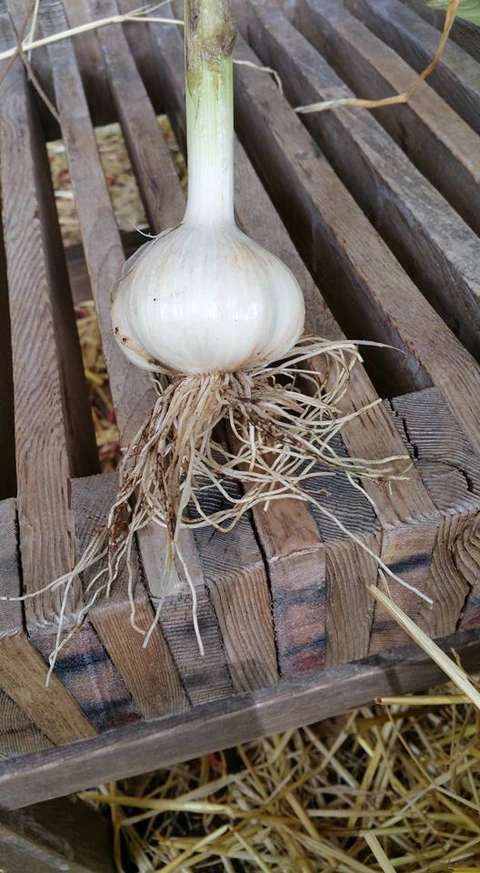
The photograph shows a real harvested bulb, neck and roots. Its upper leaves are outside the frame and its cultivar and maturity assessment were not recorded by the photographer. Use it for the bulb-inspection step, alongside your own foliage and growing history; it cannot certify readiness or crop health.
When to get more help
Investigate if decline is unusually early, rapid or patchy, especially with soft necks or basal decay. If the representative bulb is damaged or unclear, ask a local adviser before lifting the entire planting.
Follow the next useful clue
- Wrappers are already opening: Sort split bulbs and assess storage limits.Why are my garlic bulbs splitting open?
- The harvest is now drying or stored: Check curing, airflow and deterioration.Why is stored garlic going soft or mouldy?
- Leaf death is early and plants collapse: Check wilt rather than calling it maturity.Why is my garlic wilting or collapsing?
Consulted horticultural sources
Save & recheck
Compare what changes before changing course.
Save this diagnosis only in this browser, then come back and compare the same clues. No account, reminder subscription, or server-stored diagnostic record is created.
Your baseline
- Lower foliage drying near expected maturity
- Representative bulb has filled cloves and intact wrappers
Check again when you return
- Look across the planting and compare cultivars separately. Record lower-leaf decline, remaining upper green leaves and whether the pattern is gradual or patchy.
- At likely maturity, gently loosen soil beside a representative plant and lift without stabbing the bulb. Inspect fullness and wrapper integrity; do not rely on calendar date or an exact leaf percentage alone.
Tip: photograph the same area from a similar angle so the visible pattern is easier to compare.
Related questions
Diagnostic Finder
Still not sure this answer fits?
Open the Diagnostic Finder with the relevant growing subject or care context preselected and compare other published GardenSolved diagnoses.
Compare other possibilities