Peppers
Why are my pepper flowers falling off?
The short answer
Track several flowers and check recent temperatures and root-zone moisture. Unfavorable heat or cold and prolonged dry or wet conditions are the strongest first checks. Transplant stress and fertilization can contribute, but should remain secondary unless the timing and plant evidence support them.
Pepper flower drop means that a blossom or its stem physically detaches before a pepper develops. Confirm that event first, because a flower that remains attached but produces no fruit belongs to the broader no-fruit diagnosis.
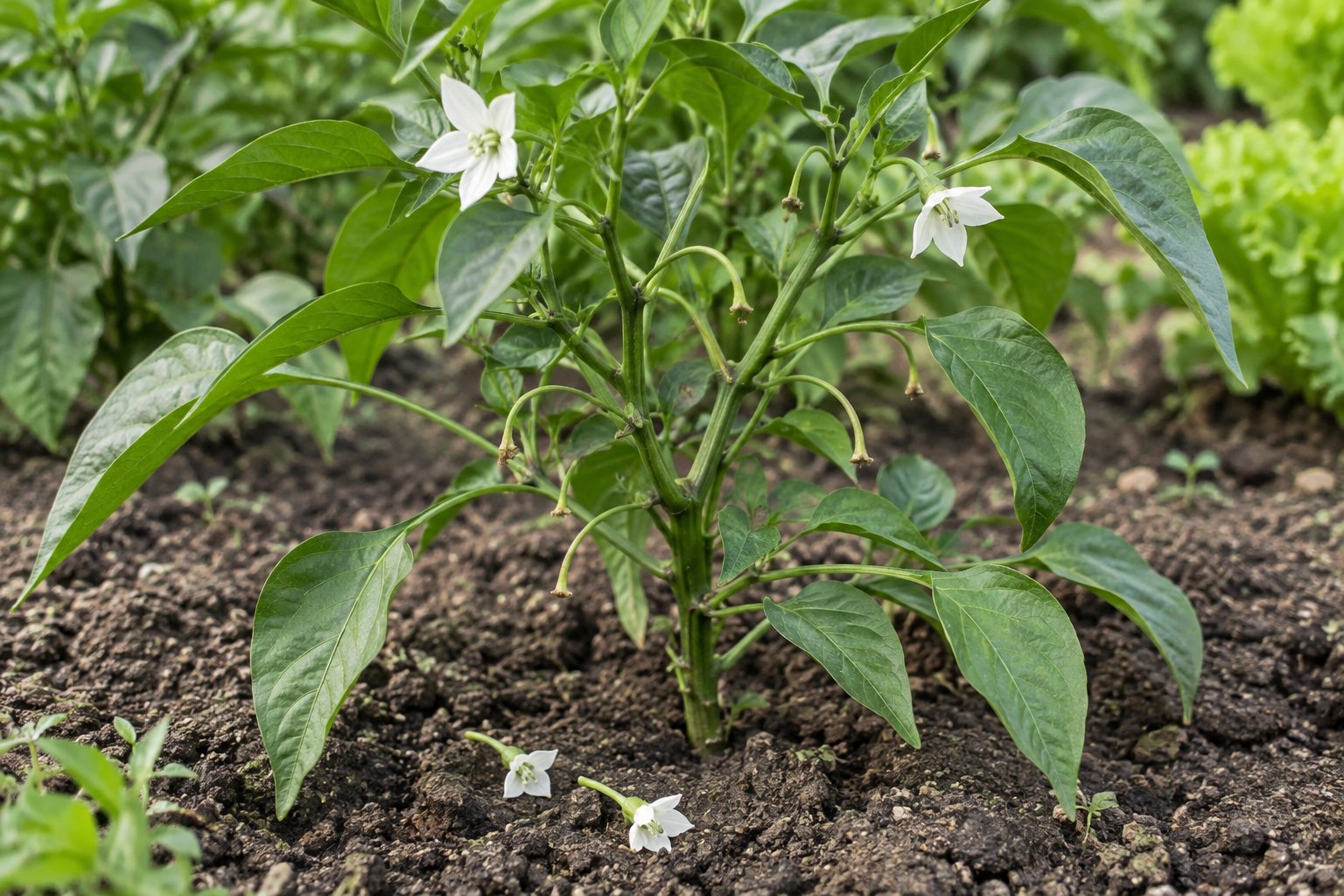
Confirm flower drop before diagnosing the cause
| What you observe | What it means | Next decision |
|---|---|---|
| The flower or its short stem physically detaches | This is flower drop | Continue with temperature and root-zone checks on this page |
| The flower remains but no pepper develops | This is not confirmed flower drop | Use the broad no-fruit and failed fruit-set owner |
| A tiny pepper forms and later drops | The failure occurred after initial fruit set | Check environmental and moisture stress plus any fruit or plant symptoms |
| Some flowers drop while others set peppers | Fruit set is still occurring | Track the proportion and timing before treating one fallen blossom as whole-plant failure |
| Flowers drop with leaf, stem, root, or pest symptoms | A broader plant problem may be involved | Use the accompanying evidence to choose the next diagnosis |
Prioritize the best-supported flower-drop branches
Unfavorable temperatures
- Flower loss begins during a sustained hot or cool period.
- Several blossoms at a similar stage are affected.
More likely if
- The plant otherwise remains reasonably healthy and later flowers improve when weather moderates.
Less likely if
- Flower loss continues in stable conditions with clear root, leaf, stem, or pest symptoms.
Reduce avoidable temperature stress and judge the next flowers after conditions moderate.
Dry or overly wet root zone
- Soil is dry at root depth or remains saturated and poorly aerated.
- Wilt or stalled growth accompanies flower loss.
More likely if
- The timing follows drought, heavy rain, repeated irrigation, or blocked container drainage.
Less likely if
- Moisture and drainage are suitable and no root-zone stress is visible.
Correct the immediate moisture condition gradually; use the watering owner for the ongoing routine.
Recent transplant or root stress
- Flower loss follows transplanting or root disturbance.
- Growth is temporarily paused while leaves remain largely intact.
More likely if
- The root ball dried, stayed saturated, or was disturbed during establishment.
Less likely if
- The plant was established long before the symptom began.
Stabilize moisture and exposure and avoid further root disturbance while new growth establishes.
Fertilizer or vegetative-growth context
- Recent fertilizer applications exceeded the label or soil-test recommendation.
- Vegetative growth is strong while flowering or fruiting is delayed.
More likely if
- The timing follows repeated feeding and other stronger causes are not supported.
Less likely if
- Leafiness is the only clue; vigorous plants with little fruit can also reflect earlier flower loss or failed fruit set.
Pause unneeded feeding and review the actual application history instead of diagnosing from leafiness alone.
Make a flower, weather, and root-zone check
- Photograph the same flower cluster over several days and look for physical detachment rather than absence of fruit alone.
- Record whether the symptom began during a hot spell, cool nights, or a sharp weather change.
- Check below the soil surface in more than one place and inspect container drainage or standing water.
- Note whether new flowers improve after weather and moisture stabilize.
- Inspect new growth and leaf undersides if distortion, mottling, stickiness, stippling, or progressive wilt accompanies the drop.
Keep flower drop separate from other Pepper owners
- Flowers remain attached but no pepper develops: Use the broad no-fruit owner to evaluate failed fruit-set conditions.Why are my pepper plants not producing peppers?
- The main need is a continuing watering routine: Move to the Pepper watering owner after correcting the immediate stress.How often should I water pepper plants?
- The whole plant is wilting or remains limp in wet soil: Use the Pepper wilting diagnosis.Why are my pepper plants wilting?
- Flowers physically detach and temperature or moisture timing fits: Continue on this page and monitor the next flower group after conditions stabilize.
What to do after flower drop is confirmed
- Keep the plant's temperature exposure and root-zone moisture as stable as the growing system allows.
- If the soil is dry below the surface, water the root zone thoroughly once; if it is saturated, stop adding water and restore drainage where possible.
- Pause fertilizer that is not supported by a soil test, product schedule, or demonstrated need.
- Avoid manipulating healthy flowers as the first response; pepper flowers can self-pollinate, and flower drop is not proof that insects were absent.
- Observe the next flowers and record whether they remain and begin setting peppers.
GardenSolved checkpoint
Do not do this yet
Do not turn every fallen flower into the same diagnosis
- Do not call a flower that remains without fruit physical flower drop.
- Do not assume missing insects caused the blossom to fall or make hand pollination the standard remedy.
- Do not apply one exact temperature threshold to every pepper cultivar and setting.
- Do not water by a rigid calendar or add water while the root zone is already wet.
- Do not blame nitrogen from leafy growth alone or add another fertilizer to force fruit set.
Confirm the likely cause first, then choose the treatment.
Look for recovery in the next flowers
- Mark the next buds that open after temperature or moisture conditions stabilize.
- Confirm whether those flowers remain long enough for a small pepper to begin developing.
- Escalate only if repeated flower loss continues or new companion symptoms appear.
Reduce repeated flower stress
- Transplant peppers after unsuitable cold conditions have passed and acclimate plants gradually.
- Maintain a well-drained root zone and reduce sharp swings between drought and saturation.
- Apply fertilizer according to soil-test or label guidance rather than using repeated high-nitrogen feeding.
- Choose varieties suited to the local growing season and protect plants from avoidable wind and temperature extremes.
When repeated flower loss needs more investigation
Obtain plant-specific help when flowers keep dropping after weather and moisture stabilize or the plant develops severe distortion, mottling, progressive wilt, damaged roots, stem lesions, or a confirmed pest problem.