Peppers
Why are my pepper leaves turning yellow?
The short answer
Compare older and newer leaves, then check moisture and drainage below the surface. Uniform yellowing, interveinal yellowing, spots or mottling, visible pests, and recent cold or spray exposure point to different branches. Do not add fertilizer or more water until the pattern and root-zone condition support that choice.
Yellow pepper leaves are a symptom, not one diagnosis. Where the color change starts, whether veins or spots remain visible, and what is happening around the roots are more useful than yellow color alone.
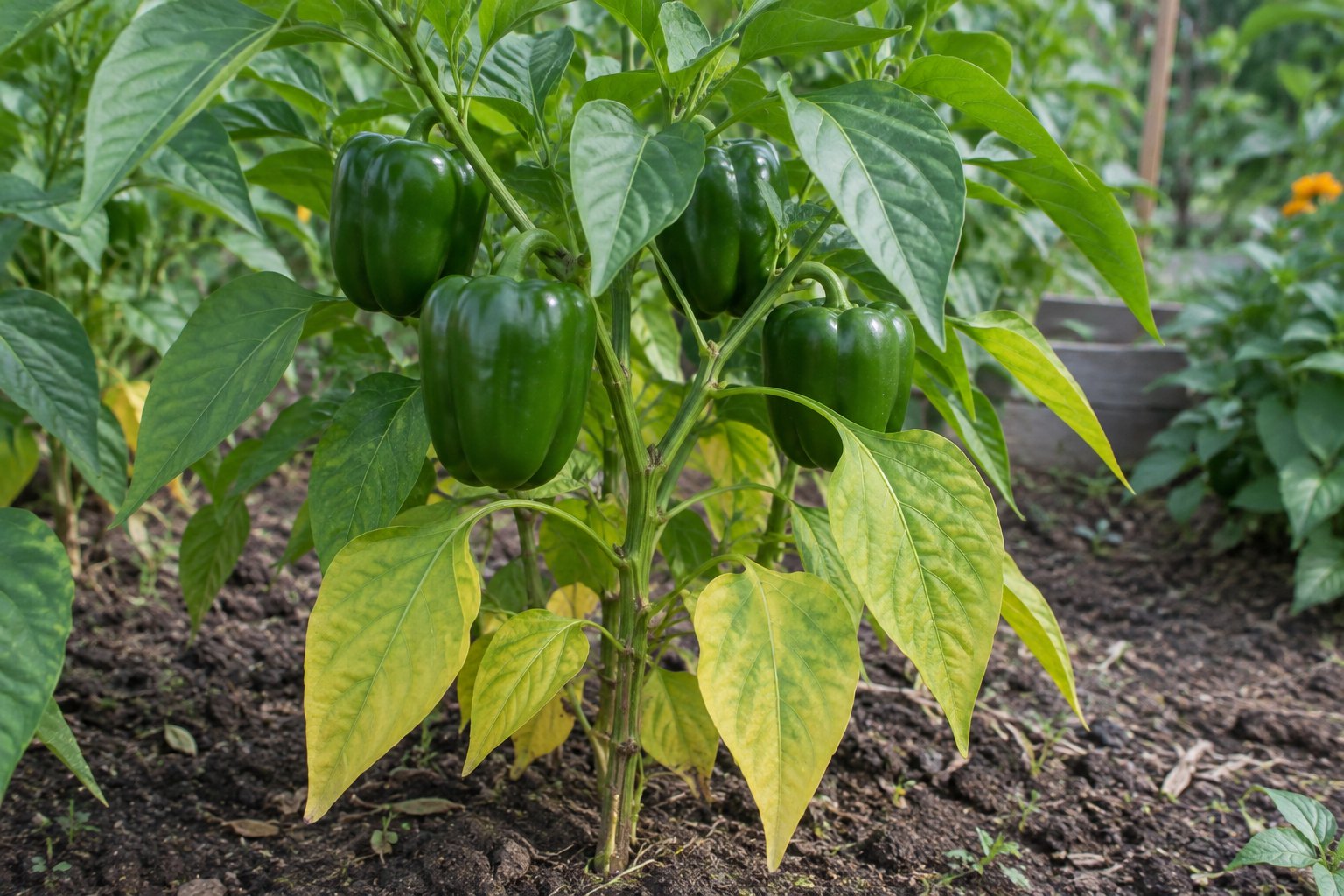
Read the yellowing pattern
| What you observe | What it suggests first | What to confirm |
|---|---|---|
| A few older or shaded leaves yellow while new growth remains vigorous | Start with age, light, and root-zone context before treating | Check whether the change is isolated or spreading through the plant |
| Older leaves are uniformly pale or yellow | Water, root, nutrient, or normal-aging branches need comparison | Check moisture, drainage, recent feeding, and the pattern on nearby plants |
| Leaves are yellow between green veins or new growth is pale | Nutrient availability or root uptake becomes a possibility | Use soil or growing-media evidence before adding a nutrient |
| Yellowing comes with spots, halos, mottling, curl, stippling, or distortion | Pest, disease, or exposure lookalikes become more important | Inspect both leaf surfaces and review the recent care and exposure history |
| Yellowing comes with whole-plant wilt or a wet/dry root zone | Root-zone stress or a separate wilt problem may be dominant | Use the moisture and whole-plant pattern to choose the next owner |
Separate the main yellow-leaf branches
Older, isolated, or shaded leaves
- The change is limited to older or shaded foliage.
- New growth and overall vigor remain normal.
More likely if
- Yellowing is slow and does not include spots, wilt, or distorted new growth.
Less likely if
- New growth is affected or the pattern spreads rapidly through the plant.
Check light, moisture, and the overall plant before removing or feeding.
Dry, wet, or damaged root zone
- Soil is very dry, stays saturated, or drains slowly.
- Yellowing appears with loss of vigor or wilt.
More likely if
- The timing follows a drought, heavy watering, transplant, compaction, or root disturbance.
Less likely if
- The root zone is stable and the leaves show a clear pest, lesion, or exposure pattern.
Correct the supported moisture or drainage problem gradually and monitor new growth.
Nutrient or uptake problem
- Yellowing follows a consistent leaf-age or vein pattern.
- Other plants or the growing medium suggest a shared fertility issue.
More likely if
- A soil or growing-media test and the pattern support the same nutrient branch.
Less likely if
- Spots, pests, wilt, mottling, or recent spray exposure explain the change better.
Use test or label evidence before changing fertilizer or adding an amendment.
Pest, disease, cold, or spray lookalike
- Yellowing appears with stippling, mottling, spots, distortion, wilt, or an exposure history.
More likely if
- Direct evidence is visible on leaves, the same pattern affects nearby plants, or symptoms followed a cold or spray event.
Less likely if
- Yellowing is isolated, slow, and unaccompanied by other changes.
Document the pattern and obtain a plant-specific diagnosis before applying a targeted treatment.
Confirm the pattern before treating
- Photograph the whole plant and close views of the upper and lower leaf surfaces, including veins, margins, spots, and new growth.
- Check moisture several inches below the surface and note drainage, compaction, recent transplanting, rainfall, and irrigation.
- Inspect tender growth and leaf undersides for aphids, stippling, webbing, or other direct signs.
- Compare affected and unaffected plants and review recent cold, feeding, compost, manure, or spray exposure.
- Use a soil or growing-media test when a nutrient or pH correction would be a consequential decision.
Route by the dominant observation
- Leaf distortion or curling is more prominent than yellow color: Use the Pepper leaf-curl pathway and keep yellowing as a companion clue.Why are my pepper leaves curling?
- The whole plant is drooping or wilt persists after the root zone is checked: Separate dry-soil stress from root, stem, and progressive wilt problems.Why are my pepper plants wilting?
- The next decision is routine root-zone care without a dominant disease or pest pattern: Set watering from actual moisture, drainage, weather, and the growing system.How often should I water pepper plants?
Act on the evidence you found
- If the root zone is dry, water at soil level; if it is saturated, pause extra irrigation and improve drainage instead.
- Remove or correct only the supported stress and keep care steady while you watch the next leaves.
- If pests or lesions are present, identify the problem before selecting an insecticide, miticide, or fungicide and follow the applicable label.
- Use test or authoritative crop guidance before adding fertilizer, lime, Epsom salt, or another amendment.
GardenSolved checkpoint
Do not do this yet
Avoid treating yellow color alone
- Do not add fertilizer or more water before checking the pattern and root-zone condition.
- Do not name a nutrient deficiency, disease, virus, or pest from yellow color alone.
- Do not spray for insects, fungus, or disease without evidence that identifies the target and a label that permits the use.
- Do not remove large amounts of healthy foliage before recording the pattern.
Confirm the likely cause first, then choose the treatment.
Judge recovery by new growth
- Correct one supported cause at a time and keep moisture, light, and feeding consistent.
- Existing yellow tissue may not turn green again; watch whether new leaves emerge with normal color and shape.
- Escalate if yellowing continues upward, new growth becomes distorted, lesions spread, or wilt persists despite stable root-zone conditions.
Reduce repeat yellowing
- Check moisture below the surface and avoid repeated swings between very dry and saturated soil.
- Use well-drained soil, protect roots during transplanting, and keep mulch away from the stem.
- Base fertilizer and pH changes on crop needs, label directions, and soil or growing-media evidence.
- Inspect leaves regularly and keep foliage dry when practical so pest and lesion patterns are found early.
When general yellowing needs a closer diagnosis
Contact a local extension office or plant-diagnostic service when yellowing progresses quickly, affects new growth, combines with persistent wilt or spreading lesions, severely distorts the plant, follows possible spray exposure, or remains ambiguous after the checks above.