Peppers
Why are my pepper leaves curling?
The short answer
Compare older leaves with the newest growth, check soil moisture below the surface, and inspect both sides of the leaves before spraying. Pepper leaves can curl or fold during heat stress; that can differ from twisted new growth with aphids, mottling or rings, or a sudden pattern after herbicide exposure. Curling alone does not confirm a virus.
Curling or cupping pepper leaves can follow environmental stress, pests, viruses, or spray injury. Leaf age, distortion, discoloration, moisture history, and direct evidence are more useful than curl alone.
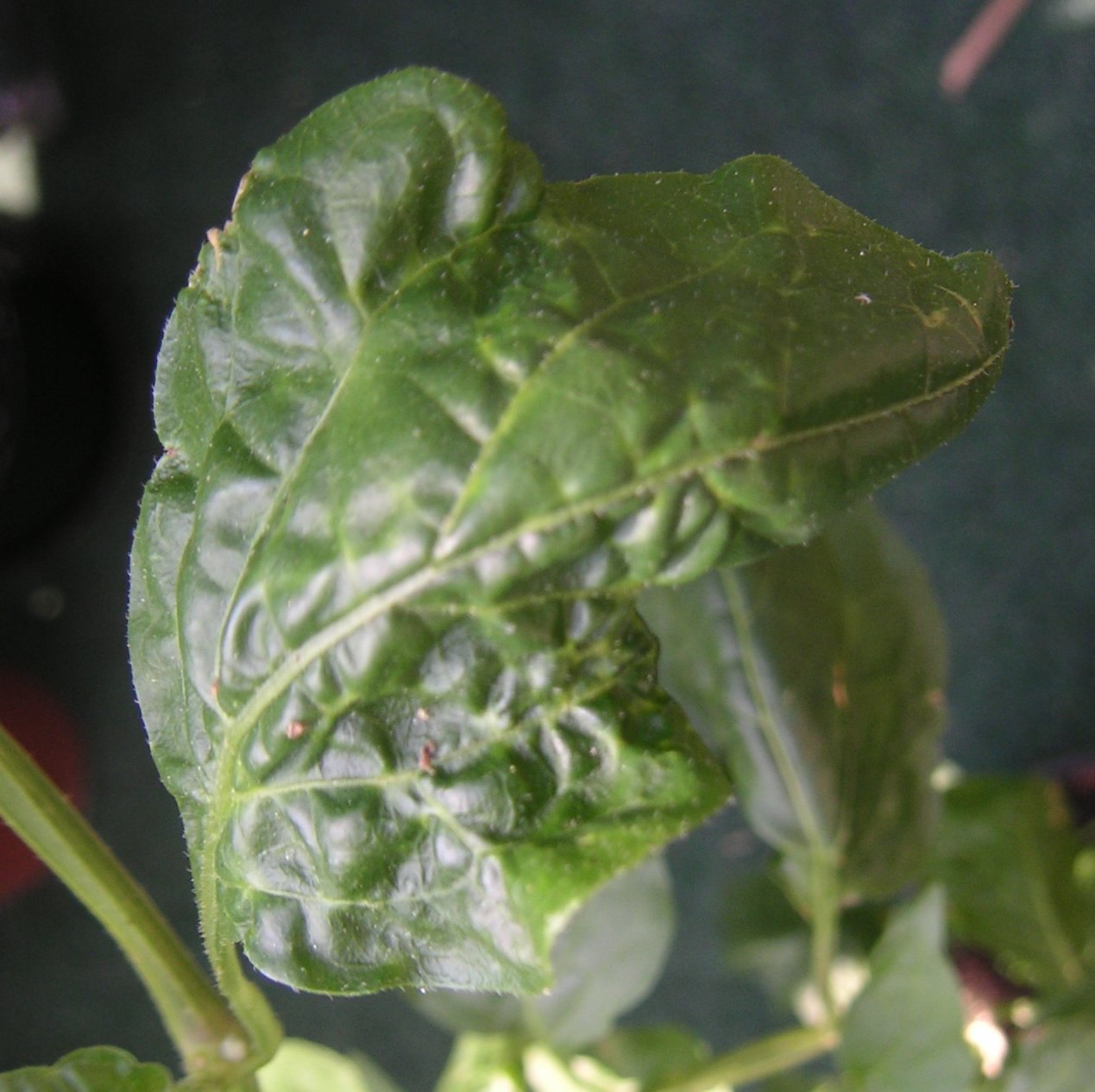

Match curl with the surrounding evidence
| What you observe | What it suggests first | What to confirm |
|---|---|---|
| Leaves curl or fold inward during heat or rapid moisture loss while new growth is normal | Physiological heat or moisture stress is more likely | Check the root zone and whether new growth remains normal as conditions cool |
| Tender new growth is twisted, cupped, or puckered | Pests, exposure, or an infectious lookalike becomes more important | Inspect undersides and review recent spray or material history |
| Curling comes with yellow mottling, rings, stunting, or abnormal fruit | A virus-like pattern needs cautious investigation | Document several plants and seek plant-specific diagnosis |
| Curling comes with droop and a dry or saturated root zone | Water or root stress may be the dominant problem | Check moisture and drainage before treating the leaves |
| Multiple plant species distort after a nearby application | Herbicide injury becomes a possibility | Compare timing, distribution, and the product or material involved |
Separate the main curling branches
Physiological heat or moisture stress
- Curl or folding is strongest during heat or rapid moisture loss.
- New growth remains normally shaped.
More likely if
- The plant recovers in cooler conditions and no direct pest, lesion, or exposure evidence appears.
Less likely if
- New growth becomes increasingly twisted or symptoms persist independently of weather.
Check the root zone, stabilize care, and monitor the next new leaves.
Sap-feeding pest evidence
- Tender growth is distorted or curled.
- Aphids or their residue are visible under leaves or around growing tips.
More likely if
- There is direct insect evidence, stippling, shed skins, or sticky residue.
Less likely if
- No pest evidence is found after careful inspection and the pattern follows heat or spray timing.
Confirm the pest before choosing a crop-labeled control; do not treat curl as proof of a pest.
Virus-like distortion pattern
- Curling is joined by yellow mottling, rings, stunting, or repeated abnormal new growth.
More likely if
- Several plants show a similar progressive pattern and cultural or pest explanations do not fit.
Less likely if
- Curling or folding eases as conditions cool and new growth remains normal.
Obtain plant-specific diagnostic guidance; curling alone is not confirmation.
Herbicide or other spray exposure
- Distortion is sudden, severe, or concentrated in new growth.
- Several unrelated broadleaf plants show similar symptoms.
More likely if
- Symptoms follow a nearby application or contaminated compost, manure, mulch, soil, or equipment.
Less likely if
- Only one plant shows a slow pattern with direct pest or root-zone evidence.
Stop the suspected exposure and seek local or product-specific guidance before making food-use decisions.
Confirm the distortion before spraying
- Photograph the whole plant and several leaves from both sides, including the growing tip and any mottling, rings, or spots.
- Check moisture below the surface and compare the plant during hot and cool periods.
- Inspect undersides and tender growth for aphids, stippling, webbing, shed skins, and sticky residue.
- Review recent applications, wind, shared sprayers, compost, manure, mulch, and whether nearby plant species show the same distortion.
- Use an extension or plant-diagnostic service when progressive new-growth distortion would change treatment or removal decisions.
Route by the dominant observed symptom
- Yellow color or chlorosis is the main concern and curl is secondary: Use leaf age, color pattern, root-zone condition, and lesion clues.Why are my pepper leaves turning yellow?
- The whole plant is drooping or the root-zone response is the main concern: Separate dry-soil stress from wet-root, stem, and progressive wilt problems.Why are my pepper plants wilting?
- Sticky residue or honeydew is actually observed with the distortion: Inspect for the responsible sap-feeding pest rather than treating curl as a diagnosis.Why are my pepper leaves sticky?
Act on the evidence you found
- If the root zone is dry, water at soil level; if it is wet, pause extra irrigation and correct drainage rather than treating the curl.
- If heat or transplant stress fits and new growth is normal, stabilize conditions and monitor instead of removing healthy leaves.
- If aphids or another pest is present, identify it before selecting a crop-labeled control and follow the label exactly.
- If spray exposure or a virus-like pattern is plausible, stop the suspected source and obtain local diagnostic guidance before an irreversible decision.
GardenSolved checkpoint
Do not do this yet
Do not diagnose from curl alone
- Do not diagnose a virus, herbicide injury, aphid infestation, or nutrient problem from one curled leaf or one photograph.
- Do not water saturated soil or add fertilizer as a diagnostic test.
- Do not spray before inspecting leaf undersides and checking the product label for the crop and target.
- Do not remove large amounts of healthy foliage; severe pruning can add stress.
Confirm the likely cause first, then choose the treatment.
Judge recovery by the next growth
- Correct only the stress supported by your checks and keep moisture and care steady.
- Older rolled leaves may not flatten completely; watch whether new leaves form with normal shape, color, and size.
- If each new leaf is more distorted, growth stops, or several plants decline together, move from observation to diagnosis.
Reduce repeat curling
- Check soil moisture below the surface and avoid repeated swings between very dry and saturated soil.
- Harden off transplants, protect roots, and avoid severe pruning during stressful weather.
- Keep weed-control sprays and shared spray equipment away from peppers and verify the history of compost, manure, and mulch.
- Inspect tender growth and leaf undersides regularly so pest evidence is found before distortion becomes widespread.
When local diagnosis matters
Contact a local extension office or plant-diagnostic service when severe distortion continues into new growth, the plant becomes stunted or declines, several plants or species show the same pattern, or spray exposure or an infectious problem is plausible. Ask for a diagnosis before making irreversible crop, pesticide, or food-use decisions.