Peppers
Why are my pepper plants wilting?
The short answer
Check the root zone several inches below the surface before adding water. Dry soil followed by recovery after one thorough watering supports water stress; a moist plant that recovers as heat falls may be temporarily heat-stressed. Wilt that persists into the next morning, begins on one side, or advances with stem, root, or leaf symptoms needs a deeper diagnosis rather than more water.
Wilting is a loss of leaf firmness, not a diagnosis by itself. Soil moisture, time of day, recovery in cooler conditions, and evidence at the stem base help separate temporary heat stress from dry roots, wet-root stress, injury, and progressive disease.
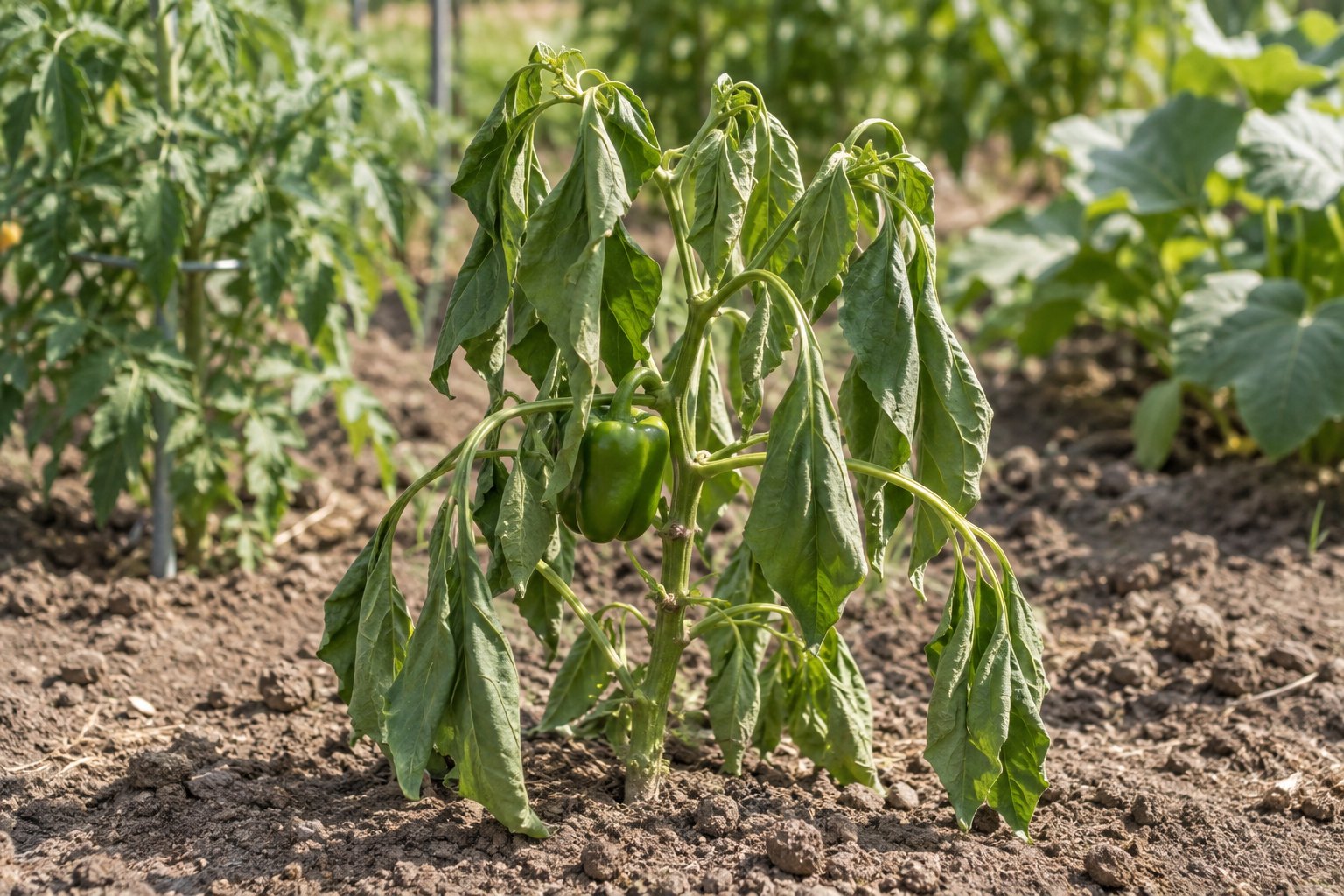
Check these clues before watering again
| What you observe | What it suggests first | Next check |
|---|---|---|
| Droop is strongest in heat and the plant is firm again by evening or morning | Temporary heat-related stress is more likely | Compare the root-zone moisture and the plant after temperatures fall |
| Soil is dry several inches down and the plant improves after thorough watering | A dry root zone is more likely | Use actual soil moisture to set the next watering |
| Soil is wet, compacted, or slow to drain and wilt continues | Root oxygen or root/crown damage needs investigation | Pause extra irrigation and inspect drainage and the soil line |
| One side or one branch wilts and the pattern progresses | Stem, vascular, or wilt-disease problems become more concerning | Document the progression and obtain plant-specific diagnosis |
| Wilt follows transplanting, cold, or root disturbance | Establishment or physical root stress is possible | Stabilize conditions and avoid further root disturbance |
Separate the main wilting branches
Temporary heat stress
- Droop is limited to hot or bright periods.
- The root zone is moist but not saturated.
More likely if
- The plant is firm again in cooler conditions and new growth remains normal.
Less likely if
- Wilt persists overnight or the pattern progresses from one side or stem section.
Keep conditions steady and judge the pattern again in the cool morning.
Dry root zone
- Soil is dry below the surface.
- Leaves are limp across the plant after a dry period.
More likely if
- A slow, thorough watering produces clear recovery and drainage is normal.
Less likely if
- The soil is already wet or the plant remains wilted after moisture is restored.
Moisten the root zone thoroughly once, then use the watering owner for the ongoing routine.
Wet, damaged, or poorly established roots
- The soil stays saturated or the plant was recently disturbed.
- The lower stem, crown, or roots show soft, dark, or water-soaked tissue.
More likely if
- Wilt continues while the root zone is wet and growth is weak or stalled.
Less likely if
- The root zone drains freely and the plant recovers fully in cooler conditions.
Stop extra irrigation, restore drainage where possible, and avoid digging through healthy roots.
Possible progressive wilt disease or stem injury
- Wilt persists or advances from one side, branch, or stem section.
- Yellow wedge-like areas, vascular discoloration, dark stem lesions, or rapid decline add supporting evidence.
More likely if
- The pattern continues despite suitable moisture and a plant-diagnostic service supports the concern.
Less likely if
- The whole plant repeatedly recovers with a healthy stem base and root zone.
Separate this decision from routine watering and obtain authoritative plant-specific guidance before removal or treatment.
Make a morning, soil, and stem-base check
- Photograph the plant during heat and again the next cool morning so recovery or progression is visible.
- Check moisture below the surface and inspect whether water is standing, trapped by a container saucer, or moving away normally.
- Inspect the lower stem and crown for dark, soft, water-soaked, girdled, cracked, or feeding-damaged tissue without cutting healthy tissue unnecessarily.
- Compare lower and newer leaves and note whether yellowing, lesions, or wilt is one-sided or spreading.
- Treat any home test as supportive only; a negative informal check does not rule out a root, crown, vascular, or other disease.
Use the owner that matches the dominant problem
- The main question is how to set the watering routine and the plant has no persistent disease pattern: Use root-zone moisture, drainage, weather, and the growing system to set care.How often should I water pepper plants?
- Yellow leaf color becomes more important than loss of firmness: Use leaf age, color pattern, root-zone condition, and companion signs to diagnose yellow leaves.Why are my pepper leaves turning yellow?
Act on the evidence you found
- If the root zone is dry, water slowly at soil level until it is thoroughly moistened, then wait for the plant's response before watering again.
- If the plant recovers in cooler conditions and the soil is not saturated, keep moisture and care steady while monitoring new growth.
- If the soil is saturated, stop extra irrigation and correct blocked drainage or standing water without tearing through healthy roots.
- If wilt persists or progresses, document the whole-plant pattern, stem base, roots where safely visible, and recent weather or care before seeking diagnosis.
GardenSolved checkpoint
Do not do this yet
Avoid turning wilt into a guess
- Do not add water solely because leaves droop; saturated roots can produce the same above-ground symptom.
- Do not apply fertilizer, fungicide, or insecticide as a diagnostic test.
- Do not diagnose bacterial, fungal, or vascular wilt from wilting alone.
- Do not remove a plant or rotate the whole bed until the evidence and an authoritative recommendation support that decision.
Confirm the likely cause first, then choose the treatment.
Judge recovery by timing and new growth
- Temporary heat droop should ease as conditions cool; compare the same plant at different times instead of judging one afternoon snapshot.
- A dry-root episode may improve after thorough watering, but damaged leaves may not become normal again; watch for firm, normally developing new growth.
- A transplant or minor root disturbance may recover gradually when moisture and drainage stay stable and roots are not disturbed again.
- Failure to recover, continued one-sided decline, or progression into new growth is a reason to move from routine care to diagnosis.
Reduce repeat wilting
- Check moisture below the surface and water the root zone thoroughly instead of using frequent shallow splashes.
- Maintain free drainage and use mulch where appropriate to reduce abrupt moisture swings without covering the stem base.
- Handle pepper roots carefully at transplanting and avoid cultivation that cuts roots near established plants.
- Protect young transplants from abrupt cold, heat, and wind while they establish.
When this is no longer a routine water problem
Escalate when wilt persists through the next cool morning, advances from one side or stem section, affects several plants, or appears with crown decay, root damage, vascular discoloration, or rapid death. Use a local extension or plant-diagnostic service before making an irreversible removal, sanitation, or treatment decision.