Peppers
Why do my pepper leaves have holes?
The short answer
Inspect both leaf surfaces, fresh growth, the plant base, and nearby soil before treating. Numerous small shot-like holes fit flea-beetle-style feeding; ragged missing tissue can fit caterpillars or slugs, while a bordered dead spot that fell out, a tear, or hail damage needs a different response. Confirm the cause before using an insecticide or fungicide.
Holes in pepper leaves usually mean tissue was eaten, but the pattern does not identify one pest by itself. Hole size, smooth or ragged edges, leaf position, pest evidence, and whether a spot dried out first help separate chewing damage from disease-like tissue loss, tearing, and weather injury.
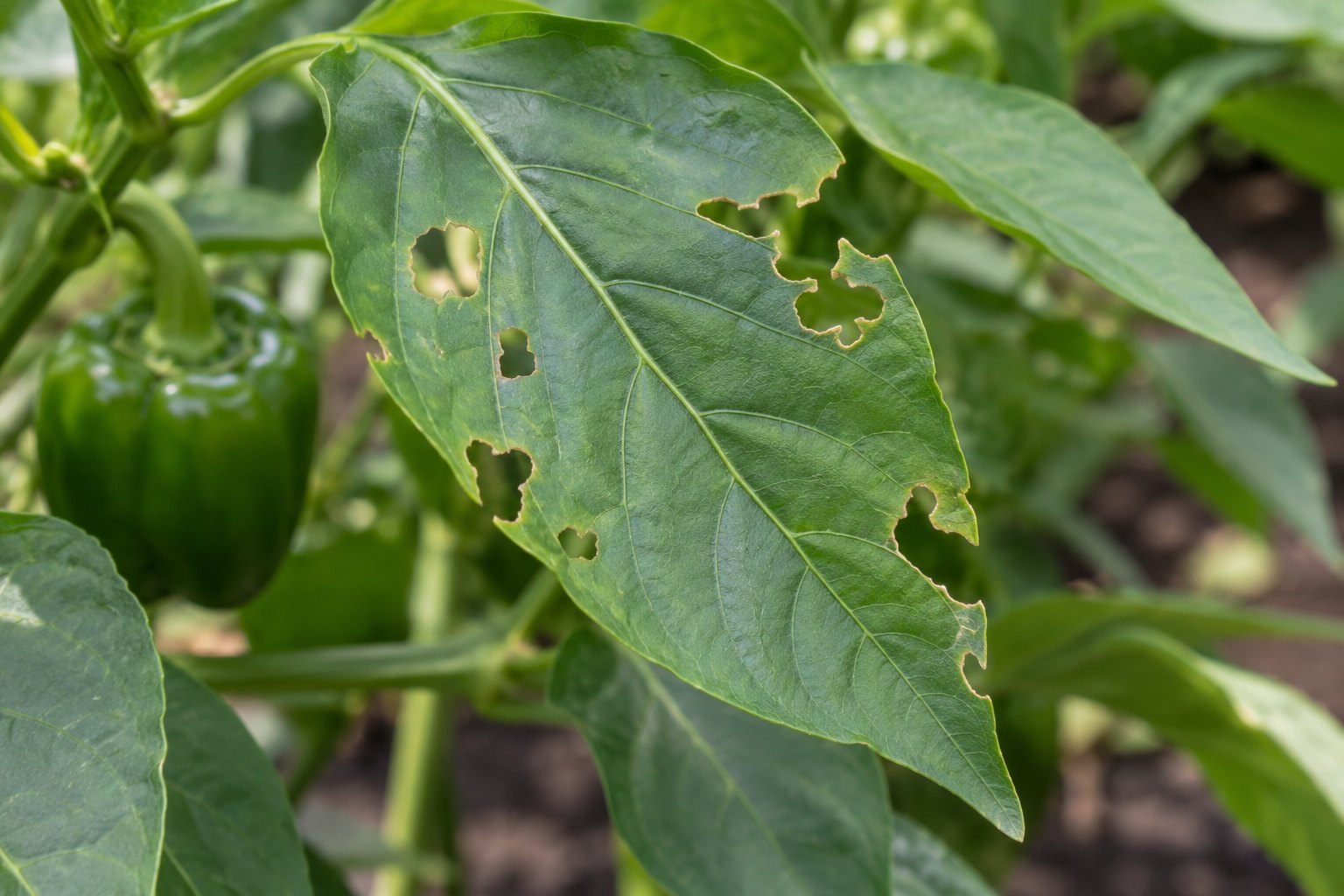
Triage the hole pattern first
| What you see | What it suggests first | Next check |
|---|---|---|
| Many tiny, round or irregular shot-like holes | Flea-beetle-style or another small chewing insect is possible | Inspect young leaves and undersides for small beetles; do not identify from holes alone |
| Large ragged holes or missing leaf edges | A caterpillar, slug, snail, or other larger chewer is possible | Check frass, feeding damage, hiding places, and the plant after dark |
| Smooth holes after a damp night | Slug or snail feeding becomes more plausible | Look for slime trails and inspect soil, mulch, and lower leaves |
| Hole surrounded by a brown, tan, or yellow halo | Dead leaf-spot tissue may have dropped out | Compare the remaining border and look for additional spots |
| Tear follows a split, vein, support, or contact point | Physical or weather damage is more likely | Review hail, wind, handling, pruning, and ties |
| Old dry holes with no fresh edges or pest evidence | Past damage may remain after the cause has gone | Check newest growth and monitor for new holes |
Compare chewing damage with lookalikes
Small chewing insects
- Many small holes can be shallow or fully open.
- New leaves may show fresh feeding while the insect is difficult to catch.
More likely if
- Small beetles jump when disturbed.
- Newest leaves have repeated shot-like holes.
Less likely if
- Openings have a clear brown halo.
- Tissue is torn along a weather-damage line.
Inspect both surfaces and nearby plants, then hand-remove visible pests where practical.
Caterpillars or larger chewers
- Holes are larger, uneven, or joined into missing sections.
- Frass, webbing, eggs, or a hidden larva may be nearby.
More likely if
- Damage increases between inspections.
- Edges are ragged or feeding is strongest overnight.
Less likely if
- Only old, dry, haloed spots remain.
Search undersides, stems, flowers, and soil or mulch before selecting control.
Slugs or snails
- Feeding can leave smooth-edged holes or missing tissue.
- Lower leaves near damp hiding places may be affected.
More likely if
- Damage follows cool, damp nights.
- Shiny slime trails or slugs are found.
Less likely if
- Only upper leaves have dry, haloed holes.
Inspect after dark and reduce hiding places without treating timing as proof.
Leaf-spot tissue loss
- A brown, tan, or water-soaked spot formed before its center dropped out.
- A border or halo and additional spots may remain.
More likely if
- Openings are part of a spreading spot pattern.
- Other leaves show spots without missing tissue.
Less likely if
- Fresh bite edges and insects are present.
Use the spot pattern for disease diagnosis rather than an insect treatment.
Tearing or weather injury
- Tissue is split, bruised, shredded, or aligned with a support or hail event.
- No pest evidence is found.
More likely if
- Damage appeared suddenly after handling or severe weather.
Less likely if
- Fresh holes continue in different leaves.
Remove rubbing or exposure and monitor new growth instead of spraying.
Find the evidence before choosing control
- Photograph the newest holes and one older leaf so fresh feeding can be separated from old damage.
- Inspect both sides of leaves with good light, especially veins, folds, growing tips, and lower foliage.
- Check stems, flowers, crown area, mulch, and soil for frass, eggs, webbing, slime, shed skins, or live pests.
- Compare the plant in daylight and after dark when night-feeding pests are possible, but do not treat time of day as identification.
- Look for a continuous spot border, torn tissue, or weather history that would explain an opening without chewing.
Route by the dominant symptom
- The main symptom is sticky residue on leaves: Use the Pepper sticky-leaves owner and inspect for honeydew-producing sap-feeders.Why are my pepper leaves sticky?
- Leaves are primarily curling or distorted without missing tissue: Use the Pepper leaf-curl owner and inspect moisture, heat, pests, disease, and exposure.Why are my pepper leaves curling?
- Yellowing or spreading spots are more important than the opening: Use the Pepper yellow-leaf owner and compare leaf age, pattern, roots, and disease-like signs.Why are my pepper leaves turning yellow?
- The whole plant is losing firmness or wilting: Use the Pepper wilting owner instead of treating wilt as chewing damage.Why are my pepper plants wilting?
What to do after the inspection
- If only a few visible pests are present, hand-pick them and remove heavily damaged tissue only when necessary; avoid stripping healthy leaves.
- Keep the growing area inspectable, check nearby plants, and reduce damp hiding places or plant debris where appropriate.
- Use a physical barrier on young plants when suitable for the pest and growing system, keeping it clear of new growth.
- If leaf spots or weather injury fit better, improve airflow and reduce exposure or handling damage instead of applying an insecticide.
- Use a pesticide only after identifying the target and confirming that the product is labeled for peppers and its harvest and pollinator directions fit.
GardenSolved checkpoint
Do not do this yet
Avoid treating the hole instead of the cause
- Do not assume every hole was made by one pest or identify a species from hole shape alone.
- Do not confuse a hole left by a dead spot with fresh chewing damage.
- Do not apply an insecticide or fungicide as a diagnostic test.
- Do not remove most healthy foliage because of old holes; judge new growth and active damage.
- Do not use an unlabeled product on edible peppers or ignore label directions.
Confirm the likely cause first, then choose the treatment.
Judge recovery by new growth
- Existing holes will not close; recovery means fresh leaves emerge without new damage or damage slows after the cause is addressed.
- Recheck newest leaves and nearby soil for live pests or fresh evidence rather than expecting damaged leaves to look normal.
- If new holes continue, repeat the inspection and seek diagnosis when the pattern is spreading or disease-like.
Make repeat damage easier to prevent
- Scout regularly, especially young leaves, lower foliage, stems, and the first weeks after transplanting.
- Keep plants spaced and leaves accessible so both surfaces can be checked.
- Use clean growing areas and remove badly diseased debris while preserving helpful predators.
- Protect young plants from avoidable rubbing, ties, wind exposure, and hail where practical.
When to investigate beyond chewing damage
Ask a local extension office or plant-diagnostic service when holes are accompanied by spreading spots, yellowing, wilt, stem or fruit lesions, rapid decline, or repeated fresh damage that remains unexplained after checking both leaf surfaces and the surroundings.