Tomatoes
Why are my tomato plants not flowering?
The short answer
If a mature tomato is making leaves but no flower buds, check usable direct light, recent nitrogen feeding, temperature stress, and whether the plant is still establishing. If flowers are present and then fall, use the blossom-drop diagnosis instead. Do not add phosphorus, a bloom booster, or extra water from the absence of flowers alone.
A tomato plant with no flowers is a different problem from a plant that makes blossoms and then drops them. First locate where reproduction has stopped: no buds at all, buds forming slowly, or flowers opening but failing afterward.
Find the stage where flowering stopped
| What you see | What to check next |
|---|---|
| Young or recently transplanted plant with no buds | Confirm establishment, root-zone moisture, light, and time; a young plant may not yet be ready to flower. |
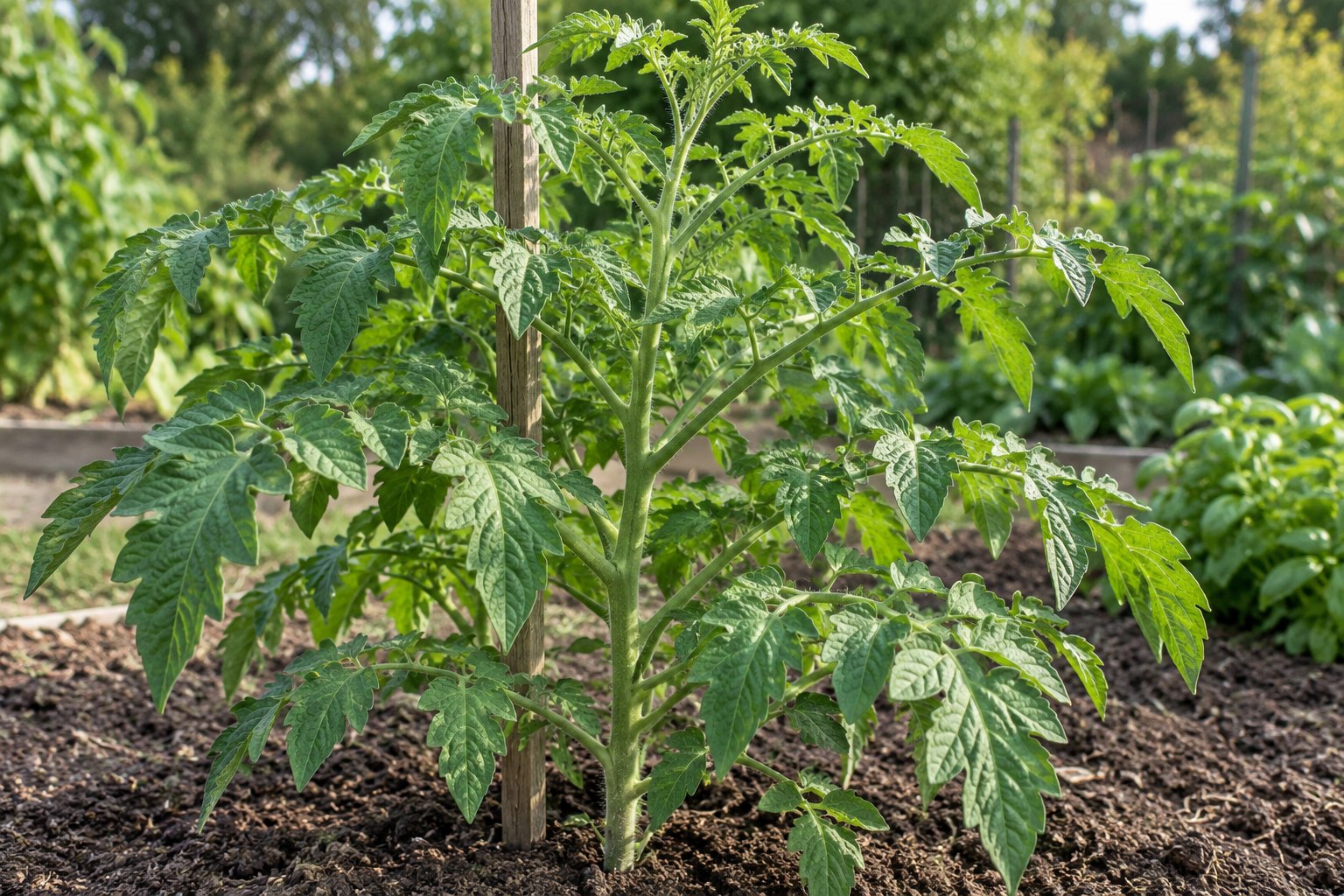
| Large leafy plant with long vegetative growth | Review nitrogen inputs and usable direct sun before adding any bloom product. |
| Buds form during a heat or cold spell but development stalls | Track whether flowering resumes when conditions moderate. |
| Flowers open and then detach | Move to the blossom-drop pathway; this is no longer a 'no flowers' problem. |
Compare the main no-flower branches
Not enough usable light
- The plant is shaded for much of the day or crowded by nearby growth.
- Stems may stretch toward the brighter side.
More likely if
- The site receives substantially less direct sun than nearby productive tomatoes.
Less likely if
- The plant receives strong direct light and neighboring tomatoes flower normally.
Improve access to light when practical, or use a sunnier site next season; do not compensate with extra fertilizer.
Too much nitrogen relative to reproductive growth
- The canopy is unusually lush and dark green while flower clusters are scarce.
- Recent feeding included repeated nitrogen-rich fertilizer or heavy fertility.
More likely if
- Leaf and stem growth accelerated after feeding while flowering lagged.
Less likely if
- The plant is pale, weak, or showing broader deficiency symptoms.
Pause unnecessary feeding and base future fertilizer on soil, media, crop stage, and label guidance.
Temperature stress
- Flower development or fruit set worsens during sustained hot days or unusually cool nights.
- Other plants also show heat or cold stress.
More likely if
- Flowering improves after the weather moderates.
Less likely if
- The problem persists through a long period of suitable conditions.
Keep moisture steady and wait for the next flowering cycle rather than forcing growth with products.
Plant stage or broader health problem
- The plant is still establishing, or overall growth is weak rather than lush.
- Distortion, severe yellowing, wilt, pest evidence, or root problems accompany poor flowering.
More likely if
- Another symptom is at least as prominent as the missing flowers.
Less likely if
- The plant is mature, vigorous, and otherwise healthy.
Follow the dominant symptom diagnosis instead of treating absent flowers as a stand-alone nutrient deficiency.
Checks before changing care
- Look for tiny developing flower clusters at shoot tips; distinguish 'no buds' from 'flowers are dropping.'
- Record the approximate hours and timing of direct light at the plant, including new shade from trees, structures, or nearby crops.
- Review every fertilizer, compost, manure, and lawn-feed input that could have supplied nitrogen.
- Check root-zone moisture below the surface and drainage; chronic drought or saturation can compound reproductive stress.
- Note whether the problem began during a sustained temperature extreme and whether new flower clusters appear after conditions improve.
- Compare with another tomato in a similar stage if available, while allowing for cultivar and planting-date differences.
Route the next question to the right owner
- Flowers are present but yellow, dry, or fall before fruit sets: Use the blossom-drop diagnosis to assess temperature, pollination, moisture, and other stress.Why are my tomato flowers falling off?
- The plant is tall, thin, and stretched rather than simply leafy: Use the leggy-growth page to evaluate light, crowding, and seedling growth.Why are my tomato plants growing tall and thin?
- Root-zone moisture or irrigation is the main uncertainty: Use the tomato watering guide instead of guessing from flowering alone.How often should I water tomato plants?
What to do now
- Keep the plant in the strongest practical direct light for its site and reduce avoidable shading or crowding.
- Pause unnecessary high-nitrogen feeding; use a soil test, container-media guidance, or a tomato fertilizer label before changing the nutrient program.
- Keep root-zone moisture reasonably steady without saturating the soil, especially during hot or windy periods.
- Allow the next flower cluster to develop after weather conditions moderate before judging whether the problem is corrected.
- If another symptom dominates, diagnose that symptom first rather than stacking fertilizer, pesticide, and watering changes at the same time.
GardenSolved checkpoint
Do not do this yet
Avoid no-flower shortcuts
- Do not assume a lack of flowers proves phosphorus deficiency.
- Do not add bloom booster, Epsom salt, calcium, or another amendment without evidence that the plant or soil needs it.
- Do not increase watering when the root zone is already moist or poorly drained.
- Do not treat pollination as the cause before flowers have actually formed.
- Do not compare flowering dates across cultivars, planting dates, or climates as though they should be identical.
Confirm the likely cause first, then choose the treatment.
What improvement looks like
- New flower clusters begin forming on otherwise healthy growth.
- Flower production resumes after a weather extreme passes or after excessive feeding is stopped.
- Growth becomes more balanced rather than continuing as only lush vegetative expansion.
- If buds form but then drop, the diagnosis has shifted to blossom drop and should be followed there.
Support flowering in future plants
- Choose a planting position with strong direct light and enough spacing to avoid later self-shading.
- Base fertilizer on soil or media needs and crop stage rather than repeated high-nitrogen feeding.
- Maintain workable drainage and steadier root-zone moisture through establishment and flowering.
- Match planting time and cultivar to the local growing season so reproductive growth is not forced into persistent temperature extremes.
When absent flowers need a broader diagnosis
Seek local extension or plant-diagnostic help when a mature plant stays flowerless through otherwise suitable conditions, when new growth is distorted or severely stunted, or when pest, herbicide, root, or disease symptoms accompany the reproductive failure.