Tomatoes
Why are my tomatoes not ripening?
The short answer
If fruit is full-sized but stays uniformly green during prolonged heat, the simplest explanation may be temperature: extension guidance notes that red-pigment production slows sharply above about 85°F (29°C). If only shoulders or patches stay green or yellow while the rest colors, treat that as uneven ripening and check heat, nutrition, cultivar, and plant health. A tomato that has reached the breaker stage can continue ripening off the vine.
A full-sized green tomato may still be immature, may be mature but waiting for cooler ripening conditions, or may be showing an uneven-ripening disorder rather than a simple delay. Fruit age, temperature, color pattern, and whole-plant health separate these cases.
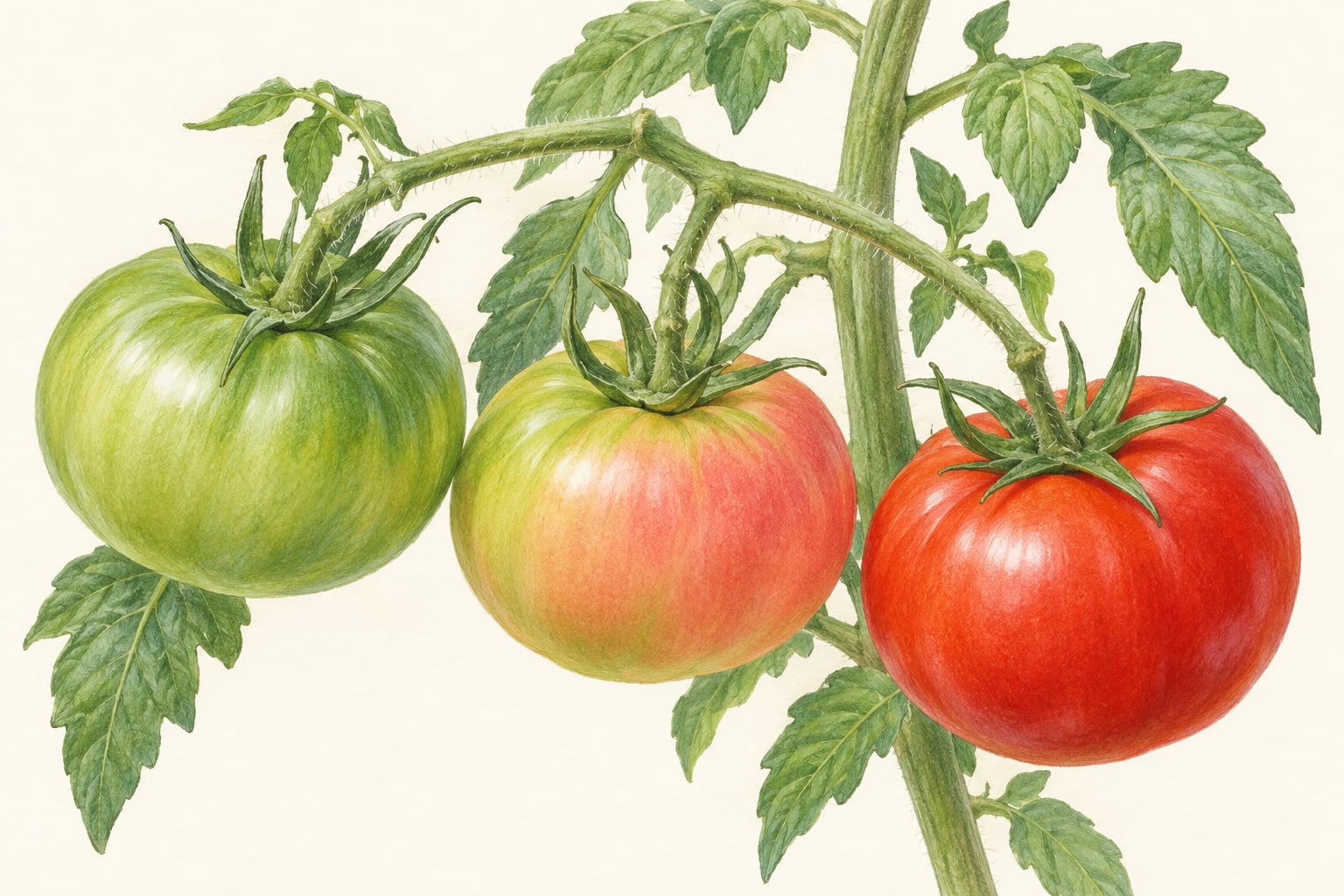
Start with the color pattern
| What you see | What it suggests checking |
|---|---|
| Uniformly green, full-sized fruit | Fruit may still be maturing, or high temperatures may be delaying normal color development. |
| First blush or color at the blossom end | The fruit has entered breaker/turning stages and can continue ripening after harvest. |
| Green or yellow shoulders while lower fruit colors | Check uneven-ripening or yellow-shoulder factors rather than assuming the whole fruit is simply unripe. |
| White, hard, blotchy, or streaked areas | Review heat, nutrition, pests, virus-like symptoms, and cultivar susceptibility. |
| Cracks, soft rot, or sunscald dominate | Route to the matching fruit-disorder diagnosis instead of treating color as the main problem. |
What tomato ripening actually changes
Immature green
Fruit is still developing; large size alone does not prove physiological maturity.
Mature green
Seeds and internal tissues have matured enough that the fruit is approaching color change, but the skin may still be green.
Breaker stage
The first visible color change begins. Extension guidance recognizes this as a mature stage from which fruit can continue ripening off the vine.
Turning to full color
Pigment development and softening continue; prolonged high temperatures can slow the red-color process even when fruit is otherwise mature.
Compare the main slow-ripening branches
Heat-delayed color change
- Many fruits remain green during a sustained hot spell.
- Ripening resumes as nights or fruit temperatures become cooler.
More likely if
- The fruit is full-sized and otherwise sound, with no patchy disorder pattern.
Less likely if
- Only shoulders or isolated patches stay green while the rest colors.
Keep care steady and wait for cooler conditions; do not force color with extra fertilizer.
Fruit is not mature yet
- Fruit set occurred later than expected or the cultivar has a longer maturity window.
- Fruit is still firm, dark green, or continuing to size.
More likely if
- The planting date and cultivar timing explain the delay.
Less likely if
- Comparable fruit on the same plant has already reached breaker stage.
Allow more time and track days from fruit set or cultivar maturity rather than size alone.
Uneven-ripening disorder
- Green or yellow shoulders, blotches, stripes, or white internal tissue remain as other parts color.
- High fertility, low potassium availability, high heat, whiteflies, or virus-like symptoms may be present.
More likely if
- The pattern is localized or patchy rather than uniformly green.
Less likely if
- All fruit simply pauses during heat and later colors normally.
Use soil/tissue evidence and pest or disease clues before changing nutrition or treating the plant.
Fruit problems that are not just 'slow ripening'
Yellow or green shoulder
The top of the fruit remains yellow-green or hard while other areas ripen; heat, cultivar, and nutrition can be involved.
Sunscald
A pale, bleached, papery or leathery patch develops on strongly exposed fruit rather than a normal green-to-ripe color transition.
Fruit cracking
Radial or concentric splits dominate; moisture swings and fruit expansion need their own diagnosis.
Rot or disease
Soft, wet, foul-smelling, mouldy, or expanding lesions are a decay problem, not a ripening schedule problem.
Checks before trying to speed ripening
- Compare the fruit with the cultivar's expected maturity range and the approximate date it set.
- Look for the first blush of color, especially near the blossom end, to identify breaker-stage fruit.
- Review sustained daytime and nighttime heat; use the fruit's pattern across several days rather than one afternoon temperature.
- Keep enough healthy foliage to avoid unnecessary sun exposure and check for major defoliation or disease.
- Review nitrogen and potassium management with soil or tissue evidence if ripening is persistently blotchy or uneven.
- Inspect leaf undersides for whiteflies and note virus-like distortion or mottling if uneven ripening occurs with broader plant symptoms.
Route fruit symptoms to the right next step
- The fruit is cracking or splitting as it colors: Use the splitting pathway for moisture swings, crack pattern, and harvest timing.Why are my tomatoes splitting?
- Root-zone moisture is unstable or irrigation is unclear: Use the tomato watering owner to stabilize the root zone without using water as a ripening treatment.How often should I water tomato plants?
- The fruit has a dark, sunken blossom-end lesion: Use the blossom-end-rot diagnosis rather than treating poor color as the main disorder.Why do my tomatoes have blossom-end rot?
What to do now
- During prolonged heat, keep moisture steady and allow time for cooler conditions rather than adding fertilizer to force color.
- If fruit has reached the breaker stage and storms, heat damage, pests, or late-season frost threaten it, harvesting to finish ripening indoors can be reasonable.
- Keep healthy foliage where practical so fruit is not suddenly exposed to intense sun.
- If color is patchy rather than simply delayed, inspect nutrition, pests, and whole-plant symptoms before changing the fertilizer program.
- Remove fruit that is actively rotting or badly damaged and diagnose the damage separately.
GardenSolved checkpoint
Do not do this yet
Avoid ripening shortcuts
- Do not strip healthy foliage simply to expose fruit to more sun; sunlight is not required for breaker-stage fruit to continue ripening, and excess exposure can contribute to sunscald.
- Do not apply extra nitrogen or potassium without soil, tissue, or crop evidence that supports it.
- Do not overwater in an attempt to speed color change.
- Do not treat green shoulders, white core, cracking, or rot as though they were all the same ripening delay.
- Do not expect every cultivar to ripen on the same calendar.
Confirm the likely cause first, then choose the treatment.
What improvement looks like
- Uniformly green mature fruit begins to show normal color as conditions moderate.
- Breaker-stage fruit continues through turning, pink, or full-color stages after harvest.
- New fruit colors more evenly after a confirmed stress or nutrient problem is corrected.
- Persistent hard shoulders or blotchy internal tissue indicate a separate uneven-ripening disorder even if other fruit ripens normally.
Support more reliable ripening
- Choose cultivars that fit the local season and expected heat pattern.
- Maintain steady water supply and adequate drainage rather than large moisture swings.
- Use soil-based fertility management and avoid excessive nitrogen.
- Protect enough healthy canopy to shade fruit while maintaining airflow and disease management.
When poor ripening needs a broader diagnosis
Ask a local extension office or plant-diagnostic service when uneven color is severe or persistent, fruit has hard white or green internal tissue, whiteflies or virus-like symptoms are present, or multiple fruit disorders overlap. These patterns should not be treated as heat delay alone.