Tomatoes
Why are my tomato plants wilting?
The short answer
Check moisture several inches below the surface before adding water. Dry soil plus recovery after a thorough watering supports drought stress; afternoon droop that clears as the day cools can be temporary heat stress. Wet soil, one-sided yellowing, stem injury, or wilt that keeps progressing needs a different diagnosis.
Wilting means the leaves are losing firmness, but it does not prove that the plant needs more water. Heat, dry soil, saturated soil, root or stem injury, and vascular disease can all interrupt the water balance in different ways.
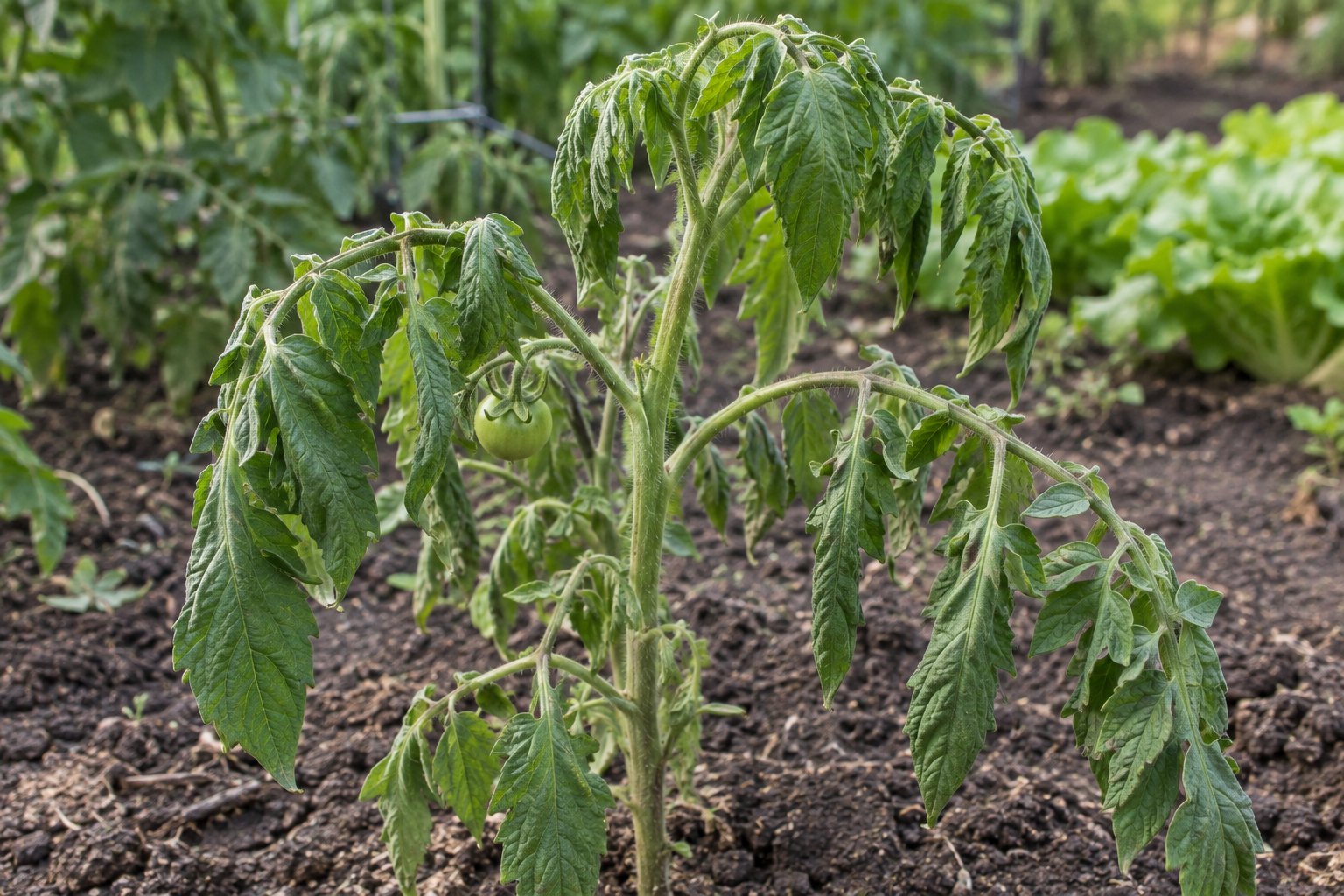
30-second wilt check
| Check | What the clue changes |
|---|---|
| Soil dry below the surface? | Dryness makes true water shortage more likely; a dry crust alone is not enough. |
| Recovers after peak heat? | Recovery as the day cools supports transient heat-related droop more than progressive wilt. |
| Soil saturated or slow to drain? | Do not add water; roots may lack oxygen or be damaged. |
| One side or the whole plant? | One-sided or steadily advancing wilt deserves closer disease and injury checks. |
| Yellowing, lesions, or stem damage? | Use the accompanying symptom to choose the next diagnostic path. |
| Transient or worsening? | Failure to recover in suitable moisture is an escalation clue. |
Compare the wilt pattern
Temporary heat-related droop
- Leaves lose firmness during the hottest part of the day.
- The plant improves later without progressive yellowing or stem collapse.
More likely if
- Root-zone moisture is adequate and the change closely follows intense heat, sun, or wind.
- The same plant is firm again in the morning or evening.
Less likely if
- The plant remains wilted overnight.
- Yellowing, lesions, stem damage, or one-sided decline keeps advancing.
Recheck during cooler conditions and protect the root zone from sharp moisture and temperature swings.
Genuinely dry root zone
- Soil is dry several inches down, not only at the surface.
- Leaves and soft stems may droop across the whole plant.
More likely if
- The container feels light or soil pulls from its edge.
- The plant regains firmness after slow, thorough root-zone watering.
Less likely if
- Soil is already wet or water stands around the roots.
- The plant fails to improve despite suitable moisture.
Water slowly at soil level, allow it to soak in, and reassess rather than repeating small surface splashes.
Saturated or poorly drained root zone
- Soil stays wet, smells sour, or drains slowly after rain or irrigation.
- Wilt may occur with yellowing, weak growth, or root decline.
More likely if
- A container lacks clear drainage or a bed remains waterlogged.
- Repeated watering does not restore firmness.
Less likely if
- The root zone is genuinely dry and the plant responds promptly to watering.
- Drainage is free and symptoms track only the hottest hours.
Pause watering, restore drainage where possible, and avoid disturbing already stressed roots unnecessarily.
Root, transplant, or stem injury
- Wilt began soon after transplanting, cultivation, staking, wind, or physical damage.
- A kink, crack, lesion, constriction, or disrupted root area is visible.
More likely if
- The affected branch sits above a damaged section.
- The timing closely follows root or stem disturbance.
Less likely if
- There is no injury history and decline moves progressively through several plants.
- A simple dry-soil episode explains the whole pattern.
Support intact stems, stop further disturbance, and monitor whether undamaged growth stabilizes.
Persistent disease-like wilt
- Wilt continues despite suitable moisture and cooler conditions.
- Yellowing or decline may begin on one side, one branch, or lower foliage and progress.
More likely if
- Several plants show a similar progressive pattern or internal stem tissue is discolored.
- The plant declines without a reversible moisture or injury explanation.
Less likely if
- The plant recovers fully after heat passes or dry soil is watered.
- Symptoms stop after a clear physical stress is corrected.
Photograph the pattern and seek a local diagnosis; home observation cannot reliably name the wilt pathogen.
Checks you can make safely
- Push a finger or narrow trowel several inches into the soil away from the stem; compare the moisture with an unaffected plant if possible.
- Record whether the plant is firm in the morning, droops only in peak heat, or remains wilted through cooler hours.
- Check whether the whole plant, one side, one branch, or only new growth is affected.
- Inspect the stem base and supports for cracks, constriction, lesions, boring holes, or chewing; avoid cutting the main stem merely to experiment.
- Review recent rain, irrigation, transplanting, cultivation, staking, wind, and root disturbance.
- A brown vascular pattern can support a wilt investigation, but it does not by itself distinguish Fusarium, Verticillium, bacterial wilt, or another cause.
Symptoms that can look like wilt
Physiological leaf roll
Leaves roll upward and may remain firm rather than hanging limp; use the curling pathway when roll is the main symptom.
Leaf yellowing or spotting
When yellow tissue, halos, or discrete lesions dominate, use the yellow- or brown-leaf pathway to classify the pattern.
A broken or bent stem
Wilt confined above a visible kink or break is a physical transport problem, not evidence of a root-zone disease by itself.
Choose the next diagnostic step
- The root zone is dry or the watering pattern is unclear: Build the next watering decision from soil, weather, and container conditions.How often should I water tomato plants?
- Yellowing is spreading or differs between old and new leaves: Map the yellowing pattern before feeding or watering again.Why are my tomato leaves turning yellow?
- Brown lesions, halos, or dead patches are prominent: Compare disease-like spots with environmental browning.Why are my tomato leaves turning brown?
- Leaves remain firm but roll or twist: Use curl direction and new-growth clues instead of treating the plant as simply wilted.Why are my tomato leaves curling?
What to do now
- If the root zone is dry, water slowly and thoroughly at soil level, then allow time for a response before watering again.
- If the soil is saturated, stop irrigation and improve drainage or empty standing saucers; do not force airless soil to stay wet.
- Shade a recent transplant temporarily during exceptional heat, support an intact injured stem, and avoid additional root disturbance.
- Isolate tools and avoid moving soil from a progressively declining plant until disease risk is clearer.
- For persistent or one-sided wilt, document the full plant, stem base, soil condition, and symptom progression for a local diagnostic service.
GardenSolved checkpoint
Do not do this yet
- Do not water already saturated soil because leaves are drooping.
- Do not repeat watering solely from the appearance of wilt without rechecking root-zone moisture.
- Do not fertilize a severely stressed or root-damaged plant without evidence that nutrition is the problem.
- Do not identify Fusarium, Verticillium, bacterial wilt, or root rot from one photograph.
- Do not apply a pesticide or fungicide indiscriminately; wilt is a symptom, not a product target.
Confirm the likely cause first, then choose the treatment.
How to judge recovery
- A dry plant should begin regaining firmness after the root zone is thoroughly moistened, although badly damaged leaves may not fully recover.
- Temporary heat droop should ease as conditions cool; repeated daily droop still warrants a moisture and root-zone review.
- If wilt persists or advances despite suitable moisture, stop treating it as a routine watering problem.
Reduce repeat wilting
- Check moisture below the surface and water deeply enough to reach the active root zone.
- Use mulch to moderate evaporation while keeping it away from the stem, and maintain free drainage.
- Harden off transplants, support stems early, and avoid cultivating deeply around established roots.
- Rotate tomato-family crops and choose locally appropriate resistant cultivars when a wilt disease is confirmed.
When to ask for diagnostic help
Contact a local extension office or plant-diagnostic service when wilt persists in suitably moist soil, advances on one side or from plant to plant, is accompanied by internal stem discoloration or rapid collapse, or cannot be separated from root or stem injury. Do not move suspect soil or choose a pesticide until the cause is clearer.