Tomatoes
Why are my tomatoes splitting?
The short answer
First confirm that the damage is a growth crack rather than blossom-end rot, catfacing, sunscald, or soft decay. A dry period followed by heavy rain or irrigation is a common cracking pattern because fruit can expand faster than the skin stretches. Stabilize root-zone moisture, harvest vulnerable fruit at an appropriate maturity stage, and do not treat cracking as proof of a calcium deficiency.
Tomato growth cracks usually start near the stem end as radial splits or concentric rings. They often follow rapid fruit expansion when water availability changes, but ripening stage, cultivar, temperature, fruit exposure, and crop growth all modify the risk.
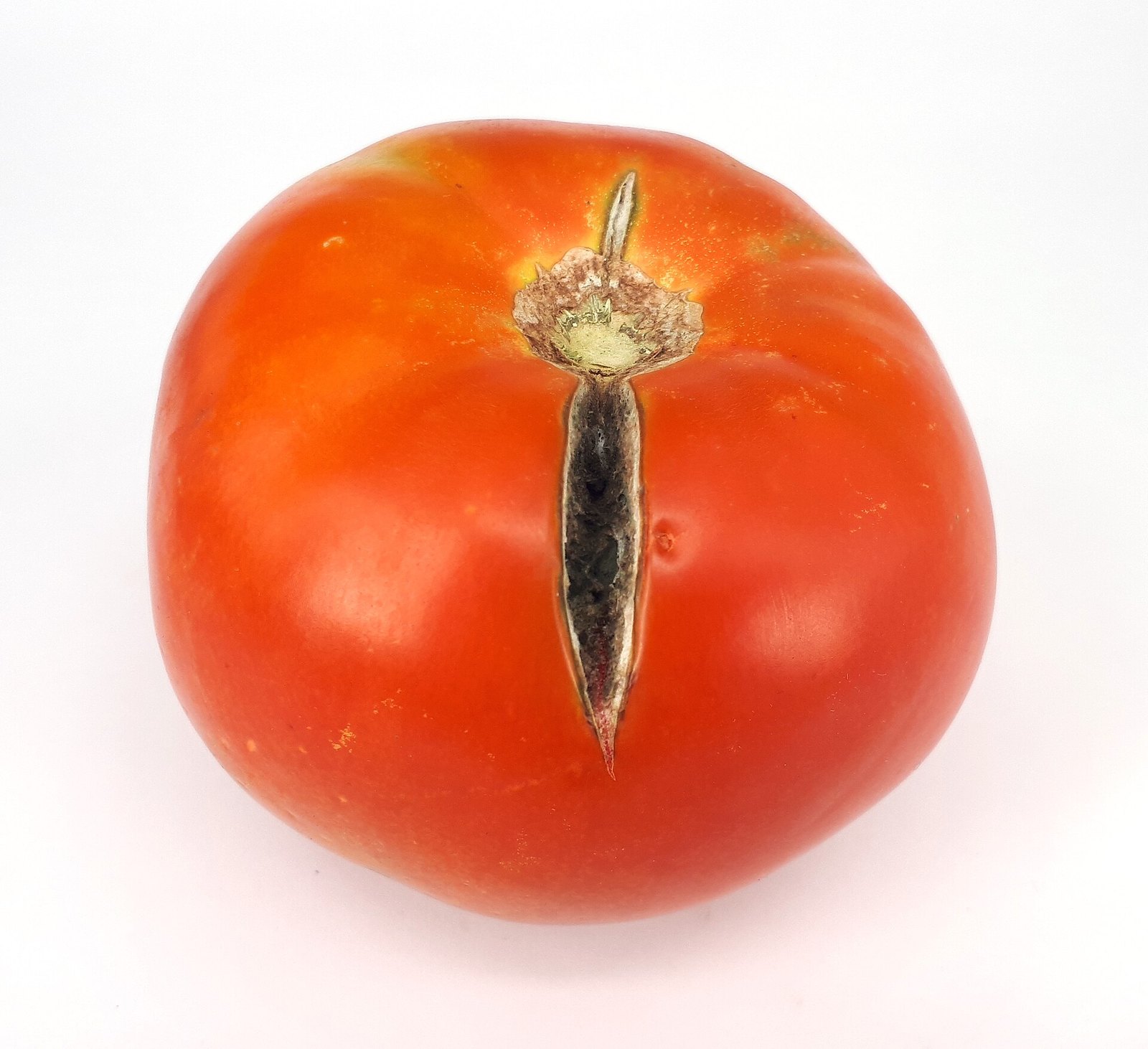

Confirm the crack pattern first
| Pattern | What it changes |
|---|---|
| Radial crack from the stem scar | Fits a common growth-crack pattern; review moisture change, ripening stage, heat, and cultivar. |
| Concentric rings around the stem end | Also fits growth cracking; repeated rings can widen as fruit expands. |
| Deep folds or scars at the blossom end | Consider catfacing or developmental injury rather than ordinary radial/concentric cracking. |
| Dark sunken patch centered at the blossom end | Use the blossom-end-rot pathway instead of treating it as a split. |
| Soft, wet, mouldy, or foul-smelling tissue | Decay is now present; do not treat this as a cosmetic crack only. |
Why growth cracks form
Rapid change in water availability
A common pattern is dry soil followed by heavy rain or irrigation. Rapid water uptake can increase fruit expansion faster than the skin can accommodate.
Ripening and fruit physiology
Cracking is often more common as fruit approaches ripeness because the skin and stem-end tissues become more vulnerable while the fruit is still expanding.
Heat, sun exposure, and rapid growth
High fruit temperature, direct exposure, and vigorous growth can add stress to fruit skin, especially when moisture also changes quickly.
Cultivar susceptibility and crop load
Tomato cultivars differ in cracking susceptibility, and growth rate can change with fruit load and pruning. The same weather does not affect every variety equally.
Checks before changing irrigation or nutrition
- Compare the crack location with radial and concentric growth-crack examples.
- Check recent rainfall and irrigation for a dry-to-wet transition or unusually large water input.
- Assess root-zone moisture below the surface and verify that water is reaching the whole root area without prolonged saturation.
- Note fruit maturity, cultivar, pruning or leaf loss, and whether exposed fruit heated strongly in direct sun.
- Inspect damaged fruit for secondary decay; a crack can become an entry point for spoilage organisms.
- Do not diagnose calcium deficiency from a crack pattern; use soil or tissue evidence for nutrient decisions.
Lookalikes that change the next step
Blossom-end rot
A dark, sunken lesion develops at the blossom end rather than a radial or concentric skin split from the stem area.
Catfacing
Deep scars, cavities, folds, or misshapen tissue are centered near the blossom end and trace back to flower-development injury.
Sunscald
A pale or bleached leathery patch develops on exposed fruit without the characteristic growth-crack geometry.
Soft rot
Wet, leaking, mouldy, foul-smelling, or rapidly softening tissue indicates decay and needs a food-safety-aware response.
Route the next question
- The root-zone watering pattern is unstable or unclear: Use the tomato watering guide to build a moisture-based routine.How often should I water tomato plants?
- The fruit is also staying green or coloring unevenly: Use the ripening page to separate heat delay from uneven-ripening disorders.Why are my tomatoes not ripening?
- The dominant damage is a dark sunken blossom-end lesion: Use the blossom-end-rot diagnosis before adding calcium or amendments.Why do my tomatoes have blossom-end rot?
What to do now
- Harvest cracked fruit promptly so the damage can be inspected before weather, insects, or microbes worsen it.
- Discard fruit that is actively rotting, mouldy, leaking, foul-smelling, or extensively soft; for food-use questions about damaged fruit, follow local food-safety guidance.
- Stabilize irrigation around actual root-zone moisture instead of compensating for a dry spell with a single extreme soaking when it can be avoided.
- Use mulch where appropriate to reduce rapid evaporation changes while keeping the stem area clear and drainage functional.
- If repeated cracking is severe, consider crack-tolerant cultivars and harvest at a suitable breaker/turning stage when local weather makes vine cracking likely.
GardenSolved checkpoint
Do not do this yet
Avoid common cracking mistakes
- Do not diagnose calcium deficiency from fruit cracking alone.
- Do not swing from very dry soil to repeated heavy irrigation if a steadier moisture pattern is possible.
- Do not strip healthy foliage just to expose fruit; excess exposure can raise fruit temperature and sunscald risk.
- Do not assume every crack is cosmetic when tissue is soft, wet, mouldy, or foul-smelling.
- Do not expect an existing crack to close; prevention applies to fruit that is still developing.
Confirm the likely cause first, then choose the treatment.
What improvement looks like
- Existing cracks remain visible but stop enlarging rapidly once the fruit is harvested or growth slows.
- Newer fruit develops with fewer cracks after moisture swings are reduced.
- Fruit harvested at an appropriate maturity stage avoids some late-vine cracking during risky weather.
- If new fruit keeps cracking despite steady moisture, reassess cultivar susceptibility, fruit exposure, crop load, and irrigation distribution.
Reduce cracking on future fruit
- Keep root-zone moisture more consistent through fruit enlargement and ripening while maintaining drainage.
- Use mulch and adequate soil volume to moderate rapid drying, especially in containers and raised beds.
- Maintain enough healthy foliage to buffer fruit from intense sun while avoiding excessive, destabilizing pruning.
- Choose cultivars described as crack-tolerant when cracking is a recurring local problem.
- Monitor ripening fruit closely around forecast heavy rain after dry weather and harvest appropriately mature fruit before damage escalates.
When a split fruit needs another diagnosis
Use a local extension or plant-diagnostic service when cracks are accompanied by unusual lesions, severe internal breakdown, repeated fruit malformation, or broader plant decline. For questions about eating damaged or decaying fruit, follow local food-safety guidance rather than relying on crack depth alone.