Tomatoes
Why aren't my tomatoes sweet?
The short answer
Compare a healthy, fully ripe fruit with the flavor expected from that cultivar. Variety matters, and tomato sweetness differs among cultivars. Fruit harvested truly green can finish with poorer flavor than fruit allowed to mature farther, while steady moisture and full sun support overall fruit quality. If a ripe tomato is intact but mild, that can be normal for the cultivar rather than a nutrient deficiency.
A ripe tomato can taste bland, sharp, or less sweet than expected even when the plant looks healthy. Tomato flavor comes from the balance of sugars, acids, and aroma compounds, and cultivars differ naturally. Start with cultivar and true ripeness, then check growing conditions and storage instead of trying to force sweetness with fertilizer or sugar water.
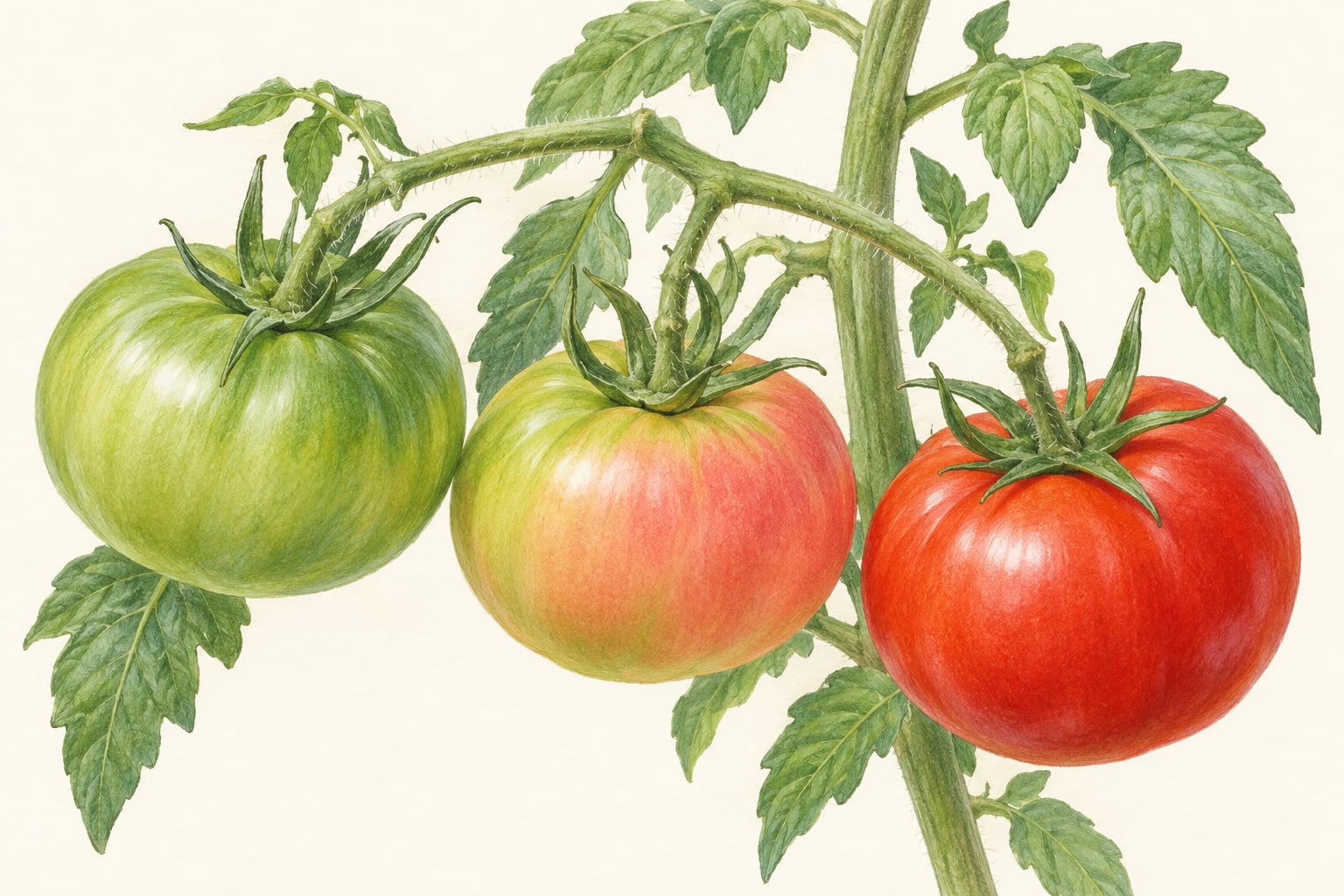
Start with cultivar, ripeness, and fruit condition
| What you observe | What it suggests first | Next check |
|---|---|---|
| Several fully ripe, healthy fruit from one cultivar taste consistently mild | Cultivar flavor may be the main explanation | Compare the cultivar description and another ripe variety grown under similar conditions |
| Fruit was picked while still truly green | Harvest stage may have limited flavor development | Compare with fruit allowed to reach a turning or ripe stage before harvest |
| Fruit quality is weak after limited sun or repeated dry-wet swings | Growing conditions may be reducing overall fruit quality | Check direct sun and root-zone moisture before changing fertilizer |
| A ripe tomato tastes dull after refrigeration | Cold storage can reduce fresh-eating flavor and texture | Compare a ripe sample at room temperature |
| Fruit is green, cracked, rotten, sunken, or otherwise damaged | Taste is not the primary diagnostic problem | Route by the visible fruit symptom first |
Compare the main flavor branches
Cultivar baseline
- Healthy ripe fruit repeatedly has the same mild, tart, or sweet balance.
- Another cultivar grown nearby tastes different.
More likely if
- The plant is healthy and fruit ripens normally.
- The variety description matches the flavor you are tasting.
Less likely if
- Flavor changed suddenly together with poor ripening, lesions, or plant decline.
Treat the flavor as a cultivar trait and choose a variety with the sweetness or flavor balance you prefer next season.
Harvested too early
- Fruit was picked while uniformly green and firm.
- Indoor-ripened fruit tastes weaker than fruit left longer on the plant.
More likely if
- The fruit had not begun a normal color transition before harvest.
- Later-picked fruit from the same cultivar tastes better.
Less likely if
- Fruit was already at the turning or ripe stage and the cultivar normally tastes mild.
For fresh eating, allow healthy fruit to reach an appropriate mature stage before harvest when weather and disease risk allow.
Growing-condition quality stress
- Plants receive less than full sun or the root zone repeatedly swings between very dry and very wet.
- Fruit quality is weak together with broader plant stress.
More likely if
- The pattern affects several fruit during the same stressful period.
- New fruit quality improves after steadier care and better light conditions.
Less likely if
- Only one cultivar tastes mild while neighboring cultivars under the same care taste as expected.
Keep moisture steady, preserve healthy foliage, and provide the strongest appropriate sun rather than using a sweetness additive.
Storage effect
- The tomato was ripe before storage but tastes muted after refrigeration.
- Texture and aroma also seem reduced.
More likely if
- A comparable ripe fruit kept at room temperature tastes better.
- The fruit is otherwise healthy and fully ripe.
Less likely if
- The tomato tasted bland before storage or never reached proper maturity.
For short-term fresh eating, keep ripe tomatoes at room temperature when food-safety and spoilage conditions allow, and taste chilled fruit after it warms.
Checks before trying to change sweetness
- Taste more than one healthy fruit from the same cultivar at the same ripeness stage.
- Compare the cultivar with another tomato grown under similar conditions; sweetness varies among varieties.
- Confirm harvest stage: truly green fruit is different from mature fruit that has begun its normal color transition.
- Check direct sun and root-zone moisture history instead of assuming bland flavor means the plant needs fertilizer.
- Separate storage effects by tasting a ripe tomato at room temperature.
Route the strongest companion clue
- Fruit stays green or changes color unusually slowly: Use the Tomato Not Ripening diagnosis; that is a maturity problem before it is a flavor problem.Why are my tomatoes not ripening?
- Fruit is splitting or cracking: Use the Tomato Splitting diagnosis and address moisture-related cracking first.Why are my tomatoes splitting?
- Fruit has a dark sunken patch at the blossom end: Use the Blossom-End Rot diagnosis rather than treating taste.Why do my tomatoes have blossom-end rot?
- The root zone repeatedly dries out or the plant wilts: Use the Tomato watering or wilting guidance to correct the plant-health problem first.How often should I water tomato plants?
What to do now
- Confirm the cultivar and judge flavor against its normal ripe profile rather than against a different tomato type.
- For fresh eating, harvest healthy fruit at an appropriate mature stage instead of routinely picking it truly green.
- Keep the root zone consistently moist and avoid shallow watering that leaves deeper roots dry.
- Provide full sun where possible and keep enough healthy foliage to support the crop without exposing fruit to unnecessary sunscald.
- If ripe fruit has been refrigerated, compare flavor again after it returns to room temperature before changing garden care.
GardenSolved checkpoint
Do not do this yet
- Do not pour sugar water around the roots; plants do not need a household sugar solution to make fruit taste sweeter.
- Do not add extra fertilizer just because ripe fruit tastes mild.
- Do not deliberately drought-stress tomato plants as a home-garden sweetness shortcut; consistent moisture supports fruit quality.
- Do not assume every red tomato should have the same sweetness; cultivar and sugar-acid balance differ.
- Do not treat cracking, rot, stalled ripening, or blossom-end injury as a flavor-only problem.
Confirm the likely cause first, then choose the treatment.
What improvement looks like
- New fruit reaches the expected mature color and texture for the cultivar.
- Flavor becomes consistent across several healthy fruit harvested at the same stage.
- Plants maintain steady growth without repeated wilting or severe moisture swings.
- You can separate a naturally mild cultivar from a temporary ripeness, storage, or plant-stress problem.
Build better tomato flavor next season
- Choose cultivars for the flavor profile you actually prefer; variety trials show real differences in perceived sweetness.
- Grow tomatoes in full sun and maintain steady root-zone moisture for strong fruit quality.
- Keep cultivar labels so you can compare flavor and ripeness accurately.
- Harvest fresh-eating fruit at a suitable mature stage instead of treating calendar age or red color alone as proof of peak flavor.
- Avoid unnecessary cold storage when ripe tomatoes will be eaten soon.
When bland flavor is not the main problem
Escalate to a plant-health diagnosis when poor flavor appears with fruit that will not ripen, widespread cracking, rot, unusual lesions, severe leaf loss, persistent wilt, or broader plant decline. Those patterns need a fruit or plant diagnosis rather than a sweetness treatment.