Strawberries
Why Are My Strawberry Leaves Turning Brown?
The short answer
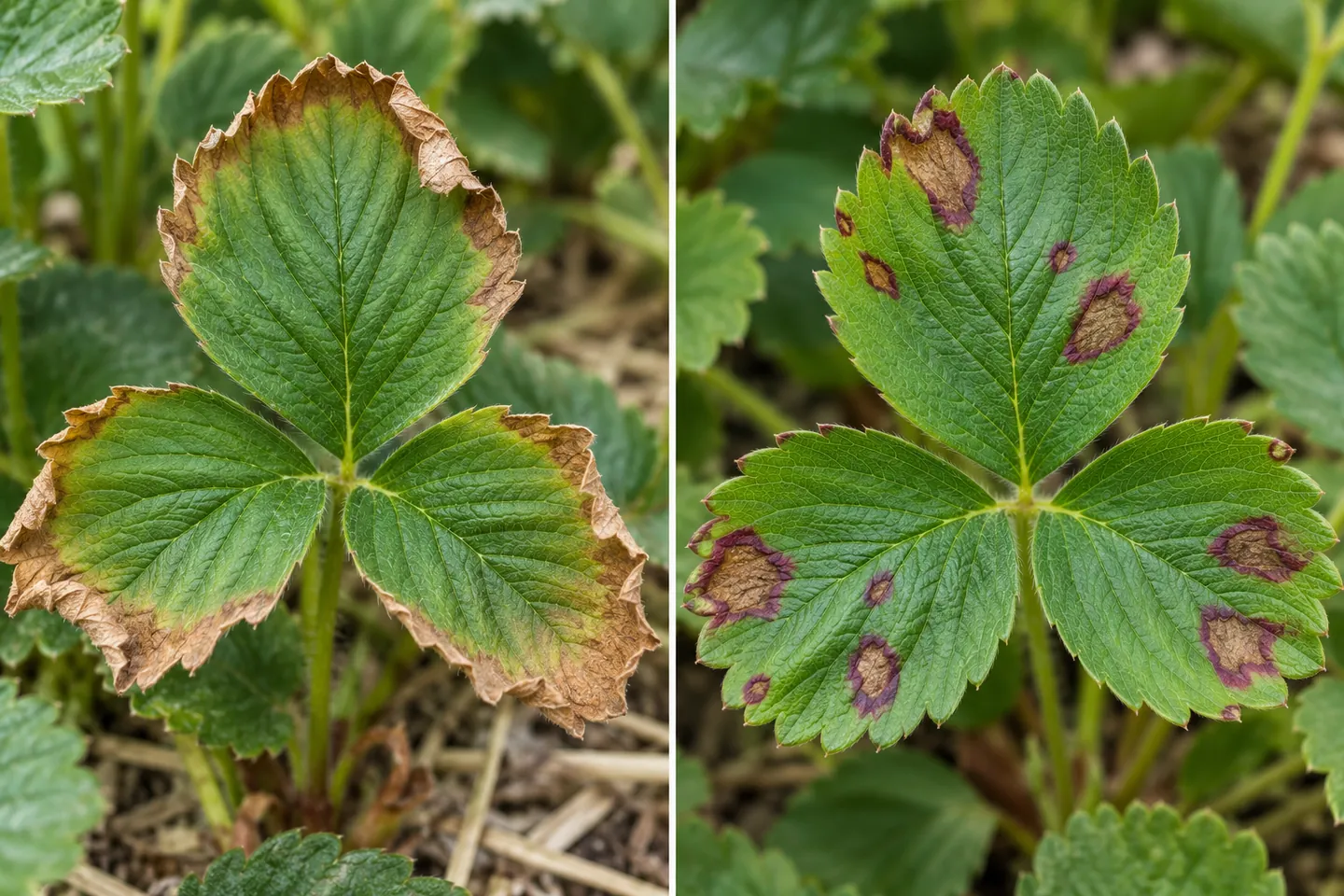
Check the root zone and the shape of the brown tissue. Dry exposed margins after weather stress point in a different direction from purple-bordered lesions, wet-root decline, or older leaves that wilt and brown while center growth stays green.
Brown strawberry leaves can come from cold or wind injury, dry roots, wet-root decline, leaf scorch or blight, mites, or wilt disease. Whether browning begins at margins, forms spots, or arrives with wilt helps narrow the cause.
Diagnostic snapshot
What to check before you act
What you are seeing
- Brown edges follow cold, wind, heat, or dry soil
- Brown tissue develops from purple or red spots
Check first
Check whether brown tissue is marginal, spot-like, V-shaped, or associated with wilt.
Hold off for now
Do not fertilize a badly wilted or root-damaged plant just because leaves are brown.
Investigate further if
Seek diagnosis when browning spreads with crown or root decline, persistent wilt, or distinctive lesions across several plants.
Photograph this before you act
- Photograph the soil surface and root-zone or container context; do not disturb roots just to take a photo.
- Take a sharp close-up of the affected leaf and a second photo of the underside.
Next best check
Check two visible clues before you act.
This mini-check narrows the match using the same canonical diagnostic clues as this answer. It does not confirm a diagnosis from one or two clicks, and it does not make a photo-only diagnosis.
Two quick observations can tell you whether to keep reading this diagnosis closely or compare other possibilities first.
Match the brown pattern to the next check
| Pattern | Check first |
|---|---|
| Dry brown margins after exposure | Review cold, wind, heat, and root-zone moisture. |
| Brown centers or expanding lesions with purple borders | Compare leaf spot, scorch, and blight patterns. |
| Brown leaves plus saturated soil or weak roots | Investigate drainage and root health. |
| Older leaves wilt and brown while inner leaves remain green | Consider a wilt-disease pattern and local diagnosis. |
How to confirm the problem
- Check whether brown tissue is marginal, spot-like, V-shaped, or associated with wilt.
- Inspect root-zone moisture and drainage before changing watering.
- Look for mites, webbing, purple lesions, crown decline, or a consistent wilt pattern.
What to do now
- Correct a confirmed dry or saturated root zone gradually rather than reacting to leaf color alone.
- Remove badly diseased foliage when sanitation guidance supports it and keep the bed open enough for airflow.
- Protect plants from severe cold and wind according to local seasonal guidance.
- If wilt or crown decline is present, inspect roots and use local diagnostic help before replanting the same site.
GardenSolved checkpoint
Do not do this yet
Avoid broad treatments
- Do not fertilize a badly wilted or root-damaged plant just because leaves are brown.
- Do not assume all brown spots are the same strawberry leaf disease.
- Do not keep wet soil wetter in an attempt to rehydrate browned foliage.
Confirm the likely cause first, then choose the treatment.
What improvement to look for
- Dead brown tissue will not become healthy green tissue.
- Judge progress by new growth and whether damage keeps spreading.
How to reduce repeat problems
- Monitor drainage and weather exposure before damage builds.
- Avoid excess fertilizer; investigate salts if browning follows feeding.
Which check comes next?
- Browning occurs with persistent wilt: Investigate the root-zone evidence.Why Are My Strawberry Plants Wilting?
- Purple spots precede browning: Compare the red-leaf disease patterns.Why Are My Strawberry Leaves Turning Red?
When to investigate further
Seek diagnosis when browning spreads with crown or root decline, persistent wilt, or distinctive lesions across several plants.
Sources
Save & recheck
Compare what changes before changing course.
Save this diagnosis only in this browser, then come back and compare the same clues. No account, reminder subscription, or server-stored diagnostic record is created.
Your baseline
- Brown edges follow cold, wind, heat, or dry soil
- Brown tissue develops from purple or red spots
Check again when you return
- Check whether brown tissue is marginal, spot-like, V-shaped, or associated with wilt.
- Inspect root-zone moisture and drainage before changing watering.
Tip: photograph the same area from a similar angle so the visible pattern is easier to compare.
Related questions
Diagnostic Finder
Still not sure this answer fits?
Open the Diagnostic Finder with the relevant growing subject or care context preselected and compare other published GardenSolved diagnoses.
Compare other possibilities