Pests & Diseases
How Do I Know If My Plant Has Aphids?
The short answer
Look for clusters of small pear-shaped insects on new growth or leaf undersides. Aphids may be green, black, gray, yellow, pink, or other colors, so color alone is unreliable. Honeydew, sooty mold, ants, curled leaves, or distorted shoots can occur with a heavier infestation, but confirm actual aphids before treating.
Aphids are small soft-bodied sap feeders that often gather on tender shoots, buds, stems, or leaf undersides. Sticky residue and curled growth can support the diagnosis, but the insects themselves are the strongest clue.
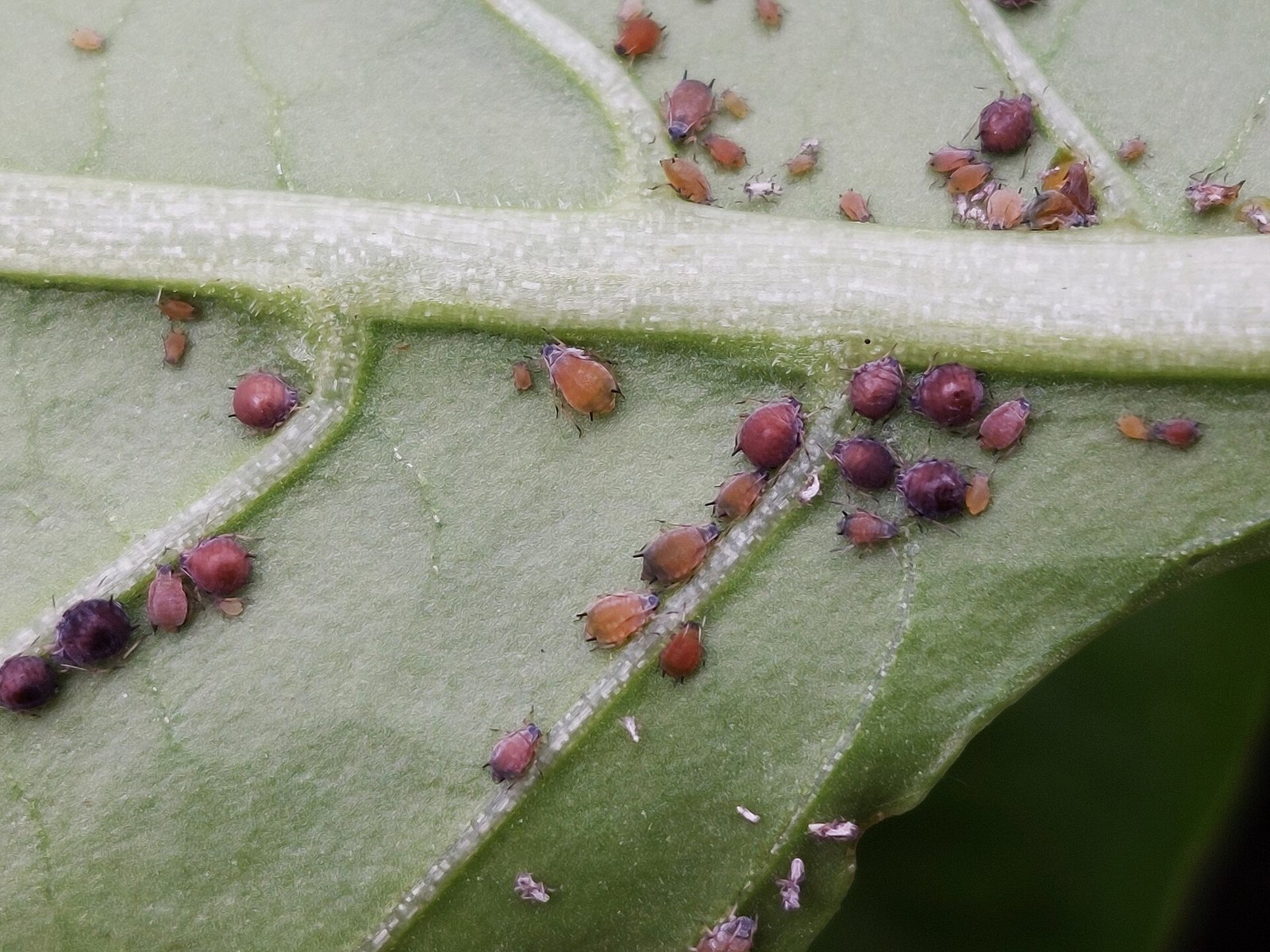

Aphids or a similar sap-feeding pest?
Aphids
- Small soft-bodied pear-shaped insects cluster on tender growth or leaf undersides.
- Colonies may include different colors and pale shed skins.
More likely if
- Sticky honeydew or ants occur directly around a visible colony.
- A hand lens reveals the characteristic body shape and rear cornicles.
Less likely if
- Tiny white adults immediately flutter from the leaf when disturbed.
- The insects are fixed waxy bumps that do not resemble soft-bodied aphids.
Confirm the colony on multiple leaves before choosing management.
Whiteflies
- Tiny white moth-like adults rest on leaf undersides.
- Adults flutter up when infested foliage is disturbed.
More likely if
- Flat immature stages are also present on the underside.
- The visible adults are white and winged rather than pear-shaped.
Use the Whiteflies guide for underside inspection.
Scale or mealybugs
- Scale appears as attached waxy bumps; mealybugs have conspicuous white waxy filaments or cottony masses.
More likely if
- The pest is fixed to stems or veins, or is surrounded by obvious white wax.
Use the Scale or Mealybugs guide before treating.
Checks before calling it aphids
- Inspect tender shoots, buds, stems, and leaf undersides with a hand lens.
- Compare the insect body with the real aphid photograph and look for the pear-shaped outline rather than matching color.
- Disturb the leaf gently: aphids usually remain on the plant, unlike adult whiteflies that readily flutter away.
- Check nearby leaves for honeydew, sooty growth, ants, or shed skins as supporting clues.
What to do after you confirm aphids
- For a light infestation, remove or rinse aphids from affected shoots and leaf undersides with water if the plant can tolerate it.
- Recheck new growth every few days because small colonies can rebuild quickly from survivors.
- Outdoors, avoid destroying lady beetles, lacewings, hoverfly larvae, and other natural enemies while you monitor the colony.
- If a pesticide becomes necessary, identify the plant and aphid problem first and use only a product legally labeled for that plant and use, following the label exactly.
GardenSolved checkpoint
Do not do this yet
- Do not diagnose aphids from sticky leaves, ants, or curled growth without finding the insects.
- Do not apply a broad-spectrum insecticide before checking whether natural enemies are already suppressing the colony.
- Do not overfertilize in response to distorted new growth; excess tender growth can make a plant more attractive to sap feeders.
- Do not use homemade soap or detergent mixtures as if they were universally safe for foliage.
Confirm the likely cause first, then choose the treatment.
When to investigate further
Escalate when colonies are widespread, growth is badly distorted or dying back, the pest cannot be identified confidently, or repeated infestations persist after nonchemical removal. On edible plants, use crop-specific local guidance before applying any pesticide.
Sources
Related questions
Diagnostic Finder
Still not sure this answer matches?
Continue with this plant already selected. The Finder will let you compare the visible problem and, when needed, the pattern against other relevant GardenSolved answers.
Compare other possibilities