Pests & Diseases
How Do I Know If My Plant Has Whiteflies?
The short answer
Turn over several leaves and look for tiny white moth-like adults plus flat immature stages on the underside. Gently disturbing an infested leaf often sends adults fluttering into the air. Honeydew, sooty mold, yellowing, or reduced vigor can accompany heavier infestations, but confirm the insects because aphids, scale, and mealybugs can also cause sticky foliage.
Whiteflies are tiny white winged sap feeders that usually concentrate on leaf undersides. Adults often make themselves obvious by fluttering up when infested foliage is disturbed.
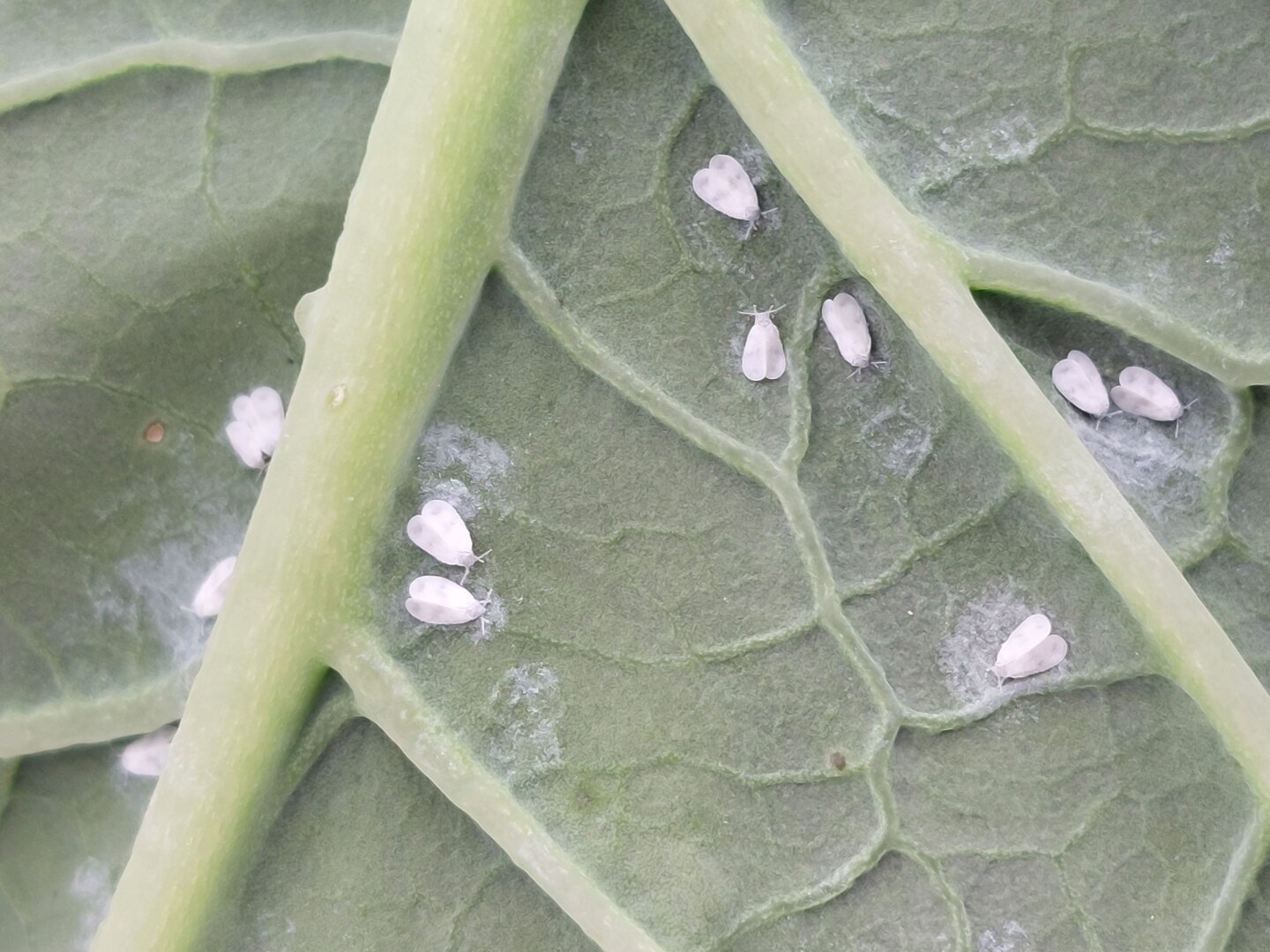

Whiteflies or another sticky-leaf pest?
Whiteflies
- Tiny white winged adults rest on leaf undersides.
- Adults flutter when disturbed and flat immature stages can remain attached below the leaf.
More likely if
- Both adult and immature stages are found on the same plant.
- Honeydew occurs below a visible underside population.
Less likely if
- The insects are pear-shaped and remain clustered when disturbed.
Confirm both underside insects and the fluttering adult behavior.
Aphids
- Soft pear-shaped insects form colonies on shoots or leaf undersides.
- They may be many colors and usually do not take off as a cloud of white adults.
Use the Aphids guide.
Mealybugs or scale
- Mealybugs have cottony white wax; scale appears as attached bumps or shields.
More likely if
- The pest does not flutter and remains fixed or wax-covered on stems and veins.
Use the Mealybugs or Scale guide.
Checks before calling it whiteflies
- Inspect the underside of multiple leaves with a hand lens.
- Gently disturb foliage and watch for tiny white moth-like adults fluttering away.
- Look for flat immature stages still attached to the underside after adults move.
- Check nearby leaves for honeydew and sooty mold, but use those only as supporting clues.
What to do after you confirm whiteflies
- Separate a movable infested indoor plant and inspect neighboring plants, especially their leaf undersides.
- Rinse sturdy leaf undersides where practical and remove badly infested expendable leaves without stripping healthy foliage.
- Use sticky traps only to monitor adult activity and population trend; continue underside inspections for immature stages.
- If pesticide treatment is needed, use only a product labeled for the plant and whitefly problem and follow the label exactly.
GardenSolved checkpoint
Do not do this yet
- Do not diagnose whiteflies from sticky or yellow leaves without seeing the insects.
- Do not assume every small white speck is an adult whitefly; confirm shape and behavior on the underside.
- Do not treat sticky traps as complete control because immature stages remain on leaves.
- Do not use an unlabelled pesticide mixture on edible or ornamental plants.
Confirm the likely cause first, then choose the treatment.
When to investigate further
Escalate when whiteflies are widespread, leaves are dropping or growth is distorted, or repeated physical management is not reducing the population. Greenhouse and food-crop situations can require species- and crop-specific local guidance.
Sources
Related questions
Diagnostic Finder
Still not sure this answer matches?
Continue with this plant already selected. The Finder will let you compare the visible problem and, when needed, the pattern against other relevant GardenSolved answers.
Compare other possibilities