Pests & Diseases
How Do I Know If My Plant Has Spider Mites?
The short answer
Inspect leaf undersides with magnification. Spider mites are tiny moving dots, often with eggs nearby; repeated feeding creates many fine pale specks that can merge into bronzed or bleached foliage. Fine webbing strongly supports a heavier infestation, but drought stress or thrips can also discolor leaves, so confirm mites with a hand lens or a white-paper tap test.
Spider mites are extremely small and often reveal themselves through their feeding pattern before the mites are obvious. Fine pale stippling on leaves, bronzing, and delicate webbing in heavier infestations are the main clues to investigate.
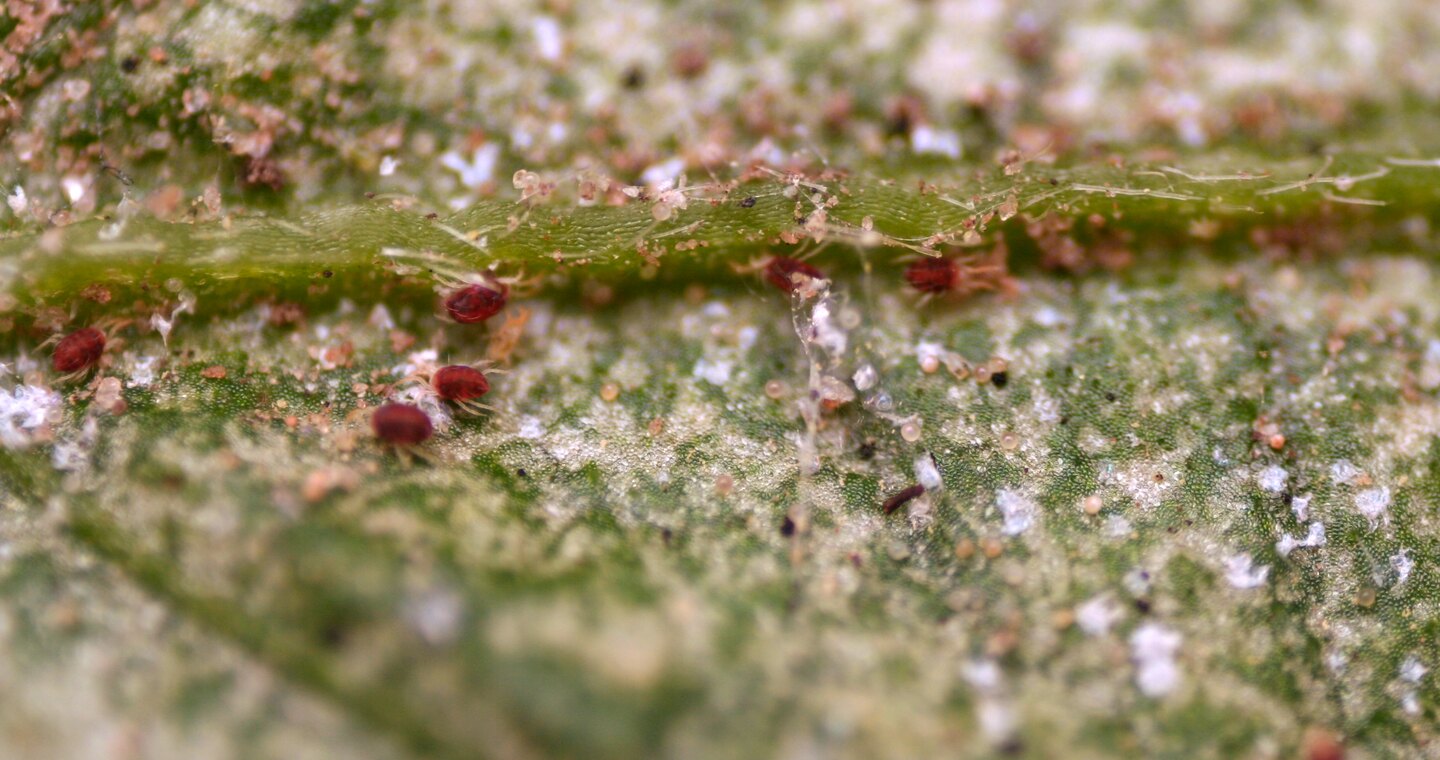

Spider mites, thrips, or drought stress?
Spider mites
- Fine, evenly scattered stippling develops from many tiny feeding points.
- Mites or eggs are visible underneath the leaf; heavier infestations may produce fine webbing.
More likely if
- A white-paper tap test reveals tiny moving specks.
- The damaged leaf has fine silk close to veins or stems.
Less likely if
- No mites, eggs, or webbing can be found after careful inspection.
Confirm mites with magnification before choosing a mite-specific response.
Thrips
- Feeding often looks more silvery, streaked, or scarred than evenly stippled.
- Tiny dark tar-like frass may accompany damage.
More likely if
- Slender insects are found in flowers, folded leaves, or on damaged tissue.
- Black frass specks occur beside pale scars.
Use the Thrips guide for the frass-and-scar pattern.
Water or heat stress
- Leaves may yellow, bronze, curl, or crisp without any pest being present.
More likely if
- Root-zone moisture or recent heat explains the timing and repeated pest checks are negative.
Check the root zone and recent weather before treating for mites.
Checks before calling it spider mites
- Use a hand lens on several leaf undersides and look for tiny moving mites plus eggs.
- Tap an affected leaf over clean white paper and watch the dislodged specks for movement.
- Compare the damage with nearby healthy leaves; mite stippling usually consists of many small feeding points rather than one large lesion.
- Check for fine webbing close to the plant surface, especially where damage is most severe.
What to do after you confirm spider mites
- Separate a movable infested indoor plant from nearby plants while you inspect the rest of the collection.
- Rinse leaf undersides thoroughly with water where the plant and setting allow it, then repeat inspections rather than assuming one wash removed every stage.
- Reduce avoidable plant stress by correcting confirmed watering or heat problems without keeping the root zone saturated.
- If a pesticide or miticide is considered, use only a product legally labeled for the plant and mite problem and follow its label, including repeat-treatment instructions.
GardenSolved checkpoint
Do not do this yet
- Do not diagnose spider mites from yellowing or bronzing alone.
- Do not treat ordinary spider webs away from foliage as proof of spider mites.
- Do not spray an unconfirmed pest problem with a broad-spectrum insecticide; some products can disrupt natural enemies and do not solve mite problems.
- Do not compensate for bronzed leaves by keeping the pot or soil continuously wet.
Confirm the likely cause first, then choose the treatment.
When to investigate further
Escalate when leaf bronzing, drop, or webbing is extensive, multiple nearby plants are affected, or repeated inspection does not clearly show mites. A different pest, disease, or environmental stress can produce overlapping discoloration.
Sources
Related questions
Diagnostic Finder
Still not sure this answer matches?
Continue with this plant already selected. The Finder will let you compare the visible problem and, when needed, the pattern against other relevant GardenSolved answers.
Compare other possibilities