Pests & Diseases
How Do I Know If My Plant Has Mealybugs?
The short answer
Confirm actual insects rather than calling every white patch a mealybug. Mealybugs have a white powdery or cottony wax covering, often with short filaments around the body, and may produce sticky honeydew. Inspect leaf axils, veins, stems, flowers, and hidden plant junctions; scale insects and harmless residues can look similar from a distance.
Mealybugs are sap-feeding insects covered with conspicuous white wax. They often collect in protected places such as leaf axils, along veins, on stems, flowers, or around other tight plant structures.
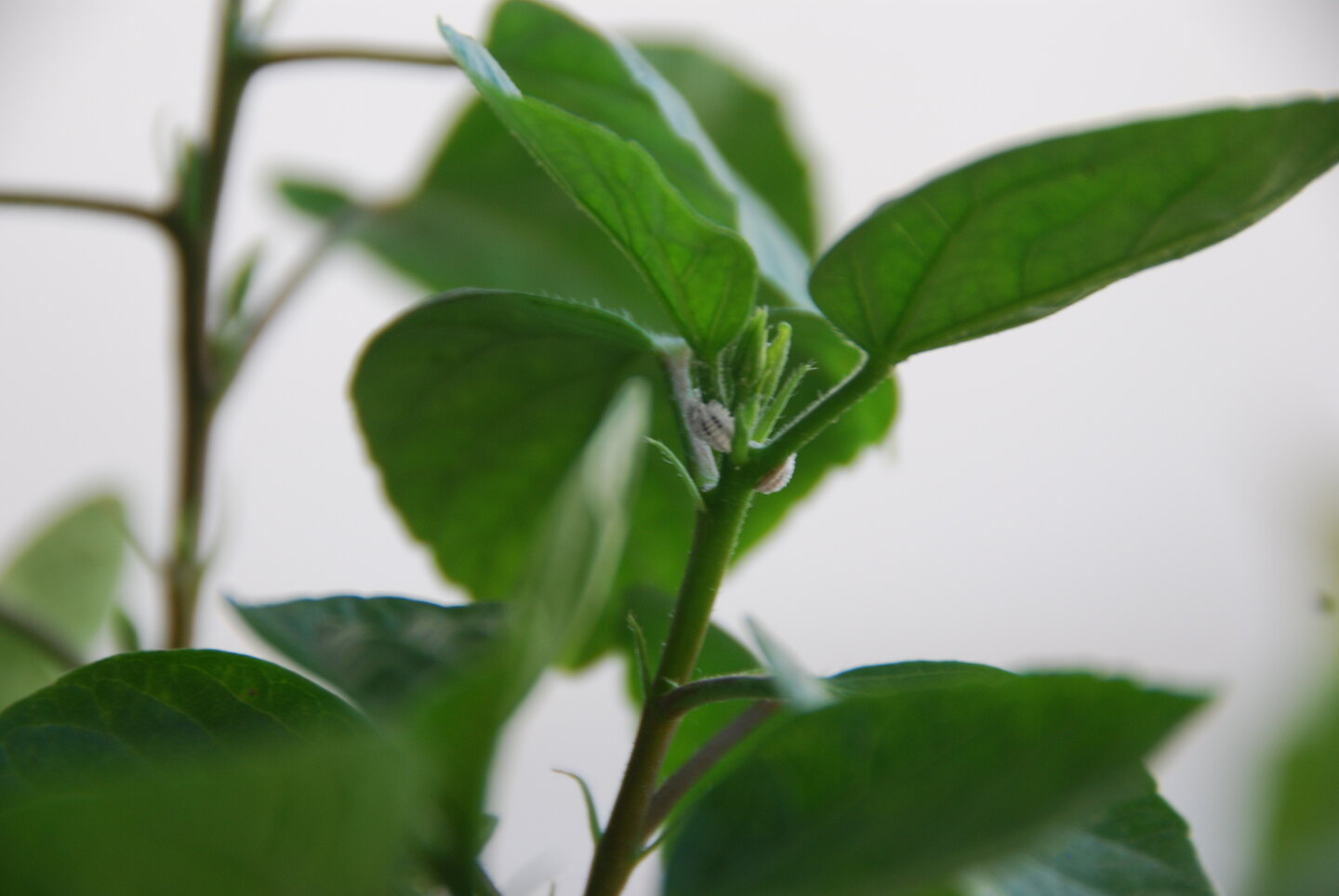

Mealybugs, scale, or harmless white residue?
Mealybugs
- Distinct soft-bodied insects are covered in white powdery or cottony wax.
- They gather in axils, veins, stems, or other protected plant parts.
More likely if
- Honeydew occurs near visible insects.
- The wax contains identifiable bodies with short filaments.
Less likely if
- The mark is a flat crust or powder with no insect body underneath.
Confirm insects in more than one protected location.
Scale insects
- Established scale often looks like attached brown, tan, white, or waxy bumps rather than fluffy mobile insects.
More likely if
- The bumps remain firmly attached along stems or veins.
Use the Scale guide and identify soft versus armored scale.
Residue or fungal growth
- Mineral residue, dried sap, or fungal growth can be white but lacks a mealybug body.
More likely if
- Repeated close inspection finds no insects or honeydew.
Identify the residue or growth separately rather than treating for insects.
Checks before calling it mealybugs
- Use magnification to find the actual white wax-covered insect within the cottony material.
- Inspect leaf-stem junctions, veins, undersides, flowers, and sheltered crevices where mealybugs often hide.
- Check for honeydew or sooty mold near the insects, but do not use stickiness alone as identification.
- Inspect neighboring plants because early infestations can be easy to miss.
What to do after you confirm mealybugs
- Isolate a movable infested indoor plant while inspecting nearby plants.
- Remove visible insects physically from accessible leaves and stems and discard heavily infested dead or expendable plant material where appropriate.
- Wash sturdy foliage where practical and continue close inspection of protected junctions where survivors may remain.
- If pesticide treatment is needed, use only a product labeled for the plant and mealybug problem and follow the label exactly.
GardenSolved checkpoint
Do not do this yet
- Do not spray a plant because you see an unidentified white fuzzy patch; confirm insect bodies first.
- Do not assume honeydew proves mealybugs because aphids, whiteflies, and soft scale can also produce it.
- Do not rely on one visible removal if protected plant junctions have not been inspected.
- Do not use concentrated household cleaners or unlabelled mixtures on foliage.
Confirm the likely cause first, then choose the treatment.
When to investigate further
Escalate when the infestation is extensive, insects are hidden in crowns or other inaccessible structures, the plant is losing vigor, or repeated nonchemical removal does not reduce the population.
Sources
Related questions
Diagnostic Finder
Still not sure this answer matches?
Continue with this plant already selected. The Finder will let you compare the visible problem and, when needed, the pattern against other relevant GardenSolved answers.
Compare other possibilities