Pests & Diseases
How Can I Tell Downy Mildew From Powdery Mildew?
The short answer
Powdery mildew usually produces obvious white-to-gray powdery growth on a leaf or stem surface. Downy mildew more often begins with yellow, tan, oily, or angular upper-surface lesions and produces gray, white, purple, or dark sporulation mainly on the leaf underside in humid conditions. Powdery mildews are fungi; downy mildews are oomycetes. Always confirm the host because lesion shape and sporulation color vary among plant species.
Downy mildew and powdery mildew can both discolor leaves, but they are biologically different diseases and their strongest visual clues are not the same. Host species matters, so use the comparison as a route to the right diagnosis rather than a universal symptom formula.
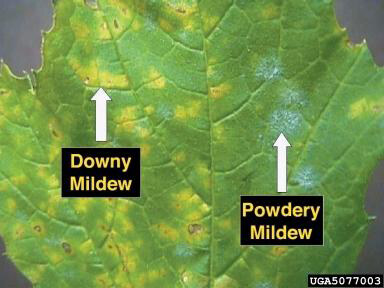

Compare the strongest clues
| Clue | Powdery mildew | Downy mildew |
|---|---|---|
| Most obvious visible growth | White-to-gray powdery or felt-like colonies on plant surfaces | Gray, white, purple, or dark sporulation often strongest on the leaf underside |
| Upper leaf pattern | Powdery colonies may be obvious directly on the upper surface | Yellow, tan, oily, or angular lesions often appear above the underside sporulation |
| Moisture relationship | Free water on the leaf is not required for infection | Leaf wetness or high humidity commonly supports infection and sporulation |
| Biology | True fungal disease caused by powdery mildew fungi | Oomycete or water-mold disease, not a true fungus |
| Best next check | Confirm progressive powdery surface growth on the host | Turn the leaf over and inspect directly below the upper lesion |
Which pattern fits better?
Powdery mildew is the stronger fit
- The dominant sign is white-to-gray powdery growth sitting on the plant surface.
- The coating expands from small spots into larger colonies.
More likely if
- The host is known to get powdery mildew and underside inspection does not reveal a downy lesion-sporulation pattern.
Use the Powdery Mildew guide and then host-specific management.
Downy mildew is the stronger fit
- Upper leaves show yellow, tan, oily, or angular lesions while corresponding underside areas develop fuzzy sporulation.
- The outbreak is associated with moist or humid conditions.
More likely if
- Lesions are bounded by veins on a host where that is characteristic.
- Underside sporulation becomes easier to see during humid conditions.
Use host-specific downy mildew guidance because the pathogen and management differ by crop.
Neither is confirmed
- There is only a pale mark, residue, necrotic spot, or natural variegation without convincing disease growth.
More likely if
- Repeated inspection finds no progressive powdery colony and no corresponding underside sporulation.
Use the Brown Spots diagnostic guide or another host-specific differential.
Checks before choosing a mildew diagnosis
- Turn over several affected leaves and compare the exact same lesion from both sides.
- Use a hand lens if the underside growth is subtle.
- Record whether the visible growth sits broadly on the surface or is concentrated beneath yellow, tan, oily, or angular upper lesions.
- Check the plant species and current local disease guidance before assuming the same mildew species affects every host.
What to do after you separate the two
- Remove badly affected expendable foliage where appropriate and clean up diseased debris according to host-specific guidance.
- Improve plant spacing and air movement where dense foliage is keeping humidity high.
- If downy mildew is the stronger fit, reduce avoidable leaf wetness and use current crop-specific disease alerts or Extension guidance.
- If any pesticide is considered, select only a product labeled for the actual plant and target disease; a product effective on a fungal powdery mildew is not automatically appropriate for an oomycete downy mildew.
GardenSolved checkpoint
Do not do this yet
- Do not use the word mildew as if downy and powdery mildew were the same disease.
- Do not diagnose from the upper leaf surface only; underside inspection is essential when downy mildew is possible.
- Do not use one host's lesion shape as a universal rule for every plant species.
- Do not apply a fungicide or other pesticide until the product label covers the host, target disease, and use site.
Confirm the likely cause first, then choose the treatment.
When to get a host-specific diagnosis
Escalate when the disease is moving quickly through a crop, regional downy mildew warnings are active, symptoms differ from the common comparison pattern, or an edible crop requires a pesticide decision. Downy mildew species and management are highly host-specific.
Sources
Related questions
Diagnostic Finder
Still not sure this answer matches?
Continue with this plant already selected. The Finder will let you compare the visible problem and, when needed, the pattern against other relevant GardenSolved answers.
Compare other possibilities