Pests & Diseases
What Does Powdery Mildew Look Like on Plants?
The short answer
Look for white to gray powdery spots or felt-like patches that sit on the plant surface and expand over time. Infected young tissue can curl or distort, and severe infections can yellow or drop leaves. Confirm progressive powdery growth rather than diagnosing from natural variegation, dried spray residue, dust, or one pale mark. Downy mildew is a different disease group and more often pairs upper-surface yellow lesions with gray-to-purple growth on the leaf underside.
Powdery mildew is a group of fungal diseases that produce superficial white-to-gray powdery growth on susceptible plants. The coating can start as separate spots and expand across leaves, stems, buds, or flowers, but host species and disease severity change the exact pattern.
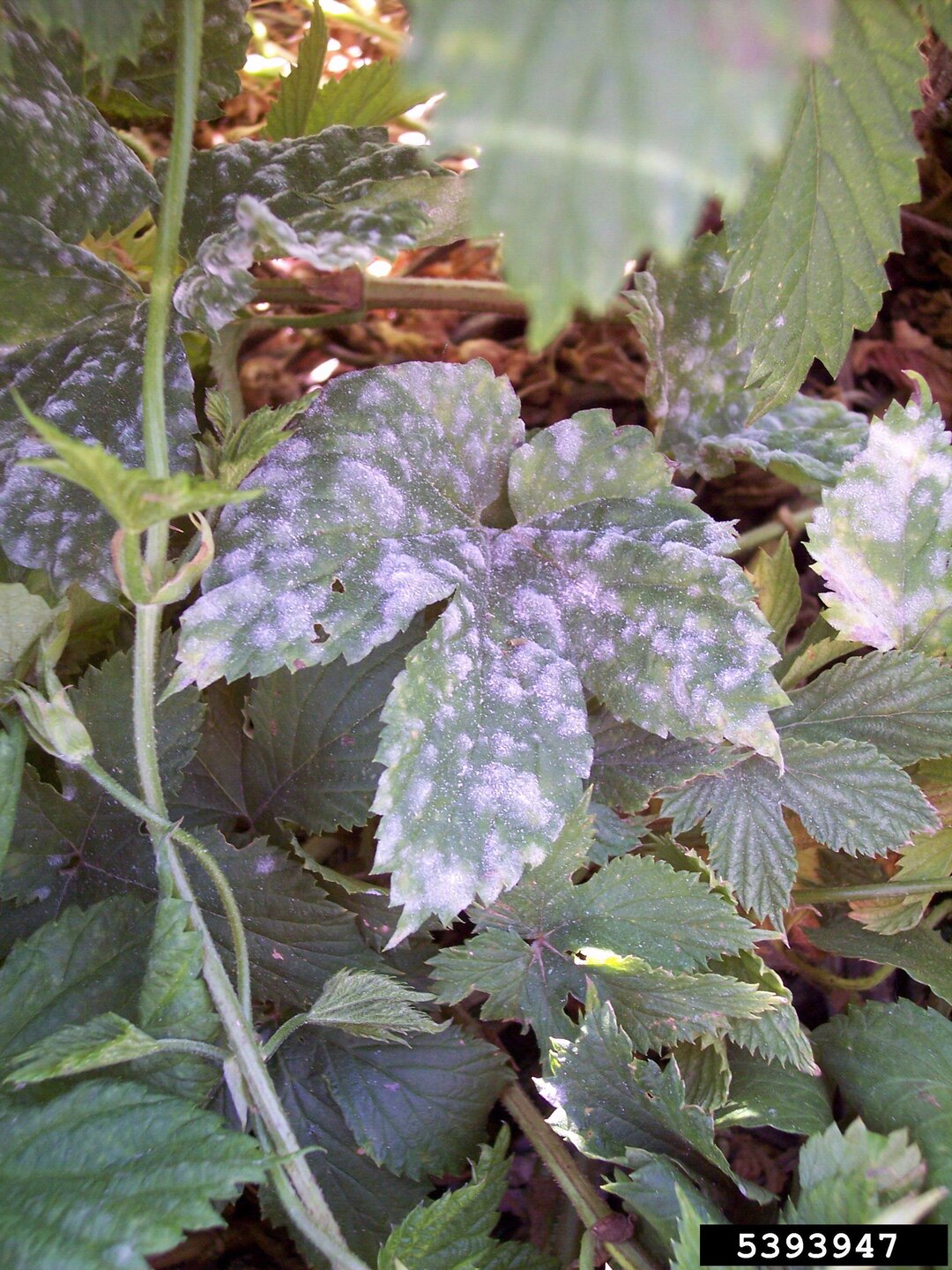

Powdery mildew or a white lookalike?
Powdery mildew
- White-to-gray powdery or felt-like growth sits on living plant surfaces.
- Patches enlarge, merge, or appear on additional leaves over time.
More likely if
- Young tissue is also curled or distorted.
- The coating occurs on a known susceptible host and progresses from small spots into broader surface growth.
Less likely if
- The white pattern is identical on every healthy leaf or wipes away once and never returns.
Confirm the progressive surface-growth pattern and then use host-specific management guidance.
Downy mildew
- Upper leaf surfaces often develop yellow, tan, or angular lesions while sporulation is more evident underneath.
- Moist or humid conditions commonly favor visible underside growth.
More likely if
- Lesions are vein-bounded or angular and the underside carries gray, purple, or dark fuzzy growth.
Use the Downy vs Powdery Mildew comparison before treating.
Residue or natural markings
- Spray residue, mineral deposits, dust, or natural silver-white markings can resemble powder from a distance.
More likely if
- The pattern stays unchanged, occurs symmetrically as a normal leaf trait, or corresponds exactly with a recent spray or splash event.
Observe clean new growth before assigning a disease diagnosis.
Checks before calling it powdery mildew
- Compare several affected leaves with healthy leaves from the same plant and host variety.
- Look for progressive white-to-gray powdery or felt-like growth rather than one static pale mark.
- Inspect leaf undersides, stems, buds, and flowers for additional colonies where the host commonly develops disease.
- Check whether young tissue is becoming distorted or older infected leaves are yellowing as the visible growth spreads.
What to do after you confirm powdery mildew
- Remove heavily infected expendable leaves or spent plant material where that can be done without stripping most of the plant.
- Improve spacing and air movement around susceptible foliage and avoid excessive nitrogen that drives dense tender growth.
- Monitor clean new growth so you can judge whether the disease is still spreading rather than using old white patches as the only measure of success.
- If a fungicide is justified for a high-value or repeatedly affected plant, use only a product labeled for that host and powdery mildew and follow preventive timing and label directions exactly.
GardenSolved checkpoint
Do not do this yet
- Do not diagnose powdery mildew from every white leaf marking or dried residue.
- Do not assume a fungicide will erase or cure tissue that is already visibly infected; many products protect healthy tissue rather than reversing established lesions.
- Do not overfertilize a struggling plant in response to mildew symptoms.
- Do not copy a treatment from another crop without confirming that the product is labeled for the actual plant and use site.
Confirm the likely cause first, then choose the treatment.
When to investigate further
Escalate when white growth is accompanied by rapid tissue collapse, unusual stem or crown symptoms, a pattern confined mainly to leaf undersides, or severe disease on an edible or high-value plant. Those clues can indicate a different disease or require host-specific diagnosis.
Sources
Related questions
Diagnostic Finder
Still not sure this answer matches?
Continue with this plant already selected. The Finder will let you compare the visible problem and, when needed, the pattern against other relevant GardenSolved answers.
Compare other possibilities